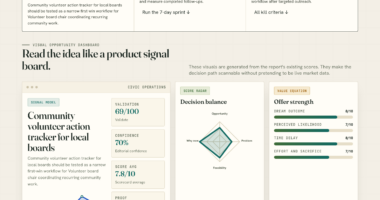

📊 Full opportunity report: Europe Regulated the Interface and Forgot to Build the Engine on ThorstenMeyerAI.com — validation score, market gap, and execution plan.
TL;DR
Europe focused on regulating AI interfaces like cookie banners but neglected building the actual AI models and infrastructure. As a result, it trails behind the US and China in AI capability and innovation, risking dependency and geopolitical disadvantages.
European regulators have focused on legislating the surface of AI technology, such as cookie banners and consent interfaces, while neglecting to develop the underlying AI models and infrastructure. This approach has left Europe behind the US and China in AI innovation and capability, raising concerns about dependency and geopolitical influence.
The European Union’s regulatory efforts have centered on user interface elements like cookie banners, which studies show are often ineffective and legally questionable. Despite this, Brussels has yet to create a comparable AI infrastructure or fund significant AI research, resulting in a technological gap.
European AI labs, such as Mistral, are underfunded and lag behind global leaders like OpenAI, Google, and Chinese models like Zhipu’s GLM 5.2. Mistral’s flagship model ranks well below the top AI models in performance, and Europe’s AI industry is unable to match the capabilities or funding levels of its US and Chinese counterparts.
Additionally, Europe’s regulatory approach, exemplified by the AI Act, was enacted before the technology was fully developed, leading to a mismatch between regulation and innovation. The continent’s capital markets are fragmented and insufficient to support large-scale AI development, further hindering progress.
Europe regulated the interface and forgot the engine
The cookie banner is the most-used European software of the decade. While Brussels perfected the consent pop-up, the frontier was built elsewhere — and now, in H2 2026, Europe wants to buy back in without changing what put it on the outside.
This isn’t about whether privacy or safety matter — they do. It’s that Europe mistook regulating the interface for having a seat at the table. You can’t grant your way out of a structural problem while keeping the structure — the laws, the capital gaps, the energy costs, the talent drain all left untouched. The fix isn’t another framework: it’s open weights as a product, sovereign compute on affordable power, real capital plumbing — and to stop mistaking a check for a strategy.
Implications of Europe’s Focus on Interface Regulation
This focus on regulating AI interfaces without investing in core AI technology risks leaving Europe dependent on foreign models and infrastructure. It diminishes Europe’s global competitiveness, weakens its strategic autonomy, and could impact its influence in future AI-driven geopolitics. The lack of domestic advanced AI models also hampers innovation and economic growth within the continent.
Agentic AI Architectural Patterns: Engineering Blueprint to Build 24/7 Autonomous Agents That Work While You Sleep | Master Production-Grade Automation, Build Deterministic Pipelines & Control Costs
As an affiliate, we earn on qualifying purchases.
As an affiliate, we earn on qualifying purchases.
Europe’s AI Policy and Investment Shortfalls
Europe’s AI strategy has historically prioritized regulation over research and development. The AI Act, introduced before the technology’s full emergence, exemplifies this approach. Despite warnings from economic and industry experts about the negative impact of fragmented markets and regulatory burdens, the continent has failed to create a unified capital market capable of funding large-scale AI projects.
Meanwhile, major competitors like the US and China have invested heavily in AI infrastructure, resulting in advanced models and capabilities that Europe cannot match. Chinese firms such as Zhipu and Alibaba are shipping models that outperform many European efforts, often freely available, further widening the gap.
European AI companies like Mistral have raised only a few billion dollars, a fraction of the funding received by US firms like OpenAI and Anthropic, which are valued at hundreds of billions of dollars. This funding disparity reflects the broader structural issues in Europe’s innovation ecosystem.
“Europe is essentially regulating the surface while the core engine is being built elsewhere. That puts us at a strategic disadvantage.”
— European AI researcher
Unresolved Questions About Europe’s AI Future
It remains unclear whether Europe will reorient its strategy to prioritize building and funding core AI infrastructure or continue focusing on regulation. The effectiveness of recent proposals like the Digital Omnibus in closing the technological gap is still uncertain, as is the potential for increased investment and talent retention within Europe.
Next Steps for Europe’s AI Strategy and Capabilities
European policymakers may need to shift from surface regulation to actively funding and developing AI models and infrastructure. Monitoring the progress of initiatives like the Digital Omnibus and efforts to attract talent and capital will be critical. Additionally, Europe’s ability to foster a competitive AI ecosystem could determine its future role in global AI governance and innovation.
Key Questions
Why has Europe focused on regulating AI interfaces instead of developing AI models?
European regulators prioritized user privacy and safety, leading to regulations like cookie banners, but did not invest enough in the core AI technology, leaving the continent behind in innovation and capability.
What are the consequences of Europe’s lack of advanced AI models?
Europe risks dependency on foreign AI models, losing strategic autonomy, and falling behind in economic and geopolitical influence as other regions develop and deploy more capable AI systems.
Can Europe’s current regulatory approach be changed to boost AI development?
While possible, it would require a significant policy shift, increased funding, and efforts to build a domestic AI ecosystem capable of competing globally. The current focus remains heavily on regulation rather than infrastructure.
What does this mean for European industries relying on AI?
European industries may face limitations in adopting cutting-edge AI solutions, potentially losing competitiveness and innovation opportunities to regions with more advanced AI models and infrastructure.
Source: ThorstenMeyerAI.com