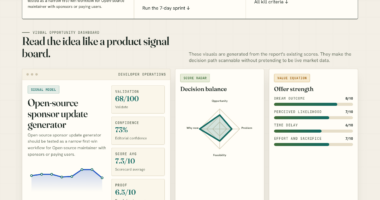
📊 Full opportunity report: Next In Colorado: The Intersection Of Supply-Chain Operations And Political Shifts on IdeaNavigator AI — validation score, market gap, and execution plan.
TL;DR

Colorado’s upcoming political races are now influencing supply-chain operations, prompting a new focus on geopolitical signals. A monitor tool is being developed to help operations leaders respond swiftly to these changes, with early testing underway.
Recent political races in Colorado, particularly those involving the democratic socialist movement and key electoral contests, are beginning to influence supply-chain and trade operations in the state. This intersection presents a new challenge for operations leaders tasked with managing geopolitical and trade exposure in a rapidly changing environment.
Trade and supply-chain operations in Colorado are increasingly affected by political shifts, notably in upcoming primaries and key races connected to the democratic socialist movement. An emerging challenge is the difficulty for operations leads to catch early signals of such developments, which can impact trade routes, policy decisions, and international relations.
To address this, a new monitoring approach is being developed, leveraging tools like Google Trends and other feeds to filter geopolitical signals relevant to supply-chain management. The goal is to provide role-specific, real-time briefs that help operations leaders make timely decisions, rather than relying on weekly or delayed summaries.
According to sources familiar with the initiative, this monitor aims to identify critical signals—such as shifts in political power or policy proposals—that could influence trade flows or supply routes in Colorado and beyond. The project is currently in a testing phase, with early validation involving delivering targeted briefs to operations managers and assessing decision impacts.
Implications of Colorado’s Political Shifts on Supply Chains
This development matters because political changes in Colorado could have ripple effects on regional and national supply chains, especially if new policies or political instability disrupt trade routes or regulatory environments. For companies managing supply-chain exposure, early detection of such signals can enable proactive adjustments, reducing risks and costs.
Moreover, the initiative reflects a broader trend of integrating political intelligence into supply-chain management, emphasizing the importance of role-specific, real-time information in a fast-moving geopolitical landscape. As supply chains become more intertwined with political developments, understanding and responding to these signals could become a competitive advantage.
As an affiliate, we earn on qualifying purchases.
Colorado’s Political Landscape and Supply-Chain Dynamics
Colorado has seen a series of high-profile political contests recently, including primaries involving the democratic socialist movement and other key races that could shift the state’s political alignment. Historically, Colorado’s political environment has been a battleground for national issues, with recent elections highlighting debates over economic policy, trade, and social reforms.
Trade and supply-chain operators have traditionally focused on macroeconomic indicators and international trade policies. However, the increasing influence of local political shifts—particularly in swing states like Colorado—has prompted a reevaluation of how political signals are monitored and integrated into operational decision-making.
Earlier efforts to track geopolitical developments relied on broad news summaries and weekly reports, which proved insufficient in a landscape where decisions are made on a daily basis. The current focus is on developing tools that can filter and deliver targeted, role-specific updates to supply-chain managers, enabling more agile responses to emerging risks.
Unclear Impact of Political Shifts on Supply-Chain Stability
It remains uncertain how specific political outcomes in Colorado will concretely affect supply-chain routes, policies, or international trade agreements. While early signals suggest potential disruptions, the exact scope and timing of these impacts are still developing and depend on future electoral results and policy implementations.
Additionally, the effectiveness of the new monitoring tool in enabling timely decision-making has yet to be fully validated, with ongoing testing and feedback collection needed to confirm its utility.
Next Steps in Monitoring and Response Development
The project team plans to expand testing by delivering role-specific briefs to a broader set of operations managers in Colorado and neighboring states. They will assess whether these signals lead to tangible decision changes or operational adjustments.
Further development will focus on refining filtering algorithms, integrating additional data sources, and establishing feedback loops to improve signal relevance and timeliness. The goal is to operationalize this monitoring approach before upcoming elections and trade policy shifts.
Stakeholders expect that, if successful, this model could be adapted to other states and regions where political shifts influence supply-chain stability, creating a new standard for geopolitical risk management in logistics.
Key Questions
How will political shifts in Colorado impact supply chains?
Political shifts can influence trade policies, regulatory environments, and regional stability, which in turn can disrupt supply routes or alter trade agreements. Early detection allows companies to adapt proactively.
What is the new monitoring tool being developed?
It is a role-specific, real-time signal monitor that filters geopolitical and political signals from sources like Google Trends to alert supply-chain managers of relevant developments.
When will the monitoring system be fully operational?
The system is currently in testing, with broader deployment expected after validation and refinement over the coming months, ahead of key electoral and trade policy events.
Could this approach be used in other states?
Yes, if proven effective, the model could be adapted to monitor political and geopolitical signals in other regions where local politics impact supply chains.
What are the main risks of relying on political signals for supply-chain decisions?
The primary risks include false positives, delayed signals, or misinterpretation of political developments, which could lead to unnecessary or misaligned operational responses. Continuous validation is essential.
Source: IdeaNavigator AI