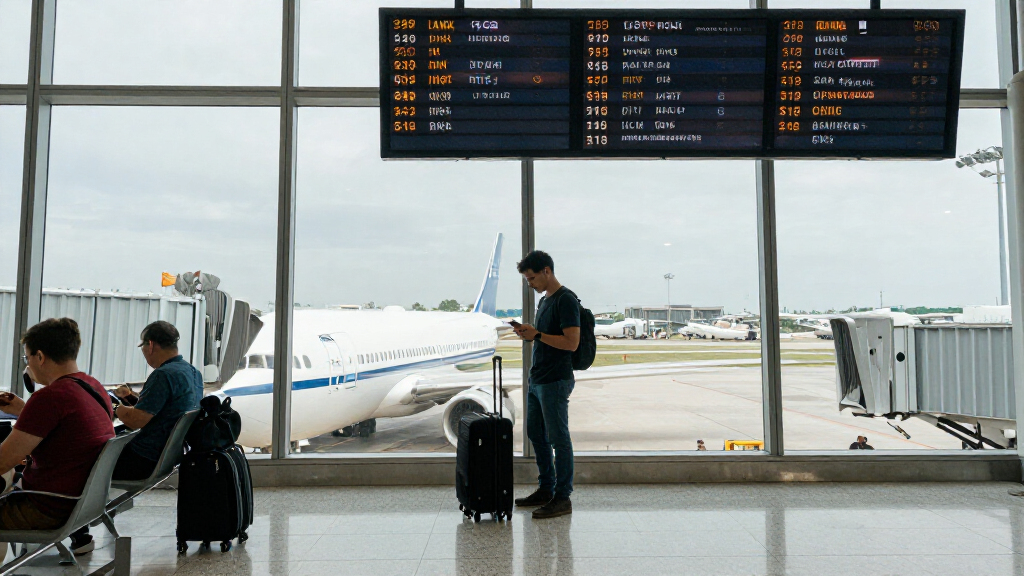

🔍 Read the full analysis: Why Flights Stopped At Every US Airport For More Than 4 Hours on ThorstenMeyerAI.com

Get the little things that make your day delivered free with Prime
- Fast, free delivery on millions of items
- Prime Video, Amazon Music and more included
- Member-only deals all year
TL;DR
The FAA ordered a nationwide ground stop on Nov. 13 after communication and radar instability affected air traffic facilities, according to Transportation Secretary Sean Duffy and FAA advisories. The stop lasted about 4 hours and 23 minutes; officials reported no evidence of a cyberattack but said the cause has not been fully explained. Thousands of flights were cancelled that day, though published totals include cancellations not necessarily caused by the stop.
The Federal Aviation Administration grounded departures nationwide for about 4 hours and 23 minutes on Friday, Nov. 13, after communication and radar instability affected air traffic facilities, according to FAA advisories and Transportation Secretary Sean Duffy. The interruption delayed flights across the country and disrupted some international travel; officials have not published a written report identifying the underlying cause.
The FAA Command Center issued its nationwide stop at 3:54 p.m. Eastern Time, directing departing aircraft to remain on the ground. Its advisory cited “extraordinary circumstances” and safety. The FAA later recorded the stop as cancelled at 8:16 p.m.; Duffy said airspace reopened at 8:15 p.m. The roughly four-hour, 23-minute duration is measured from the event times in the FAA advisories.
The disruption followed problems first reported around Chicago. At 3:21 p.m., an FAA advisory cited equipment issues and warned of arrival delays and airborne holding at O’Hare. The agency stopped departures to O’Hare at 3:28 p.m. and to Midway at 3:31 p.m. Duffy said the broader instability began at 3:36 p.m., affecting radar and communications at en route centers and approach-control facilities around the country.
Duffy said more than 3,500 aircraft were airborne when the nationwide stop began, with fewer than 400 still in the air by 8 p.m. Medevac, life-saving cargo and law-enforcement flights were allowed to continue. The FAA advisories said some facilities began releasing flights in coordination with the Command Center before the nationwide restriction was lifted. The agency’s Friday statement described communication issues affecting multiple air route traffic control centers and said technicians were investigating.
FAA ground stop · Nov 13, 2026 · times ET (UTC−5)
Unreliable data, a full stop, a slow restart
What the FAA Command Center’s advisories and Transportation Secretary Sean Duffy describe, step by step.
US airspace (schematic)
plane (schematic)airports
3,500+ planes in the airwhen the stop began, Duffy says Fewer than 400still airborne by 8 p.m. ET, Duffy says Restartground stop cancelled; flights resume slowly
What the FAA and Duffy said
- 3:21 p.m.Chicago O’Hare: arrival delays “due to equipment issues”FAA advisory 106
- 3:36 p.m.Radar and communications unstable at centers and TRACONs nationwideDuffy
- 3:54 p.m.“All airports are ground stopped”; departures heldFAA advisory 111
- 4:20 p.m.Airborne holding expected at “any and all airports”FAA advisory 116
- 8 p.m.Fewer than 400 planes still airborne, down from 3,500+Duffy
- 8:16 p.m.Nationwide ground stop cancelled; Duffy: airspace reopened at 8:15 p.m.FAA advisory 005
Sources: FAA Air Traffic Control System Command Center advisories 106, 111 and 116 (Nov 13) and 005 (Nov 14, 2026, UTC dates); Transportation Secretary Sean Duffy at the White House briefing, Nov 13 (transcript: Roll Call Factba.se) and on X (as quoted by Fox Business); BBC News, Nov 14. Durations: own calculation from advisory event times (2026: 20:53 to 01:16 UTC; 2023: 12:20 to 14:00 UTC). The radar picture is a schematic, not real traffic.
Graphic: Powered by Thorsten Meyer AI
How the Ground Stop Disrupted Travel
A nationwide departure halt affects more than planes waiting at gates. Aircraft and crews can end up out of position, and a delay lasting several hours can carry into later flights as airlines work to reconnect schedules. The FAA continued issuing local and airline-specific ground stops after the national order ended, as carriers handled aircraft and crew disruptions.
FlightAware counted 9,159 cancellations within, into or out of the United States on Friday, and 9,896 cancellations worldwide that day. It reported another 3,515 cancellations by 7:58 a.m. ET Saturday. Those figures count all cancellations in the relevant periods, not just flights caused by the FAA’s stop, so they should not be read as a direct measure of the order’s impact. The disruption also reached overseas: Eurocontrol suspended U.S.-bound departures from its member states at the FAA’s request, according to Xinhua, while BBC News reported that Sydney Airport held U.S.-bound flights and Air Canada cancelled some U.S.-Canada services.
For travelers, the practical effect can persist after a ground stop is lifted: a scheduled flight may still be delayed or cancelled if its aircraft or crew is unavailable. The episode also raises questions about the resilience of the communications infrastructure air traffic controllers rely on to coordinate safe movement.
Products Worth Considering

Philips Hue Play HDMI Sync Box 4K + 65 Play Gradient Smart TV Strip Light

Philips Hue Bridge Pro Smart Lighting Hub

LEVOIT Vital 200S-P Smart Air Purifier for Large Rooms, White
As an affiliate, we earn on qualifying purchases.
From Chicago Equipment Alerts to a National Halt
The FAA’s public advisories show the sequence narrowing from local trouble to a national restriction. Chicago-area alerts cited equipment and communications issues, and at 3:30 p.m. the Command Center activated a diversion-recovery tool for all airports. The nationwide advisory followed at 3:54 p.m. It said inbound international flights would be handled case by case.
During the stop, the FAA warned that aircraft could be held at any airport and extended flight-plan drop times to 240 minutes. A later advisory said flights would be released as en route facilities recovered, through coordination with the Command Center. At 7:37 p.m., the agency reported that some coastal facilities had released some international departures. The nationwide restriction was then cancelled, but local restrictions continued into the night.
Duffy attributed the problem to older analog telecommunications switches and routers that became overloaded with data and supplied inconsistent information. He said the system did not lose all radar or telecommunications. The FAA’s statement called its account preliminary and subject to change. An FAA-commissioned 2023 review counted 21 en route centers, which primarily manage aircraft traveling between airports.
“We experienced instability for our radar and our communications.”
— Transportation Secretary Sean Duffy
The Cause Is Still Under Investigation
Officials have not released a written root-cause report explaining what caused the equipment instability or why the communications systems became inconsistent. Mullin said there was no evidence of a cyberattack at the time, but explicitly said investigators were not ruling one out. The available account therefore does not establish whether the event resulted solely from equipment failure or whether another factor contributed.
Duffy and the maker of the FAA’s new SMART air-traffic tool said SMART was not connected to the equipment involved. That addresses one proposed explanation but does not identify the precise failed component or explain the full chain of events. The FAA also described its initial statement as preliminary and subject to change.
The flight-cancellation totals require caution: they cover all cancellations during the stated periods, including those that may have had unrelated causes. The available figures do not isolate how many cancellations or delays resulted directly from the nationwide order.
FAA Review and Modernization Plans
The FAA has said technicians are investigating, but the source material provides no date for a final report or a detailed account of the next investigative steps. Until the agency publishes further findings, the exact failure mechanism and any corrective measures remain unknown.
Duffy argued that the episode shows the need to replace older air-traffic systems and called for $50 billion in funding. He warned that similar events could happen again without investment. That is his assessment, not a confirmed forecast; the funding proposal’s status and timetable are not specified in the available information. Travelers should check with airlines for flight-specific updates, while the FAA’s findings and any subsequent system changes will clarify what was fixed and how recurrence risks are being addressed.
Key Questions
Why did the FAA stop departures across the United States?
The FAA said communication issues affected multiple air route traffic control centers. Sean Duffy described instability in radar and communications at en route centers and approach-control facilities. Officials have not published a final root-cause report.
How long did the nationwide ground stop last?
FAA advisory event times put the stop at about 4 hours and 23 minutes, from around 3:53 p.m. to 8:16 p.m. ET on Nov. 13, 2026. Duffy said airspace reopened at 8:15 p.m.
Was the disruption caused by a cyberattack?
Homeland Security Secretary Markwayne Mullin said officials had seen “zero evidence” of a cyberattack, while also saying they would not rule one out. The cause has not been definitively established in a published report.
How many flights were cancelled because of the stop?
The available figures do not isolate cancellations caused by the ground stop. FlightAware counted 9,159 cancellations within, into or out of the United States on Friday, but that total includes cancellations for other reasons.
Could another nationwide stop happen?
Duffy warned that similar events could recur without major investment in air-traffic systems. That is his assessment; officials have not said that another stop is scheduled or inevitable.
Source: ThorstenMeyerAI.com