
📊 Full opportunity report: Can A Dollar Cost Calculator Reveal Hidden Investment Fees? on IdeaNavigator AI — validation score, market gap, and execution plan.

Get the little things that make your day delivered free with Prime
- Fast, free delivery on millions of items
- Prime Video, Amazon Music and more included
- Member-only deals all year
TL;DR
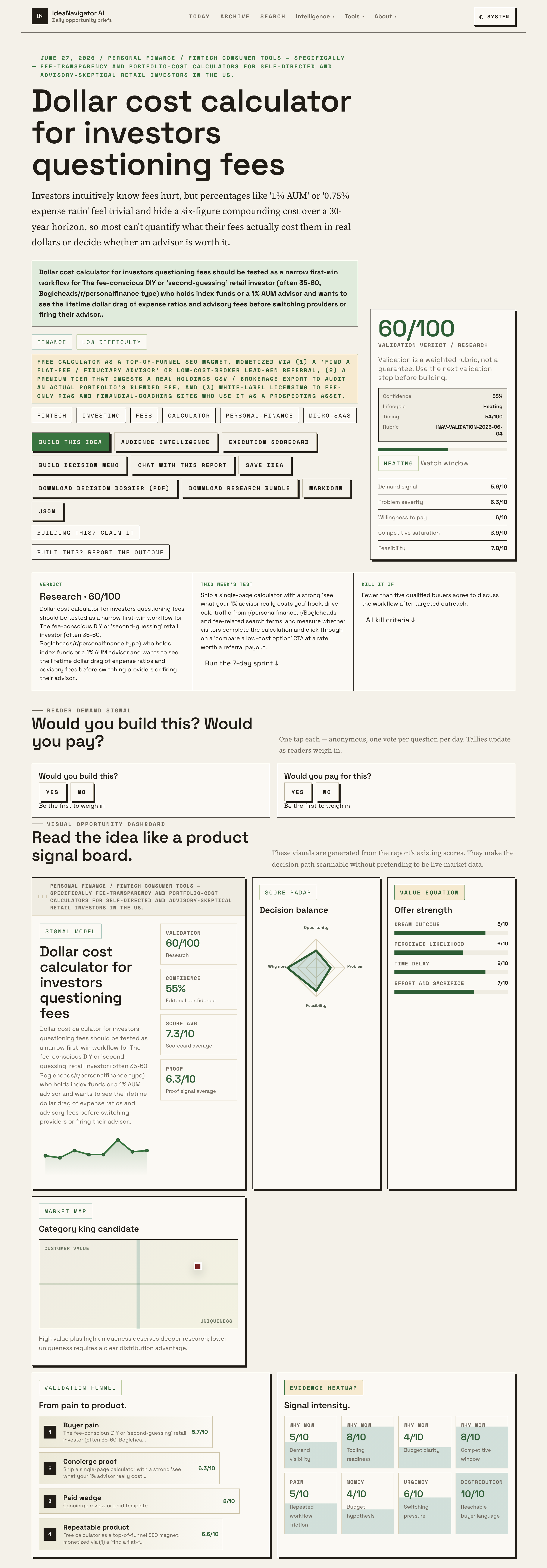
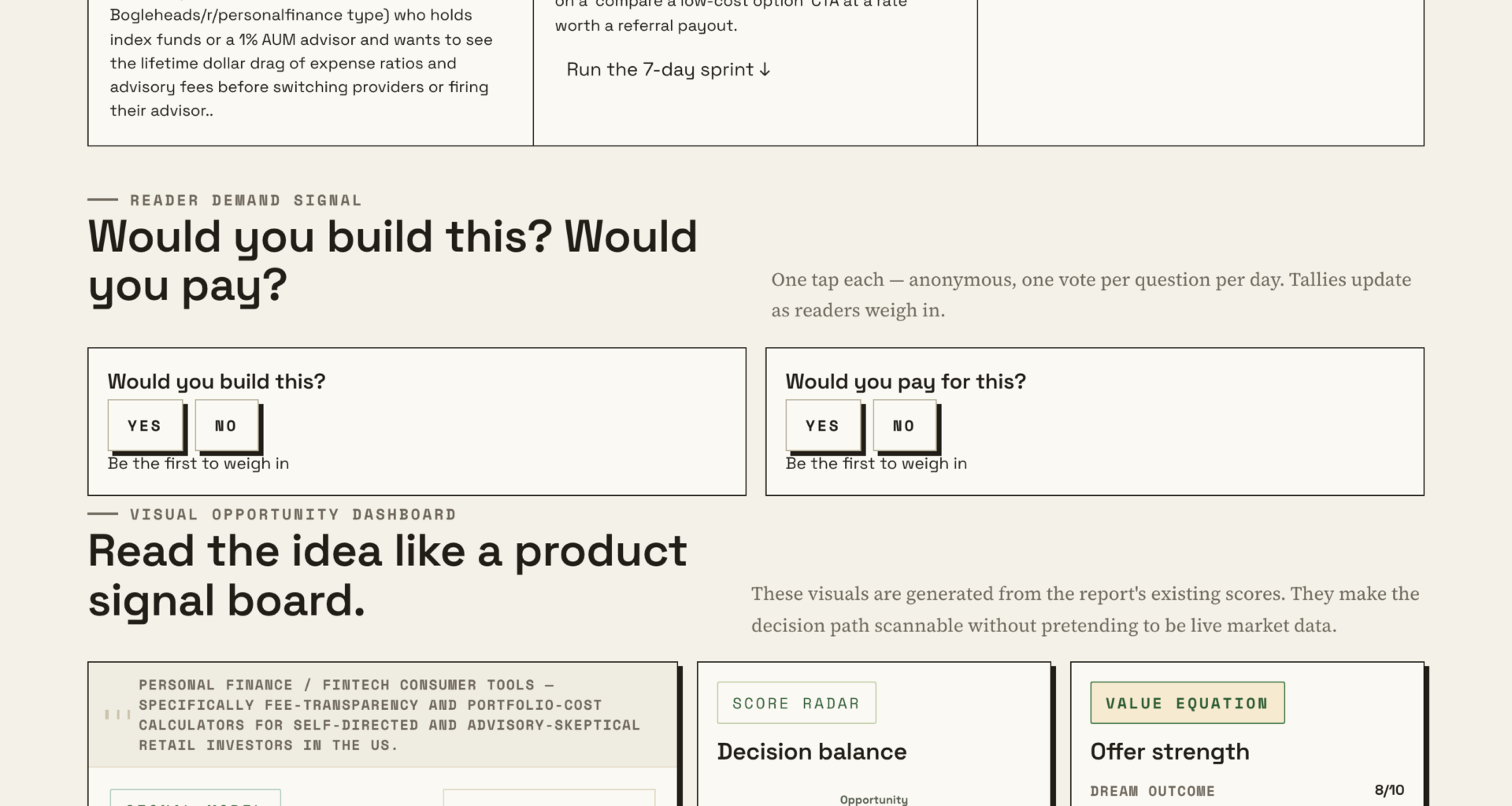
A proposed dollar cost calculator for investors aims to quantify the lifetime dollar drag caused by investment fees. It targets fee-conscious retail investors, especially those with index funds or advisory fees, to help them understand the real impact of costs. The tool is in development, with testing planned to measure its effectiveness in raising fee awareness.
A new online dollar cost calculator is being developed to help fee-conscious retail investors quantify the lifetime dollar drag caused by investment fees, including expense ratios and advisory charges. The tool aims to address a common challenge: investors often underestimate how fees erode their wealth over decades, especially when fees are expressed as percentages rather than dollar amounts. This initiative responds to rising fee awareness amid low-cost index funds, robo-advisors, and recent regulatory shifts, and seeks to empower investors to make more informed decisions.
The calculator, currently in prototype testing, allows users to input their current investment balance, monthly contributions, investment horizon, expected annual return, and fee rates such as expense ratios and AUM advisory fees. It then estimates the total dollars lost to fees over the investment period, compares the ending balance with a low-cost baseline, and shows how fees impact retirement savings in dollar terms. The output includes a shareable PDF or chart, designed to make the cost impact clear and tangible. The goal is to serve as a first step for retail investors who second-guess their advisors or hold index funds, helping them visualize the real dollar cost of ongoing fees.
According to sources involved in the project, the tool is intended as a simple, accessible, single-page web application that does not require login, making it easy for users to test different scenarios quickly. The developers plan to promote it through personal finance communities such as Reddit’s r/personalfinance and Bogleheads, with the hope that it will encourage more fee transparency and prompt users to consider lower-cost alternatives or renegotiate their advisory arrangements.
Why a Dollar Cost Calculator Changes Fee Awareness
This calculator could significantly shift how retail investors perceive investment costs. While many understand that fees matter, they often struggle to translate percentage fees into dollar amounts that reflect their actual long-term impact. By providing a concrete dollar estimate, the tool makes the cost of fees more tangible, potentially motivating investors to seek lower-cost options or question ongoing advisory charges. As regulatory and market dynamics evolve—such as the 2024 Department of Labor fiduciary rule changes and the rise of ultra-low-cost index funds—understanding true costs becomes increasingly critical for retirement planning and wealth accumulation. The calculator aims to fill a gap in fee transparency, especially for those who are fee-sensitive or skeptical of high-cost advisors.
As an affiliate, we earn on qualifying purchases.
Rising Fee Awareness and the Need for Transparency Tools
Over recent years, the investment industry has seen a surge in low-cost index funds and robo-advisors, which have normalized sub-0.10% expense ratios. Despite this, many retail investors remain unaware of how even small percentage fees can compound into substantial dollar losses over decades. Traditionally, fee disclosures are presented as percentages, which can feel trivial or abstract, especially for those unfamiliar with compound interest. Meanwhile, regulatory shifts, such as the vacating of the 2024 Department of Labor fiduciary rule, have reintroduced non-fiduciary advice, increasing the importance of self-education among investors. The proposed calculator aims to address this knowledge gap by translating percentage fees into actual dollar impacts, making the costs more relatable and actionable.
Previous efforts have focused on fee disclosures or comparing fund expense ratios, but few tools have offered a straightforward way for investors to see the lifetime dollar cost of ongoing fees based on their specific circumstances. The developer team believes that a simple, accessible calculator could serve as a first step toward greater fee transparency and smarter investment choices.
What Aspects of the Calculator Are Still Being Developed?
It is not yet clear how accurately the calculator will reflect real-world investment scenarios, especially with varying fee structures and market conditions. Developers plan to test its functionality and user engagement, but the effectiveness of translating complex fee arrangements into simple dollar estimates remains to be validated. Additionally, how well the tool will motivate behavioral change among different investor segments is still uncertain. The project is in early testing, and further refinement and user feedback are needed to determine its ultimate impact and accuracy.
Next Steps for Deployment and Validation
The development team plans to release a beta version for testing within the next few months, targeting personal finance communities and early adopters. They will measure user engagement, completion rates, and whether the tool prompts users to explore lower-cost options or consult advisors differently. Based on feedback, the calculator will be refined to improve accuracy, usability, and clarity. The ultimate goal is to integrate it into broader financial education platforms or advisor websites, promoting greater fee transparency and empowering retail investors to make more cost-effective decisions.
Key Questions
How does the calculator estimate lifetime dollar costs?
The calculator uses user inputs such as initial balance, monthly contributions, investment horizon, expected return, and fee rates to simulate the total fees paid over time. It then compares this with a low-cost baseline to show the dollar difference at the end of the period.
Can this tool help me decide whether to keep my current advisor?
Yes, by quantifying the total dollar cost of ongoing advisory fees, it can help you assess whether the fees are justified by the value received or if switching to a lower-cost provider might be beneficial.
Will the calculator account for variable or changing fees over time?
Initially, the tool will assume static fee rates for simplicity. Future versions may incorporate dynamic fee scenarios if user feedback indicates this is a priority.
Is this calculator suitable for all types of investments?
It is primarily designed for typical retirement and long-term investment accounts, such as index funds and advisory portfolios. It may not accurately reflect complex or highly variable fee structures.
How will this tool be distributed or monetized?
The calculator will be offered for free as an SEO-driven lead magnet, with potential revenue from referrals to low-cost advisors, premium portfolio audits, and white-label licensing to financial services firms.
Source: IdeaNavigator AI
NFL season / tailgating Picks
team gear
As an affiliate, we earn on qualifying purchases.