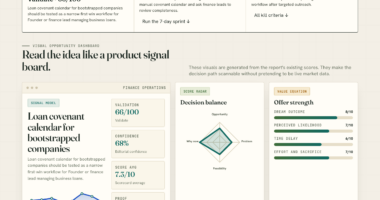

📊 Full opportunity report: What We Lose Without AI Signal: A Massive $425 Billion Toll on ThorstenMeyerAI.com — validation score, market gap, and execution plan.
TL;DR
Google’s Gemini 3.5 Pro AI model has been delayed multiple times, causing a $425 billion decline in market value. The delay highlights challenges in AI development and impacts investor confidence.
Google’s Gemini 3.5 Pro AI model has not shipped as scheduled, leading to a $425 billion loss in market capitalization for Alphabet, according to reports from Bloomberg and industry sources. The delay underscores the challenges faced by Google in delivering its flagship AI on time and impacts investor confidence at a critical moment for the company’s AI ambitions.
On May 19, 2026, Google announced during I/O that Gemini 3.5 Pro would be available in June 2026. However, as of mid-July, the model remains unreleased, with multiple sources reporting that it is months behind schedule due to difficulties in improving coding capabilities and reliability issues, including hallucination rates. Google has declined to comment on the specific reasons for the delay.
The delay has had a tangible market impact: Alphabet’s stock dropped by 4.4% the day after Bloomberg reported the postponement, wiping approximately $200 billion from its market cap. This, combined with a prior $225 billion decline following senior DeepMind researchers’ departure, totals an estimated $425 billion loss in less than a month. Despite these market reactions, Alphabet’s core financials—$109.9 billion in revenue in Q1 2026 and 63% growth in Google Cloud—remain strong, indicating that the valuation decline is driven primarily by investor sentiment and expectations around AI leadership.
Third-party reports suggest that Google may be discarding a near-ready model and restarting pre-training on a native Gemini 3 foundation, citing reliability issues such as hallucinations. However, Google has not confirmed these reports, and many technical specifications, including the model’s capabilities and release dates, remain unverified.
The cost of absence
now has a number: ~$425B.
Gemini 3.5 Pro has missed three deadlines since Google I/O. Bloomberg (Jul 16, ten sources): months behind, coding the sticking point. The market’s verdict came in two selloffs — with zero change to reported fundamentals.
Two selloffs, one story
That’s what absence costs when a market prices it: not countable lost deals — a repricing of whether the company still sets the pace.
Three deadlines, zero launches
Rebuild, hallucination, and stopgap-Flash details rest on third-party reporting Google has not confirmed — labeled accordingly.
Contracts sign on schedules, not roadmaps. Pressure from above (shipped flagships) and below (monthly open-weight cadence): the floor rises whether or not the ceiling does.
- Holding may be right: if the reliability reporting is even directionally true, shipping broken costs more than shipping late. Restarting a failed model is judgment, not weakness.
- Narrative cuts both ways: $425B evaporated on story; Google’s distribution didn’t shrink. A strong launch restores on story too.
- Watch what shipped: Gemini Flash-class models are out — and topping at least one independent document-parsing leaderboard. Small-and-available beating large-and-promised is this week’s thesis wearing a Google badge.
![Claude AI for Beginners Bible: [5 in 1] The Ultimate Guide to Automate Your Work, Save Hours Every Week, and Use AI for Real-World Results](https://m.media-amazon.com/images/I/415+fSJacsL._SL500_.jpg)
Claude AI for Beginners Bible: [5 in 1] The Ultimate Guide to Automate Your Work, Save Hours Every Week, and Use AI for Real-World Results
As an affiliate, we earn on qualifying purchases.
As an affiliate, we earn on qualifying purchases.
Impact of AI Development Delays on Market Confidence
The delay of Gemini 3.5 Pro highlights the high stakes of AI leadership in the tech industry. Market valuation losses reflect investor concerns about Google’s ability to deliver on its AI promises and maintain competitiveness against rivals like OpenAI and Anthropic. The situation demonstrates how delays in flagship AI models can significantly affect a company’s market value, even when core financials remain strong. It also underscores the importance of timely product launches in a landscape where open-weight models and smaller competitors are gaining ground.
Google’s AI Development Timeline and Market Expectations
Google announced Gemini 3.5 Pro during I/O 2026, with an initial scheduled release in June. The model’s delay follows a pattern of ambitious AI timelines that have repeatedly been missed in recent years. The company has faced internal challenges, including efforts to improve coding capabilities and reliability, which have reportedly caused setbacks. Meanwhile, competitors like GPT-5.6 Sol and Grok 4.5 launched publicly in early July, intensifying pressure on Google to deliver its flagship model.
Market reactions to delays have been severe, with Alphabet’s stock price falling sharply after reports of the postponement. Despite the setbacks, Google continues to ship smaller, competitive models like Gemini 3.5 Flash, which are making an impact in specific benchmarks. The broader industry is watching closely as the company navigates these development hurdles amid a rapidly evolving AI landscape.
“Google’s Gemini 3.5 Pro is months behind schedule, primarily over efforts to improve coding capabilities, and a recent training-data update produced disappointing results.”
— Bloomberg, Julia Love and Davey Alba
Unconfirmed Details About Gemini 3.5 Pro’s Capabilities
Many technical specifics about Gemini 3.5 Pro, including its exact capabilities, token context window, pricing, and final release date, remain unconfirmed. Reports suggest a rebuild on a native Gemini 3 foundation and reliability issues, but Google has not verified these claims. The precise reasons for the delays and the model’s final performance metrics are still unclear.
Next Steps for Google’s AI Development Timeline
Google is expected to provide updates on Gemini 3.5 Pro’s development status in upcoming quarterly reports or dedicated announcements. Industry observers will watch for signs of whether the company can accelerate development or if further delays are anticipated. Meanwhile, competitors continue to release and improve their models, increasing pressure on Google to reestablish its AI leadership position.
Key Questions
Why has Google’s Gemini 3.5 Pro been delayed?
According to industry reports, the delay is due to challenges in improving coding capabilities and reliability issues, including hallucination rates, which have necessitated a rebuild of the model’s foundation. Google has not officially confirmed these reasons.
How much market value has Google lost due to the delay?
Google has lost approximately $425 billion in market capitalization over the past month, driven by investor reactions to the delays and internal development challenges.
What are the implications for Google’s AI leadership?
The delays have raised concerns about Google’s ability to maintain its competitive edge in AI, especially against rivals like OpenAI and Anthropic, who are releasing models more rapidly.
Will the smaller models Google has shipped fill the gap?
While models like Gemini 3.5 Flash are competitive in benchmarks, they are not considered replacements for the flagship Gemini 3.5 Pro. The impact of delayed flagship models on overall market dominance remains uncertain.
Source: ThorstenMeyerAI.com