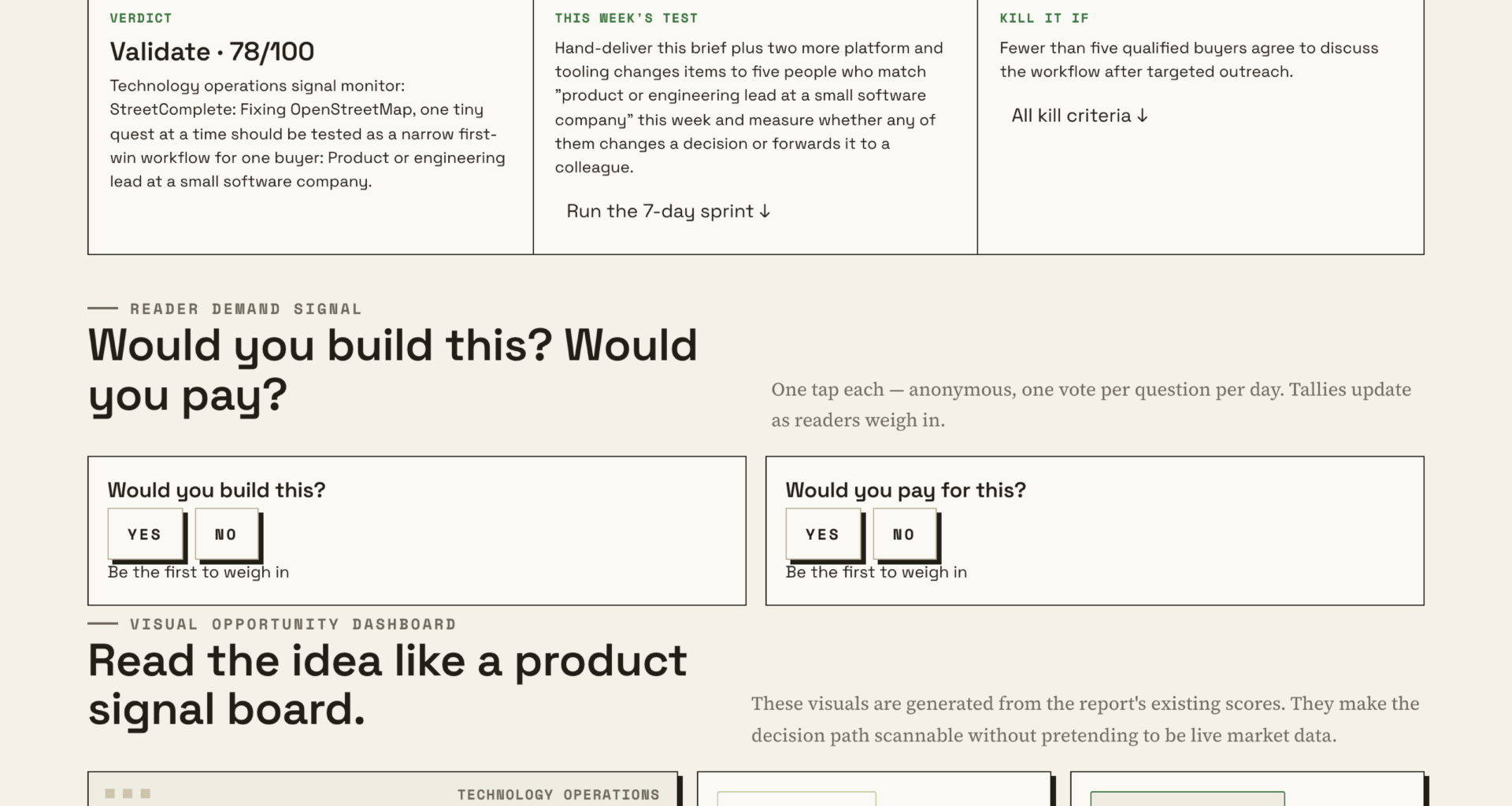
📊 Full opportunity report: How StreetComplete Invites More People To Contribute To OpenStreetMap on IdeaNavigator AI — validation score, market gap, and execution plan.

Get the little things that make your day delivered free — and shop member deals
- Fast, free delivery on millions of items
- Access to Prime Big Deal Days deals on October 6–7
- Prime Video, Amazon Music and more included
TL;DR
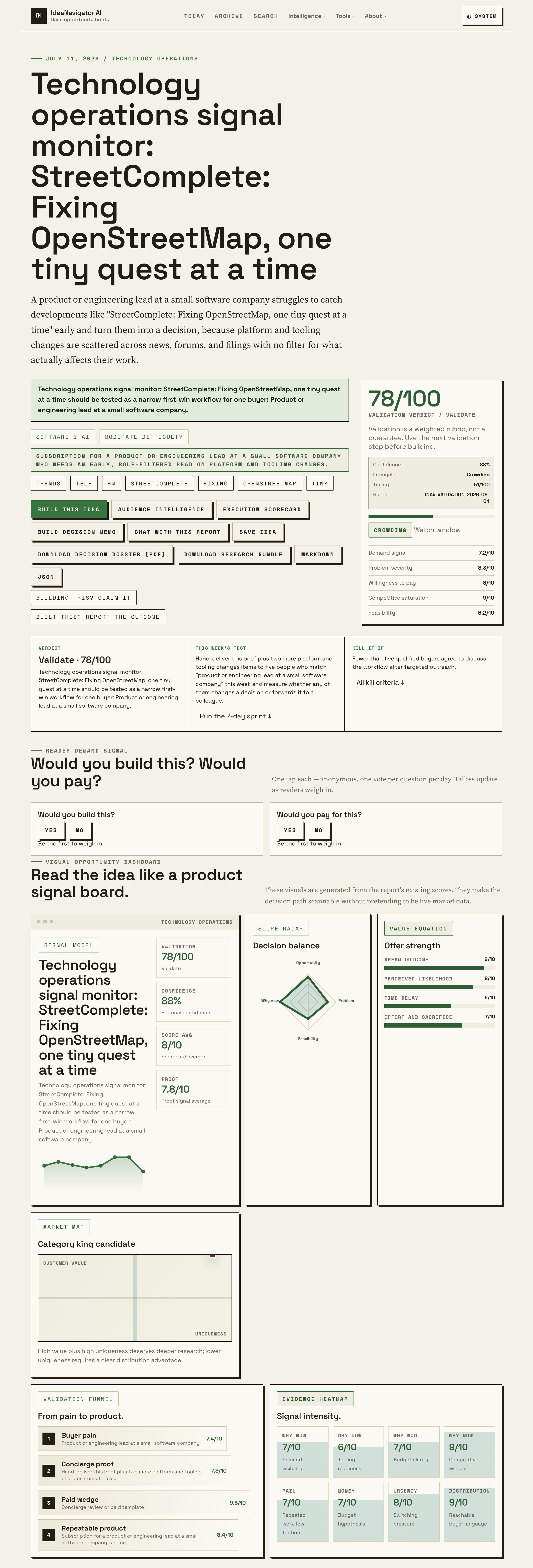
StreetComplete presents OpenStreetMap contributions as small, focused quests that people can complete through the app. An IdeaNavigator AI brief proposes testing a role-filtered monitor for product and engineering leads, using this item as one example; it does not report a new StreetComplete launch or measured impact.
IdeaNavigator AI has proposed testing a narrow signal-monitoring workflow for product and engineering leads at small software companies, using StreetComplete’s small-task approach to OpenStreetMap contributions as an example. The brief describes the opportunity as helping teams spot relevant platform and tooling developments early, but it does not report a new StreetComplete release or measured results from such a monitor.
StreetComplete is framed in the brief as a way to improve OpenStreetMap through individual, small tasks, or “quests.” That format can make map contributions more approachable for people who may not be ready to edit map data directly or take on a large mapping project. The brief does not provide product specifications, usage figures or evidence about how many people contribute through the app.
The proposed product would monitor Hacker News and similar feeds, filter items for product and engineering leads at small companies, and turn relevant developments into short briefs covering what changed, why it matters and what a reader could do. The brief says Hacker News surfaced the StreetComplete item with an 88/100 signal; it gives no scoring method, comparison baseline or time window, so that figure cannot establish reach or importance on its own.
For validation, IdeaNavigator AI suggests hand-delivering the StreetComplete brief and two other platform or tooling items to five people matching the intended audience during the week. It proposes measuring whether recipients change a decision or forward a brief to a colleague. Those are suggested tests, not completed research findings. The proposal also identifies subscriptions as a possible business model, without evidence yet of willingness to pay.
A Test for Faster Tooling Signals
The proposal addresses a practical attention problem: product and engineering leads may encounter platform changes across news sites, forums and other feeds, while only a portion of those items affect their work. A focused brief could save readers from sorting every item themselves, if its filtering is accurate and its summaries help them make decisions.
StreetComplete makes a useful example because it connects a specific tool with a clear contribution pattern: small tasks that can be completed one at a time. For software teams, the relevant question is not simply whether the app is interesting, but whether a change or approach offers a lesson for their own products, workflows or technical choices. The monitor proposal is meant to make that connection explicit.
The business case remains unproven. A handful of recipients forwarding a brief or changing a decision would offer an early indication of usefulness, but would not by itself establish demand for a paid subscription. The proposed test would help distinguish an item that attracts attention from a service that teams would use repeatedly.
From Map Quests to Team Briefs
OpenStreetMap is a collaborative map project whose data can be edited by contributors. StreetComplete’s approach, as characterized in the IdeaNavigator AI brief, organizes possible improvements into individual questions or tasks. That makes the app relevant to a discussion of contribution design: people can address a defined gap without first taking on a broad mapping assignment.
The brief recasts that product story as a signal-monitoring opportunity for a particular audience: product or engineering leads at small software companies. Its focus is not a general guide to OpenStreetMap or a report on StreetComplete’s development. Instead, it proposes a service that watches technology feeds and explains why an item might matter to that audience. No details are provided about feed coverage beyond Hacker News and similar sources, how relevance would be scored, or how often briefs would be delivered.
Demand and Signal Quality Remain Untested
No validation results are reported. The five-person exercise is a recommendation, and it is not clear whether it has begun. The brief does not identify participants, describe their current information habits or say what would count as enough evidence to continue building the monitor.
The 88/100 Hacker News signal is also unexplained: the scoring criteria, observation window and baseline are absent. It should be treated as a figure attached to the brief, rather than proof of a trend or broad interest. Other open questions include which feeds the service would cover, how it would avoid irrelevant alerts, whether the summaries would be accurate enough for decisions and whether intended readers would pay for access.
Five Reader Interviews Are Proposed
The next step outlined by IdeaNavigator AI is to share the StreetComplete brief and two additional platform or tooling items with five product or engineering leads at small software companies this week. The proposed check is whether anyone changes a decision or passes a brief to a colleague. No outcome or subsequent product milestone has been reported. Results from that exercise would help show whether the audience finds the format useful; evidence of repeat use and willingness to pay would still be needed to support a subscription service.
Source: IdeaNavigator AI
Key Questions
What is the development being reported?
IdeaNavigator AI proposed testing a signal-monitoring service for small-company product and engineering leads, with StreetComplete as an example item. The brief does not announce a StreetComplete product change.
What does StreetComplete do?
The brief describes StreetComplete as helping people contribute to OpenStreetMap by completing small, focused tasks called quests. It does not include detailed product or usage information.
Has the proposed monitor been built?
The brief describes an MVP concept and a validation plan. It does not say that the monitor has been built or that the proposed test has produced results.
What does the 88/100 signal mean?
The brief says Hacker News surfaced the item with an 88/100 signal, but gives no scoring method, time window or comparison baseline. Its meaning cannot be independently assessed from the details provided.
How would the idea be tested?
The proposed test is to deliver three briefs to five people in the intended audience and track whether a brief changes a decision or is forwarded to a colleague. These are suggested measures, not reported findings.
Source: IdeaNavigator AI
Fall Picks
fall essentials
As an affiliate, we earn on qualifying purchases.