
🔍 Read the full analysis: How To Find AI Automation Tools For Your Small Business on ThorstenMeyerAI.com

Get the little things that make your day delivered free with Prime
- Fast, free delivery on millions of items
- Prime Video, Amazon Music and more included
- Member-only deals all year
TL;DR
ThorstenMeyerAI.com has published a roundup of 15 books intended to help small-business owners learn about AI automation. The list compares learning resources—not working software—and recommends choosing a book based on the process to improve, technical comfort and existing business apps.
ThorstenMeyerAI.com has published a roundup of 15 books aimed at small-business owners who want to learn how to automate marketing, sales, customer service and routine operations with AI, as detailed in the original analysis. The list compares educational guides, not automation software, so readers still need to select and configure the platforms that will run any workflows they build.
The roundup names AI Automation for Small Businesses: A Practical Guide to Automating Marketing, Sales, Customer Service, Operations, and Everyday Work as its best overall pick, citing the range of business functions signaled by its title. It presents AI Automation Made Simple for Small Business as a possible starting point for readers seeking a no-code learning path, and ChatGPT for Business: The 10X Playbook as a source of workflow ideas that readers may adapt. Readers looking for software options can also explore AI automation tools for small-business growth.
Other titles in the list are described through signals in their names, including beginner framing, everyday tasks, entrepreneurship and structured plans. The roundup says that guides focused on a particular assistant or learning style may suit some buyers better than broad overviews, while wider-ranging titles may speak to more business functions.
The publisher says its comparison is based on the titles’ stated audiences, formats and topics because the supplied information did not include detailed book contents. It does not establish that any title covers a specific software integration, produces a particular business result or contains step-by-step instructions beyond what its description indicates. For a closer look at software options, see this side-by-side comparison.
The 15 picks
- 1
 Smart AI for Small Business: 50 Simple Hacks to Grow Revenue, Cut Costs, and…View on Amazon →
- 2
 The Small Business Owner’s AI Handbook: How to Use Artificial Intelligence to…View on Amazon →
- 3
 AI Tools for Small Business: A Practical Guide to Automation, Saving Time, an…View on Amazon →
- 4
 AI-Powered Automation and Workflows for Small Business OwnersView on Amazon →
- 5
 ChatGPT for Business: The 10X Playbook — 100 AI Workflows to Save Time, Grow…View on Amazon →
- 6
 AI Automation for Small Businesses: Build Smarter Workflows, Save Time, Reduc…View on Amazon →
- 7
 Claude AI Made Practical: A Beginner’s Guide to Everyday Work, Small-Business…View on Amazon →
- 8
 AI Automation for Small Businesses: A Practical Guide to Save Time, Work Smar…View on Amazon →
- 9
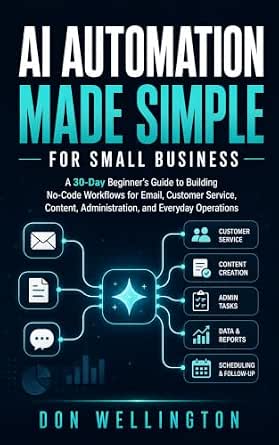 AI Automation Made Simple for Small Business: A 30-Day Beginner’s Guide to No…View on Amazon →
- 10
 AI Automation for Small Business: Simple AI Workflows for Everyday TasksView on Amazon →
- 11
 AI Automation for Small Business: A Practical Guide to Automating Marketing,…View on Amazon →
- 12
 AI for Small Business, Volume I: Getting Started — Set It Up Yourself, No Tec…View on Amazon →
- 13
 AI for Small Business: From Marketing and Sales to HR and OperationsView on Amazon →
- 14
 AI Automation for Small Businesses: Build Semi-Passive Income Systems Without…View on Amazon →
- 15
 AI for Entrepreneurs and Small Business Owners: How to Compete with Larger Bu…View on Amazon →
Choose a Guide Before a Platform
The roundup addresses a practical distinction that can affect small businesses’ purchasing decisions: a book can explain a workflow, but it does not execute one. Owners need to check whether the ideas fit the applications they already use, such as email, customer databases, payment services and task-management systems, and confirm integration details with the software providers.
Choosing a learning resource around a specific bottleneck may also help owners avoid buying several introductory books without testing a workflow. The source recommends identifying a repetitive task, defining its steps and expected result, then matching a guide to that need. For customer-facing or sensitive work, businesses should also decide which AI-generated outputs require human review before they are sent or used.
Products Worth Considering

Ring Alarm 14-Piece Kit

Dyson V15 Detect Cordless Stick Vacuum

iRobot Roomba Max 875 Robot Vacuum and Mop
As an affiliate, we earn on qualifying purchases.
How the 15-Book List Was Built
ThorstenMeyerAI.com frames the titles as business learning resources and says it ranked them by apparent practical workflow coverage, accessibility for nontechnical owners and relevance to common small-business functions. Its stated comparison favors books that appear to balance hands-on application with broad business use, while recognizing that more specialized guides may better fit a particular tool or learning preference.
That method has limits: the source says the information available for comparison was limited to titles and their stated scope. It therefore treats phrases such as “no-code,” “beginner” or “30-day plan” as clues about a possible learning path, not proof of the level of detail inside a book. Readers are advised to review descriptions or sample pages for examples, screenshots and setup instructions.
“These are learning resources, not automation platforms.”
— ThorstenMeyerAI.com roundup
What the Book Descriptions Cannot Confirm
The source material does not give publication dates, prices, edition details, sample-page findings or a full contents review for all 15 titles. It also does not verify which software products each book supports, how current its instructions are, or whether following them saves time or money. Those details should be checked with publishers and software providers before purchase or implementation.
The roundup’s recommendations are editorial judgments based on the titles’ stated scope. A title that suggests no-code setup or a structured plan may not necessarily provide detailed instructions; the available material does not confirm that. Nor does it establish that a particular guide will suit every business, team or existing technology setup.
Verify Fit Before You Automate
Owners considering a title can start by listing the repetitive task they want to improve, how often it occurs and who currently handles it. They can then compare that need with the book’s description and sample pages, and check whether its named tools work with their existing systems. The source recommends testing one small workflow rather than committing to several introductory guides at once.
Before putting an automation into use, businesses should define what success looks like and decide which outputs require approval—especially for customer messages, financial details, hiring or sensitive personal information. The roundup does not announce a follow-up test of the books or a software rollout; readers will need to verify the details and results for their own circumstances.
Key Questions
Are the 15 picks AI automation software?
No. They are books and learning resources intended to help owners understand or plan automation. Businesses still need software to build and run workflows.
Which title does the roundup rate best overall?
ThorstenMeyerAI.com names AI Automation for Small Businesses: A Practical Guide to Automating Marketing, Sales, Customer Service, Operations, and Everyday Work as its best overall pick, based on the broad range of functions stated in its title.
Which books may suit beginners?
The roundup points to AI Automation Made Simple for Small Business for its no-code framing. That description is a selection cue, not confirmation of how detailed or accessible the book’s instructions are.
What should a small business check before choosing a guide?
Identify the process to improve, assess the team’s technical comfort, and check whether the advice fits existing business apps. Review sample pages for practical setup detail and set human review rules for outputs that could affect customers or sensitive records.
Source: ThorstenMeyerAI.com