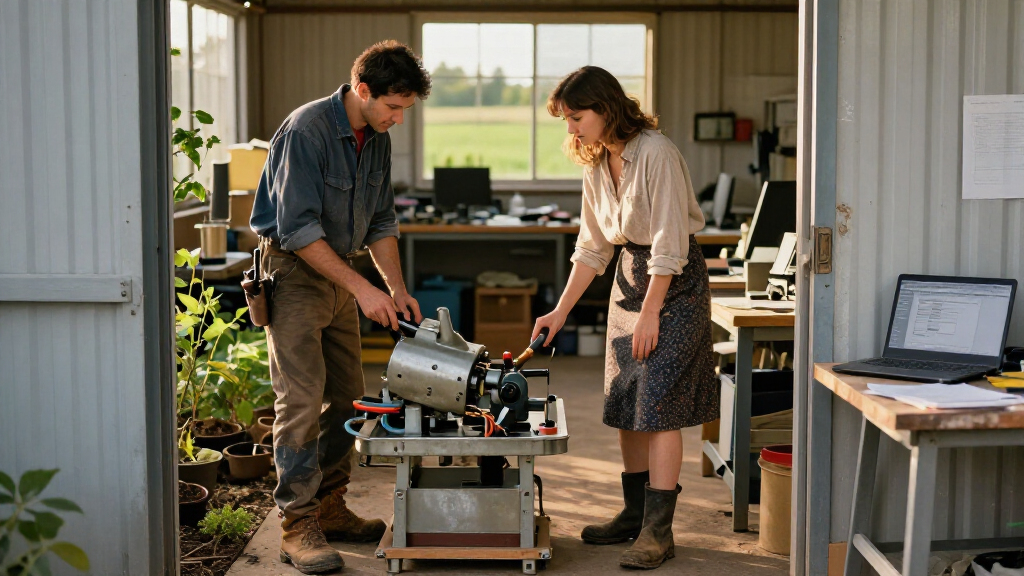
🔍 Read the full analysis: The Field, Factory, And Office: Three Ways We Work on ThorstenMeyerAI.com

Get the little things that make your day delivered free with Prime
- Fast, free delivery on millions of items
- Prime Video, Amazon Music and more included
- Member-only deals all year
TL;DR
Thorsten Meyer published the first episode of Work After Work on Nov. 2, 2026, using the three-sector model—primary, secondary and tertiary work—to explain how employment has shifted from farms to services. The essay cites historical and modeled employment figures and presents a separate, explicitly speculative thesis that automation could eventually form a sector of its own.
Thorsten Meyer published the first episode of his 60-part series Work After Work on Nov. 2, using the familiar division of work into primary, secondary and tertiary sectors to explain how employment has moved from farming to factories and services. The series is framed around how economies change as machines take on more tasks, a question with direct relevance to workers and industries facing automation.
The episode defines the primary sector as work that takes resources from nature, such as farming, fishing and forestry; the secondary sector as manufacturing, construction and energy; and the tertiary sector as services including trade, transport, health, education and government. Mining can be classified differently across statistical systems, Meyer notes, and some jobs do not fit neatly into one box.
To illustrate the long shift in employment, Meyer cites estimates by economic historian Stanley Lebergott showing that farming accounted for 73.7% of the U.S. labor force in 1800, 40.2% in 1900 and 12.0% in 1950. The International Labour Organization’s modeled estimate puts the U.S. farming share at 1.5% in 2025. These figures describe employment shares, not the amount of food produced.
The episode also reports that, in the ILO’s modeled global estimates, services have employed more people worldwide than farming since 2001. It contrasts falling agricultural employment with the growth of service work and argues that the three-sector framework helps track where people work, even though its boundaries are imperfect.
How the Work Shift Shapes Jobs
The episode sets up a question that matters beyond economic history: when technology reduces the labor needed in one kind of work, where do workers go? The movement from farming into manufacturing and then services is a major part of the modern employment story. It helps explain why changes in productivity can alter the mix of jobs without eliminating the need for work as a whole.
That history does not prove that future automation will create enough new jobs, or that workers can move into them easily. Meyer presents the possibility of automation becoming a distinct sector as his thesis, not an established fact. The distinction matters as the series turns to machines and AI: historical patterns offer context, but they do not settle what the next employment shift will look like.
Products Worth Considering

Dyson W1 PencilWash Cordless Wet and Dry Floor Cleaner with Dock

Shark Navigator Swivel Pro Upright Vacuum NV151

Bose SoundLink Max Bluetooth Speaker
As an affiliate, we earn on qualifying purchases.
Where the Three-Sector Model Came From
The three-part framework developed in the early 20th century. Meyer credits New Zealand economist Allan G. B. Fisher with adding the term “tertiary” in work written in 1934 and published in 1935. Fisher described a tendency for employment in developing economies to move from primary activities into manufacturing and, to a greater extent, services.
Economist Colin Clark compared employment patterns across countries in his 1940 book The Conditions of Economic Progress. He described the movement from agriculture to manufacturing and then commerce and services as a companion to economic progress, while also observing that manufacturing’s share of employment does not rise indefinitely. French economist Jean Fourastié later argued in 1949 that services could absorb workers displaced by productivity gains in industry.
Meyer also addresses the claim that the United States no longer makes goods. Drawing on the episode’s cited figures, he says U.S. factory employment is about 35% below its June 1979 peak, while real manufacturing output in 2025 was about 1.9 times its 1979 level. The comparison shows why job counts and output should not be treated as interchangeable measures.
“Every later question in this season, from the tractor to the chatbot, is a question about people moving between these boxes.”
— Thorsten Meyer, describing the purpose of the series
Limits of the Sector Forecast
The episode’s figures combine historical estimates, census data and modeled estimates, which do not all use identical definitions or methods. The three sectors are a useful summary, but classifications can vary: Meyer points to mining and software work as examples where statistical treatment may differ. Readers should not assume the figures are perfectly comparable across every country and period.
The source material does not provide the full underlying tables or methodological detail for every number cited. It also does not establish how many workers future automation might displace, what new jobs might appear, or whether those jobs would be accessible to people leaving affected occupations. Meyer’s suggestion that automation could perform up to 90% of work is presented as a personal thesis, not as a measured outcome or forecast supported in the episode by a cited study.
The Series Turns to Automation
Work After Work is described as a daily series of 60 episodes about how the economy is built, how work has shifted and which tasks may remain human as machines take on more. The first installment establishes the sector framework the series intends to use when discussing technologies ranging from tractors to chatbots.
Meyer says a later installment, Episode 48, will put his automation thesis on trial. The source material does not give a publication date for that episode or specify what evidence it will use. Until then, the central distinction in the opening installment is between the historical employment shifts it documents and its forward-looking claims about automation.
Key Questions
What are the three sectors in the episode?
The primary sector extracts or grows resources from nature; the secondary sector makes goods and builds infrastructure; and the tertiary sector provides services such as retail, transport, health care and education.
When did services overtake farming in global employment?
According to the ILO modeled estimates cited by Meyer, services have employed more people worldwide than farming since 2001.
Does the episode say the United States no longer manufactures goods?
No. Meyer says U.S. factory employment is about 35% below its June 1979 peak, while real manufacturing output in 2025 was about 1.9 times its 1979 level. Employment and output measure different things.
Is automation already a separate economic sector?
The episode does not establish that. Meyer presents the idea that automation could become a sector of its own as his thesis, with a later episode planned to examine it.
Source: ThorstenMeyerAI.com