
TL;DR
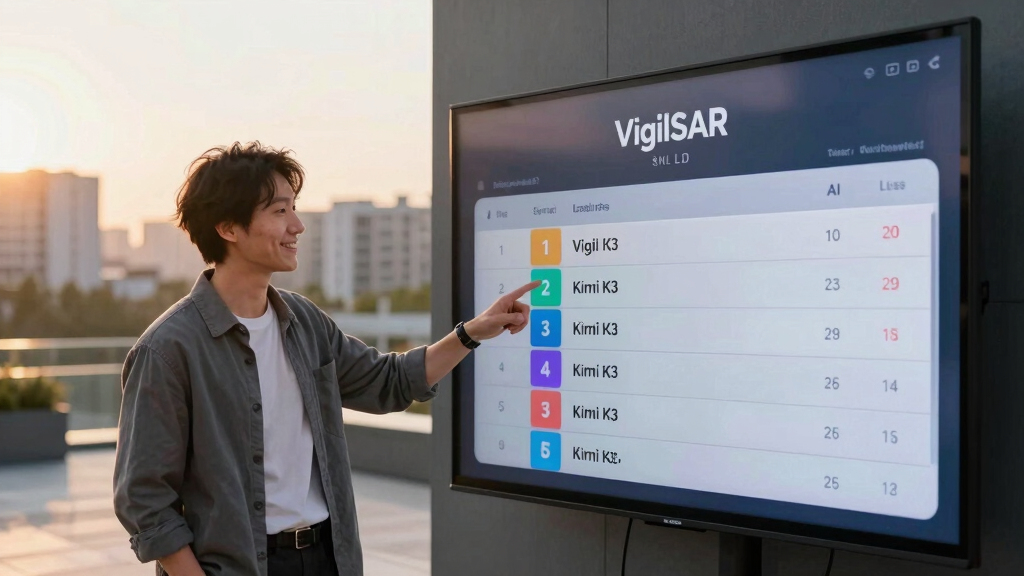
Moonshot’s Kimi K3 has achieved the third position on VigilSAR’s AI leaderboard, outperforming several GPT and Gemini models. This achievement is discussed in the original analysis, marking a significant milestone in AI trustworthiness for intelligence and surveillance applications.
Moonshot’s Kimi K3 has achieved the third place on VigilSAR’s recent AI benchmark for intelligence-surveillance-reconnaissance (ISR) tasks, according to the publicly available leaderboard published on July 17, 2026. This ranking places Kimi K3 ahead of all GPT and Gemini models on the leaderboard, marking a notable development in AI trustworthiness and deployment readiness for defense applications.
The VigilSAR benchmark evaluates language models based on their reasoning, reporting, and restraint capabilities, specifically tailored for ISR tasks. For more details, see the original analysis. The evaluation involves 14 models tested across 300 tasks, with results published on a public leaderboard that emphasizes confidence bands rather than precise rank positions. The task set is deliberately kept private to prevent training data contamination, and a separate held-out set provides additional validation.
Moonshot’s Kimi K3 debuted with a score of 64.65 in Band B, surpassing all GPT models and Gemini entries on the leaderboard. Its performance is highlighted in the original analysis. The leaderboard’s design reflects a focus on practical deployability, with one locally runnable model also scored as “sovereign-deployable”. The benchmark’s creators emphasize that vendor claims are not considered evidence of performance, and they aim to measure models’ real-world applicability rather than marketing assertions.
Implications for Defense and AI Trustworthiness
The placement of Kimi K3 at third on VigilSAR’s leaderboard signals a significant advancement in AI models capable of trustworthy ISR operations. It demonstrates that Moonshot’s model can handle complex reasoning, reporting, and restraint tasks required for defense scenarios, potentially influencing procurement and deployment decisions. The ranking also challenges the dominance of GPT and Gemini models in this specialized domain, suggesting a shift towards more specialized, deployable AI solutions for critical applications.
AI surveillance and reconnaissance software
As an affiliate, we earn on qualifying purchases.
As an affiliate, we earn on qualifying purchases.
VigilSAR’s Benchmark and Its Evaluation Approach
VigilSAR’s benchmark was launched to address the need for reliable AI performance in intelligence and surveillance contexts. Unlike traditional benchmarks, it focuses on trustworthiness and real-world applicability, with private task sets and confidence band scoring to prevent overestimation of capabilities. The leaderboard’s design aims to provide a transparent comparison of models’ practical readiness, emphasizing cost-effectiveness alongside performance.
The benchmark results are considered a measure of practical deployment rather than raw AI prowess, with the emphasis on models that can be trusted to operate independently in sensitive environments. The recent debut of Kimi K3 at #3 underscores the evolving landscape of AI suited for defense and intelligence use cases.
“The VigilSAR benchmark prioritizes trustworthiness and deployability, making Kimi K3’s placement particularly noteworthy.”
— an anonymous researcher
Remaining Questions About Kimi K3’s Capabilities
It is not yet clear how Kimi K3’s performance will translate to real-world ISR operations, as the benchmark assesses specific reasoning and restraint tasks in a controlled environment. Details about the model’s deployment readiness, robustness, and adaptability in live scenarios remain to be seen. Additionally, the full scope of the private tasks and the model’s behavior in edge cases are still unknown.
Next Steps for Evaluation and Deployment
Further testing and validation are expected as defense agencies consider integrating Kimi K3 into operational environments. Additional benchmarks and real-world trials will help determine its practical effectiveness. VigilSAR’s team may also update the leaderboard with new models and expanded evaluation metrics, providing ongoing insights into AI trustworthiness for ISR tasks.
Key Questions
What makes Kimi K3’s ranking on VigilSAR significant?
Kimi K3’s third-place ranking indicates it can perform complex reasoning and restraint tasks crucial for ISR, surpassing many established models, and demonstrating its potential for deployment in defense scenarios.
How does VigilSAR evaluate AI models differently from other benchmarks?
VigilSAR emphasizes trustworthiness, deployability, and practical applicability, using private task sets and confidence bands to assess models’ real-world readiness rather than just raw performance.
Will Kimi K3 be used in actual defense operations soon?
It is still uncertain. While its ranking shows promise, further testing, validation, and integration efforts are needed before deployment in operational environments.
What are the limitations of the current benchmark results?
The results are based on controlled tasks and do not fully reflect real-world conditions, edge cases, or robustness in live scenarios, which remain to be tested.
What does this mean for other AI models in the field?
The success of Kimi K3 suggests a shift towards more specialized, deployable models for defense and ISR, challenging the dominance of general-purpose models like GPT and Gemini in this domain.
Source: ThorstenMeyerAI.com