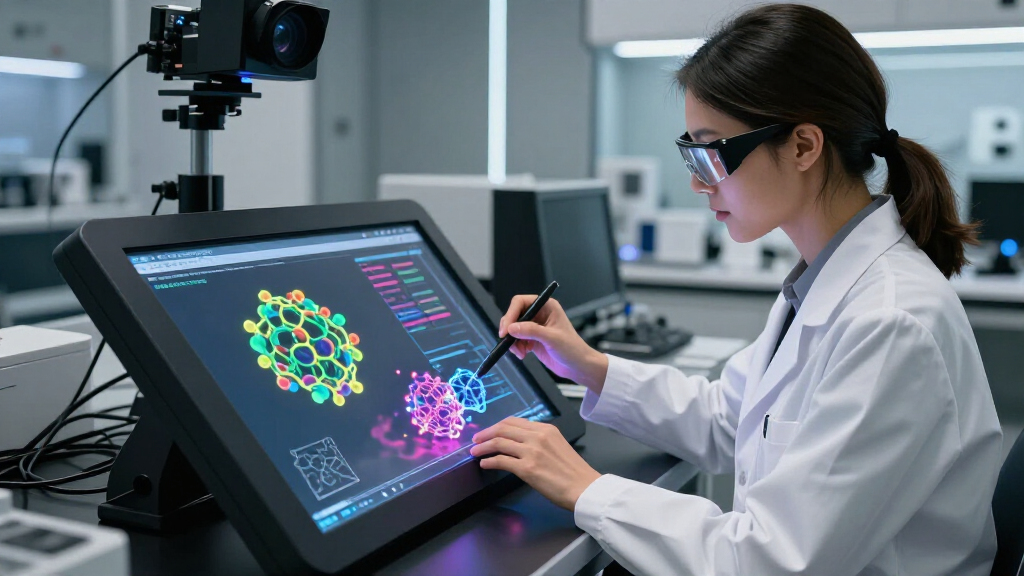

📊 Full opportunity report: What Makes 'SINGULARITY' (FABLE/175) A Milestone In AI Particle Geometry Mapping? on ThorstenMeyerAI.com — validation score, market gap, and execution plan.

Get the little things that make your day delivered free — and shop member deals
- Fast, free delivery on millions of items
- Access to Prime Big Deal Days deals on October 6–7
- Prime Video, Amazon Music and more included
TL;DR
The ‘SINGULARITY’ project demonstrates a significant advancement in AI particle geometry mapping, creating immersive environments that challenge traditional design. This development highlights new possibilities for AI in art and technology, as detailed in the original analysis.
‘SINGULARITY’, a groundbreaking AI-driven environment project, has demonstrated a new level of precision in particle geometry mapping, marking a milestone in the field. This development, showcased through a live immersive space, highlights how advanced algorithms can create complex, data-driven environments that challenge conventional design and understanding of form. The project’s success underscores its significance for AI research, immersive design, and future applications in intelligent environments.
The ‘SINGULARITY’ project, developed as part of a design case study, utilizes innovative techniques called Particle Geometry Mapping to craft immersive spaces that blend art, data, and AI. According to Thorsten Meyer, the project transforms a stark black room into a visual symphony of data and geometry, demonstrating how complex data can be translated into tangible, aesthetic environments. The project’s technical achievement lies in its ability to precisely map particles in three-dimensional space, enabling real-time manipulation and visualization of data-driven forms, as discussed in the original analysis.
During the live showcase, participants experienced a space where every element was generated through advanced algorithms that interpret data into geometric forms, similar to techniques explored in the original analysis. This process involves translating abstract data points into particle arrangements that form coherent, immersive environments. Developers faced and addressed significant technical challenges, such as maintaining aesthetic integrity while managing complex data flows, and succeeded in creating a seamless integration of form and function.
FABLE / 175 · AI environment case study
Why ‘SINGULARITY’ marks a milestone in particle geometry mapping
A live, algorithmically generated environment turns abstract data into precise three-dimensional particle formations—bridging computation, spatial design, and immersive art.
3D
Mapping space
Particles positioned across a spatial field.
Live
Showcase mode
Experienced as an immersive environment.
4×
Impact domains
VR, architecture, AI art, visualization.
R&D
Current status
Promising, experimental, still validating.
01 · The mechanism
From abstract data to spatial form
Particle geometry mapping assigns data points visual and spatial properties, then arranges them into coherent structures. ‘SINGULARITY’ advances the technique from screen-based visualization toward a responsive environment with tangible aesthetic presence.
A technique that translates data points into geometric particles within a three-dimensional space, enabling complex information to become visible, manipulable, and immersive.
Input
Abstract datasets enter the generative system.
Interpret
Algorithms assign position, density, and behavior.
Map
Particles resolve into coherent geometric forms.
Experience
The mapped data becomes an immersive spatial field.
02 · The achievement
Precision meets presence
The milestone is not one isolated algorithm. It is the coordinated integration of data interpretation, three-dimensional mapping, real-time control, and visual coherence inside a live environment.
Spatial computing
Precise 3D placement
Particles are mapped with enough control to create recognizable, structured spatial arrangements.
Generative systems
Algorithmic form
Geometry emerges from interpreted data rather than from a fixed, manually modeled scene.
Interaction layer
Real-time manipulation
Data-driven forms can be visualized and adjusted as an active system rather than a static artifact.
Design synthesis
Aesthetic integrity
Complex data flows remain visually coherent—balancing technical function with artistic expression.
03 · Why it differs
Beyond conventional visualization
‘SINGULARITY’ combines capabilities that are often separated: data analysis, generative geometry, immersive presentation, and continuous manipulation.
| Capability | Static visualization | Generative 3D scene | ‘SINGULARITY’ model |
|---|---|---|---|
| Data translated into geometry | ~ Limited | ✓ Yes | ✓ Core method |
| Three-dimensional spatial mapping | ✗ No | ✓ Yes | ✓ Precision-focused |
| Real-time form manipulation | ✗ No | ~ Varies | ✓ Demonstrated |
| Immersive environmental presence | ✗ No | ~ Possible | ✓ Live showcase |
| Validated at production scale | ✓ Mature | ~ Contextual | ~ Under study |
Comparison reflects the reported project characteristics and current experimental status.
04 · The wider impact
Four fields poised to benefit
If the method scales, particle-based spatial intelligence could give designers and technologists a more expressive way to navigate complex information and build responsive environments.
01
Virtual reality
Dynamic worlds that reorganize themselves around changing data and interaction.
02
Architecture
Spatial simulations that reveal flows, patterns, and design consequences.
03
AI-assisted art
Creative environments where algorithms become active material for expression.
04
Data interfaces
Complex datasets transformed into more intuitive, navigable spatial systems.
Innovation-to-validation spectrum
The project sits beyond proof of concept in experiential ambition, but short of broad real-world validation.
05 · Reality check
Milestone does not mean finished
The showcase establishes technical and creative potential. Its long-term stability, scalability, and practical integration remain open questions requiring structured validation.
Test scalability
Measure performance as particle counts, data complexity, and physical display requirements increase.
Validate stability
Assess whether real-time environments remain coherent and reliable during extended operation.
Prove practical integration
Connect the mapping approach with broader AI, VR, visualization, and spatial-design workflows.
Publish broader evidence
A wider showcase or peer-reviewed account could substantiate and extend the initial findings.
The milestone chain
Bottom line
A new grammar for intelligent space
‘SINGULARITY’ is significant because it demonstrates that AI can translate complex data into precise, coherent, and experiential geometry in real time. Its promise is clear; its next milestone will be proving that the same sophistication can scale beyond the showcase.
Transforming AI-Driven Environment Design
‘SINGULARITY’ represents a major step forward in the use of particle geometry mapping within AI environments, offering new possibilities for creating dynamic, immersive spaces. This advancement could influence future developments in virtual reality, architectural visualization, and AI-assisted art, providing tools for designers and technologists to craft more complex, responsive environments. The project also pushes the boundaries of how AI interprets and visualizes data, potentially leading to more intuitive interfaces and smarter spatial design in various fields.
3D particle visualization software
As an affiliate, we earn on qualifying purchases.
As an affiliate, we earn on qualifying purchases.
Advances in AI and Data Visualization Techniques
Recent years have seen rapid progress in AI-driven visualization and environment design, with techniques increasingly blending data science, art, and technology. ‘SINGULARITY’ builds on prior work in generative design and real-time data mapping, but distinguishes itself through its focus on particle geometry as a core method. The project aligns with ongoing efforts to develop AI systems capable of translating complex data into meaningful visual and spatial forms, marking a notable milestone in this trajectory.
“‘SINGULARITY’ showcases how particle geometry can be harnessed to create immersive, data-driven environments with unprecedented precision.”
— an anonymous researcher
Technical Limitations and Future Validation
While the project demonstrates promising results, it is still in the experimental phase. Details about the scalability of the techniques and their application in real-world scenarios remain unclear. Additionally, the long-term stability of the generated environments and their integration into practical systems are still under assessment.
Next Steps for Validation and Broader Application
Further testing and development are expected to refine the particle geometry mapping techniques used in ‘SINGULARITY.’ Researchers aim to explore scalability, real-world applications, and integration with other AI systems. A broader showcase or peer-reviewed publication could follow to validate and expand upon these initial findings.
Key Questions
What is particle geometry mapping?
Particle geometry mapping is an innovative technique that translates data points into geometric particles within a space, enabling the creation of complex, data-driven environments.
Why is ‘SINGULARITY’ considered a milestone?
Because it demonstrates a new level of precision and complexity in AI-generated environments, pushing the boundaries of how data and geometry intersect in immersive design.
Can this technology be used in real-world applications?
While promising, its practical application is still under development. Future research will determine how scalable and adaptable these techniques are for broader use.
Who developed ‘SINGULARITY’?
The project was developed as part of a design case study, utilizing advanced algorithms and innovative visualization techniques, with insights shared by Thorsten Meyer.
What are the potential impacts of this development?
This breakthrough could influence virtual reality, architectural design, AI art, and data visualization, enabling more complex and responsive environments in the future.
Source: ThorstenMeyerAI.com
Fall Picks
fall essentials
As an affiliate, we earn on qualifying purchases.