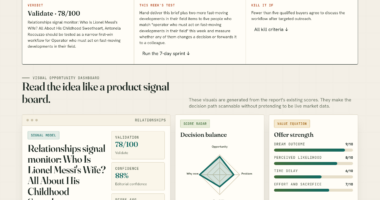

📊 Full opportunity report: AI-Washed: When ‘Productivity’ Becomes the Press Release for Cuts You Couldn’t Justify on ThorstenMeyerAI.com — validation score, market gap, and execution plan.
TL;DR
In 2026, major tech companies announced thousands of layoffs attributing them to AI, but only about 9% of companies report AI actually replacing roles. Most claims are used for public relations, not actual automation. This shift affects labor dynamics and corporate transparency.
Major technology companies, including Meta and Microsoft, announced combined layoffs of approximately 20,000 employees on April 24, 2026, framing the cuts as driven by AI-driven efficiency improvements. However, data suggests only a small fraction of these layoffs are directly attributable to AI automation, raising questions about the accuracy of the public narrative and its implications for the workforce.
Between January and April 2026, the tech industry eliminated roughly 78,557 jobs, with 47.9% of these layoffs publicly attributed to AI. Yet, private surveys reveal that only about 9% of companies report actual AI replacing roles, indicating a significant discrepancy. The majority of the layoffs are driven by corporate communication strategies aimed at presenting a narrative of technological progress and efficiency, rather than actual automation.
Major firms like Meta and Microsoft announced 20,000 layoffs in April, emphasizing AI’s role in productivity gains. Despite this, their first-quarter capital expenditure on AI infrastructure reached approximately $650 billion, with no clear link to the layoffs. Industry insiders suggest that the ‘AI’ label is often used to justify workforce reductions that are primarily motivated by capital reallocation and financial strategy.
Impact of AI-Washing on Workforce and Corporate Strategy
This discrepancy between claimed and actual AI-driven layoffs influences labor market perceptions, worker bargaining power, and public trust. The widespread use of AI as a justification for cuts shifts the narrative from technological necessity to strategic communication, affecting how companies manage stakeholder expectations and regulatory scrutiny. It also accelerates the concentration of capital ownership and widens the gap between senior and junior roles, reshaping the labor landscape.

TRAIN THE HUMAN, DEPLOY THE AI: A Human-First Guide to Mastering the Age of AI
As an affiliate, we earn on qualifying purchases.
As an affiliate, we earn on qualifying purchases.
Background of Tech Layoffs and AI Framing Strategies
Since 2020, the tech industry has eliminated approximately 900,000 jobs, with a notable increase in layoffs attributed to AI in early 2026. While AI’s actual capacity to replace roles remains limited to narrow tasks such as customer support, code completion, and content creation, companies have increasingly used AI as a narrative device to justify workforce reductions. Surveys from late 2025 reveal that 59% of hiring managers admit to framing layoffs as AI-driven to appease stakeholders and avoid negative financial signals.
The trend reflects a broader shift where AI is less a technological necessity and more a strategic tool for capital reallocation, with large investments in AI infrastructure continuing despite minimal productivity gains reported across firms.
“The AI-washing narrative is a strategic communication tool that masks the real driver: capital reallocation and cost-cutting, not automation.”
— Thorsten Meyer, author of the report
Unconfirmed Extent of Actual AI Job Displacement
While public data shows 47.9% of layoffs are attributed to AI, only about 9% of companies confirm AI has replaced roles. It remains unclear how many of the reported AI-attributed layoffs are genuinely driven by automation versus strategic messaging. The precise impact of AI on job displacement outside narrow categories is still under investigation.
Monitoring Future Workforce Trends and Corporate Claims
Further analysis of company disclosures, employee data, and productivity metrics will clarify AI’s real role in job displacement. Regulatory scrutiny may increase, and industry experts will watch for shifts in corporate communication strategies. The upcoming quarters will reveal whether actual AI-driven automation accelerates or remains limited to narrow tasks.
Key Questions
Are tech layoffs in 2026 mostly caused by AI automation?
No, only about 9% of companies report actual AI replacing roles, while most layoffs are attributed to strategic communication and capital reallocation.
Why do companies emphasize AI in their layoff announcements?
Using AI as a narrative helps companies present workforce reductions as part of technological progress, reducing negative financial and political repercussions.
Which job categories are genuinely affected by AI automation?
Customer support, junior software engineering, and content creation are the main areas where AI is replacing routine tasks, but senior roles are less impacted.
Is the reported productivity gain from AI real?
Most firms report negligible productivity gains from AI in 2026, suggesting that the primary driver of layoffs is financial strategy, not efficiency improvements.
What are the implications for workers and labor rights?
The shift toward capital concentration and the use of AI as a justification for layoffs could weaken workers’ bargaining power and widen income inequality.
Source: ThorstenMeyerAI.com