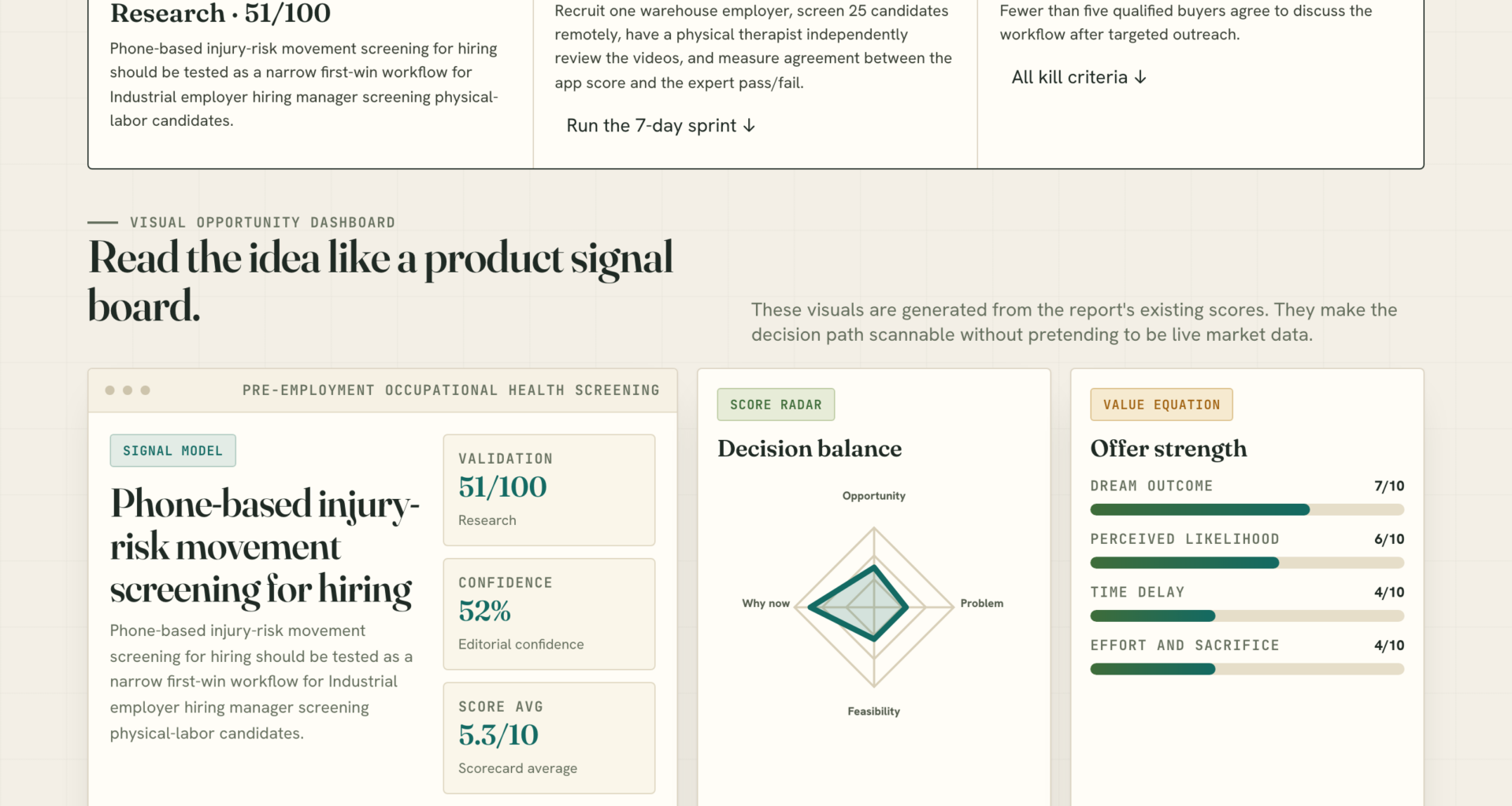

📊 Full opportunity report: Phone-based injury-risk movement screening for hiring on IdeaNavigator AI — validation score, market gap, and execution plan.

Get the little things that make your day delivered free — and shop member deals
- Fast, free delivery on millions of items
- Access to Prime Big Deal Days deals on October 6–7
- Prime Video, Amazon Music and more included
TL;DR

A pilot program is underway testing a phone-based movement screening tool for pre-employment injury risk assessment in industrial hiring. The approach uses smartphone cameras and pose estimation to evaluate candidates remotely, aiming to reduce injuries and costs.
A pilot program is testing a phone-based movement screening tool designed to evaluate injury risk in job candidates for physical labor roles, potentially transforming pre-employment health assessments in industrial settings.
The initiative aims to address the current gap where employers either skip movement screening or rely on costly, slow clinic assessments, leaving injury risks unassessed until after an incident occurs. Using smartphone cameras and pose estimation technology, the tool guides candidates through 5-7 movements—such as squats, reaches, lifts, and balance holds—and provides a pass or fail score within 24 hours for a fee estimated at $30-50 per candidate.
According to sources involved in the pilot, the system is designed to be a quick, scalable, and affordable alternative to traditional assessments, which often cost between $200 and $400 and take days to complete. The goal is to enable employers to identify high-risk mechanics early, reducing injury-related costs and improving worker safety.
Potential Impact on Industrial Hiring and Worker Safety
If successful, this phone-based screening could significantly lower the costs and time associated with pre-employment injury risk assessments, enabling more widespread adoption. By identifying risky movement mechanics before hiring, employers can potentially prevent costly injuries, reduce workers’ compensation claims, and improve overall safety culture. This approach also offers a scalable solution for remote or distributed workforces, especially in industries with high physical demands.
As an affiliate, we earn on qualifying purchases.
Growing Need for Cost-Effective Injury Prevention Tools
Current practices for assessing physical readiness in industrial hiring often involve in-person clinic assessments, which are expensive and time-consuming. Many employers skip movement screening altogether due to these barriers, increasing their exposure to injury risks and associated costs. Rising workers’ compensation premiums and a focus on proactive injury prevention have created a market opportunity for remote, technology-driven solutions. The advent of smartphone cameras and pose estimation algorithms has made remote movement analysis feasible, opening new pathways for pre-employment screening.
Previous efforts to evaluate physical fitness remotely have been limited, but recent advances in computer vision and machine learning are enabling more accurate and scalable assessments. This pilot aims to validate whether a simple, guided phone capture can reliably predict injury risk compared to expert review.
“Using smartphone cameras and pose estimation, we can now evaluate movement mechanics remotely, making injury risk screening more accessible and scalable.”
— an anonymous researcher
Validation and Reliability of Phone-Based Screening
It remains unclear how accurately the app’s scores will align with expert assessments in real-world settings. The pilot will test agreement between the app’s pass/fail results and independent review by a physical therapist, but full validation results are not yet available. Additionally, questions about user compliance, movement variability, and technical limitations are still being addressed.
Next Steps in Pilot Testing and Validation
The pilot will recruit a warehouse employer, screen 25 candidates remotely, and compare app scores with expert reviews. Results from this initial test will determine the tool’s reliability and inform further development. If promising, larger-scale trials and potential commercialization could follow within the next year, aiming to integrate this solution into standard pre-employment procedures.
Key Questions
How does the phone-based screening work?
Candidates are guided through 5-7 movements via their smartphone camera, which records their performance. The app then analyzes the video using pose estimation algorithms to assess movement mechanics and generate a pass/fail injury risk score.
What types of movements are evaluated?
Movements include squats, reaching, lifting simulations, and balance holds, selected for their relevance to occupational physical demands.
How accurate is this method compared to traditional assessments?
Validation is ongoing. The pilot aims to compare app scores with expert reviews to determine reliability, but definitive accuracy metrics are not yet available.
What are the potential benefits for employers?
Reduced assessment costs, faster screening times, early identification of injury risks, and potentially fewer on-the-job injuries and associated costs.
When might this technology be widely available?
If pilot results are positive, further testing and development could lead to broader adoption within the next 12-24 months.
Source: IdeaNavigator AI
NFL season / tailgating Picks
team gear
As an affiliate, we earn on qualifying purchases.