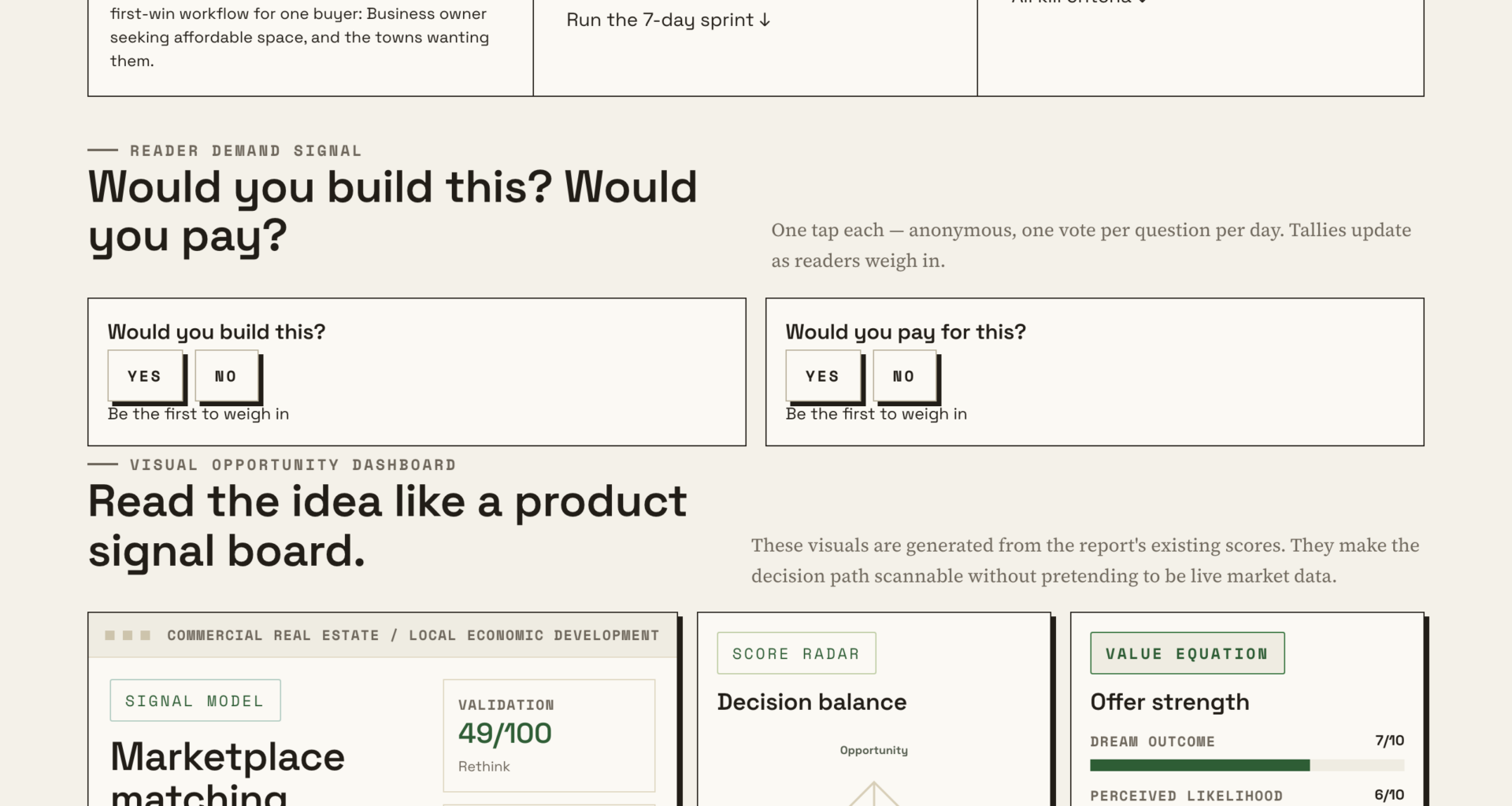

📊 Full opportunity report: A New Way To Find Commercial Space In Small Towns on IdeaNavigator AI — validation score, market gap, and execution plan.

Get the little things that make your day delivered free with Prime
- Fast, free delivery on millions of items
- Prime Video, Amazon Music and more included
- Member-only deals all year
TL;DR
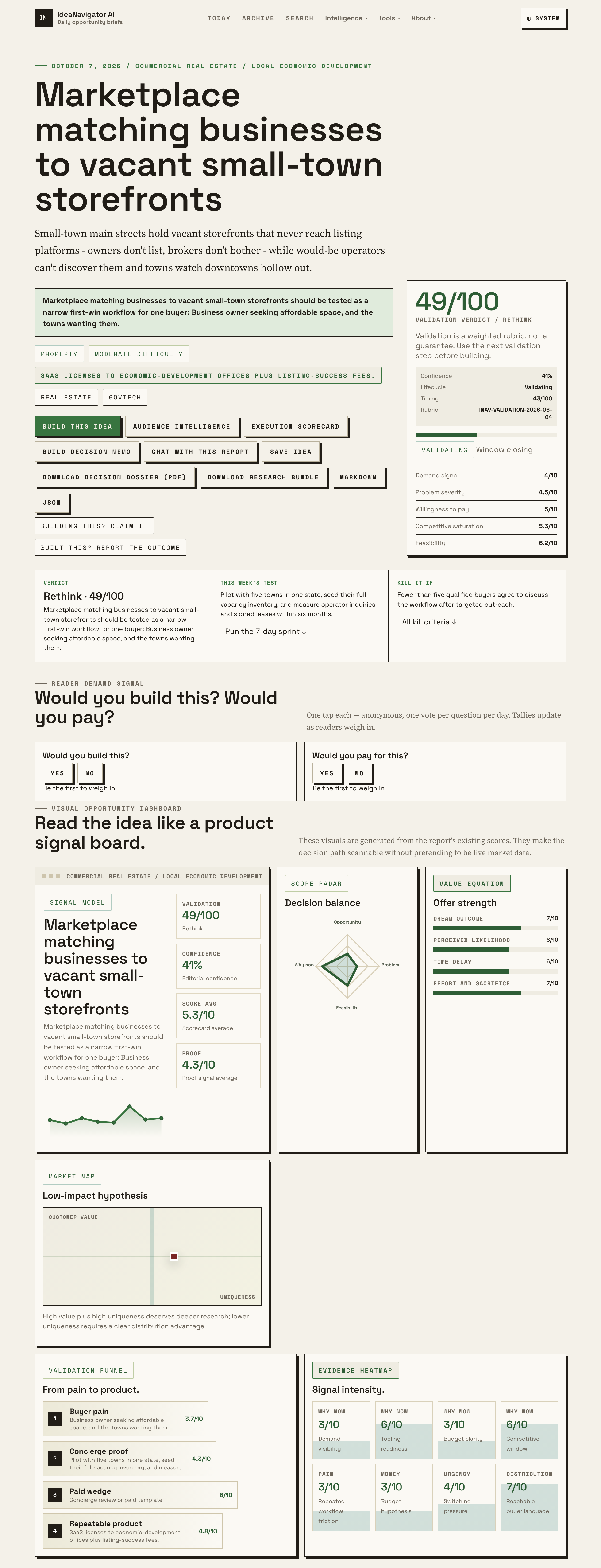
IdeaNavigator AI has outlined a proposed marketplace to match businesses seeking affordable space with vacant storefronts in small towns. The concept calls for a five-town pilot, but no launch, participating towns, funding awards or results have been announced.
IdeaNavigator AI has proposed a marketplace that would connect business operators with vacant storefronts in small towns, recommending a pilot across five towns in one state. The concept is aimed at owners whose spaces are not publicly listed and towns trying to attract businesses, but it remains a proposal: no pilot locations, launch date or operating results have been reported.
The proposed service would let towns and property owners post storefront information, including photos, size and rent, along with any available incentive programs. Business operators could browse listings by town profile and foot-traffic data, then send inquiries through the platform. Those inquiries would be routed to a local economic-development office, with relevant grants attached where available.
IdeaNavigator AI identifies two potential revenue streams: software licenses for economic-development offices and fees tied to successful listings. The proposal does not specify the size of either fee, how a successful listing would be defined, or whether the platform would charge businesses or property owners directly.
For an initial test, the proposal recommends working with five towns in one state, collecting a complete inventory of their vacant storefronts and measuring operator inquiries and signed leases within six months. Those are suggested evaluation measures, not reported outcomes. The material does not identify a team, participating municipalities, funding commitments or a platform that is already available to users.
A Route From Empty Storefronts to Leases
The idea targets an information gap on both sides of the local commercial-property market. According to the proposal, some storefront owners do not list their spaces on commercial platforms, while brokers may have little incentive to handle them. Operators looking for lower-cost space can consequently have difficulty finding available properties, and local officials may lack a shared inventory to promote.
A centralized listing system could give owners and towns a place to present spaces to prospective businesses, while directing inquiries to local development offices. Including incentive information alongside listings could help operators identify possible support earlier in their search. These are intended benefits of the design, not proven effects: there is no evidence yet that the proposed service has increased occupancy, attracted businesses or reduced vacancy.
The distinction matters to towns considering whether to adopt a new tool. A count of listings or clicks alone would not establish that vacant properties are being put to use. The suggested pilot’s focus on inquiries and signed leases over six months offers a more direct test of whether matching leads to commercial activity, although the proposal does not say how leases would be verified or how outcomes would be compared with towns not using the service.
commercial storefront listing platform
As an affiliate, we earn on qualifying purchases.
As an affiliate, we earn on qualifying purchases.
Why the Proposal Focuses on Towns
The concept is framed around two groups with aligned but different needs: business owners seeking affordable commercial space and towns hoping to bring operators into vacant buildings. Local economic-development offices are positioned as the connection point, both for receiving inquiries and for identifying grants or incentive programs that may apply.
IdeaNavigator AI presents renewed interest in small-town commercial space associated with remote-work migration, as well as grant funding available to economic-development offices, as reasons to test the idea now. The proposal does not provide data measuring that migration, quantify the funding or name a particular grant program. Those points should be treated as the rationale for the suggested timing, not as independently documented market findings in the information available.
The proposed approach is deliberately local rather than a broad national listing launch: towns would seed the system with their vacancy inventories, and operators would search by town profile and foot-traffic data. That design depends on local participation and accurate property details. It also places the development office in a practical role beyond promoting listings, since it would receive leads and connect them with available incentives.
Pilot Partners and Results Are Unconfirmed
No implementation details have been announced. The proposal names no participating towns, platform operator, development-office partners, launch date or committed budget. It also does not say whether grant funding has been secured or whether a specific state or grant program is involved.
Key operating questions remain open. The concept does not explain who would verify listing accuracy, keep rents and availability current, provide foot-traffic data, or determine whether a lease resulted from a marketplace referral. It also does not set out privacy rules for inquiries, eligibility standards for listings, or how the service would handle incentives that vary by town or business type.
There are no reported user numbers, signed leases or comparisons with existing listing services. The six-month measurement period is a recommended test, not a deadline already underway. Until a pilot is identified and results are made available, the marketplace’s demand, costs and effect on storefront vacancies remain unknown.
A Five-Town Test Would Be Next
The next step proposed by IdeaNavigator AI is to recruit five towns in one state, assemble a full inventory of vacant storefronts and direct interested operators to local economic-development offices. A test would then track inquiries and signed leases during a six-month period. No timetable or participating towns have been disclosed, so it is not clear whether or when that process will begin.
If a pilot proceeds, useful reporting would include how many properties were listed, whether the inventory remained current, how many operators made inquiries and how many ultimately signed leases. Towns and prospective users would also need clear information about listing fees, referral processes, grant eligibility and responsibility for checking property details. Results would show whether the concept merits expansion, but the proposal itself does not set a threshold for success or specify a plan for scaling beyond the initial towns.
Source: IdeaNavigator AI
Key Questions
Is the small-town storefront marketplace already operating?
No operating service or completed pilot is reported. IdeaNavigator AI describes a proposed marketplace and recommends testing it in five towns.
How would the proposed marketplace work?
Towns and property owners would post storefront details such as photos, size, rent and incentives. Operators would browse by town profile and foot-traffic data, with inquiries routed to a local economic-development office.
How would the concept make money?
The proposal identifies software licenses for economic-development offices and fees linked to successful listings. It does not give prices or define how a successful listing would be measured.
What would a pilot measure?
The suggested six-month test would track operator inquiries and signed leases after five towns provide their vacant-storefront inventories. No pilot dates or results have been announced.
Which towns are participating?
No towns have been named in the proposal. The state, partners, funding arrangements and launch schedule are also unspecified.
Source: IdeaNavigator AI
NFL season / tailgating Picks
team gear
As an affiliate, we earn on qualifying purchases.