📊 Full opportunity report: Best Practices For Setting Up A Civic Engagement Logistics Space on IdeaNavigator AI — validation score, market gap, and execution plan.

Get the little things that make your day delivered free — and shop member deals
- Fast, free delivery on millions of items
- Access to Prime Big Deal Days deals on October 6–7
- Prime Video, Amazon Music and more included
TL;DR
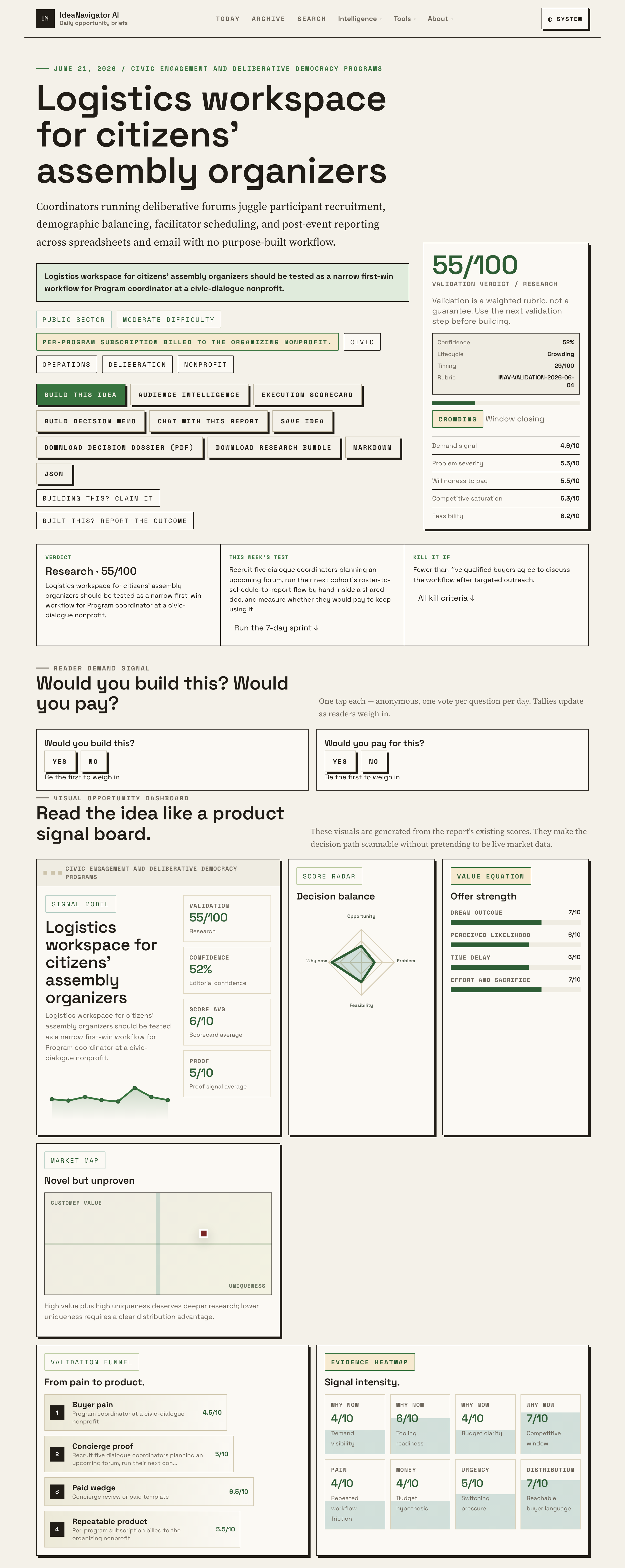
A civic-dialogue nonprofit is testing a dedicated logistics workspace for citizens’ assembly organizers. This approach aims to streamline participant recruitment, scheduling, and reporting, addressing current manual workflows. The initiative seeks validation from civic coordinators and could influence future civic engagement programs.
A civic-dialogue nonprofit is actively testing a dedicated logistics workspace designed to streamline the planning and execution of citizens’ assemblies. This initiative responds to the increasing demand from funders and local governments for deliberative democracy programs, which are often hampered by manual, spreadsheet-based workflows. The new workspace aims to simplify participant recruitment, demographic balancing, facilitator scheduling, and post-event reporting, offering a scalable solution for civic organizers.
The proposed logistics workspace functions as a guided, digital platform that takes a cohort of participants from initial roster creation through to scheduling and final reporting. It is intended to replace the current reliance on spreadsheets and email communication, which many small nonprofits find inefficient and difficult to scale. The platform would generate a demographically balanced session schedule and track attendance, ultimately producing a comprehensive report for each event.
Funders and local governments are increasingly commissioning citizens’ assemblies, but small civic nonprofits delivering these programs lack purpose-built tools, leading to manual workflows that limit growth. The nonprofit behind this initiative plans to validate the workspace by recruiting five dialogue coordinators preparing for upcoming forums. They will manually run their next cohort’s processes in a shared document and compare the results with the platform’s potential to automate and streamline these tasks.
Why a Dedicated Logistics Workspace Matters for Civic Programs
This initiative addresses a critical bottleneck in civic engagement: manual, labor-intensive event coordination. By developing a purpose-built workspace, nonprofits can improve efficiency, reduce errors, and scale their operations to meet increasing demand from funders and governments. A successful implementation could set a new standard for how deliberative democracy programs are organized, making them more accessible and manageable for small organizations.
As an affiliate, we earn on qualifying purchases.
Growing Demand for Scalable Civic Engagement Tools
Over recent years, funders and local governments have increased their support for citizens’ assemblies and deliberative panels as part of participatory democracy initiatives. However, many small civic nonprofits lack dedicated tools, relying instead on manual workflows involving spreadsheets and email communication. This limits their capacity to manage multiple events simultaneously and hampers scalability. The idea of a guided, digital logistics workspace emerges as a potential solution to these challenges, with initial testing underway by a nonprofit organization.
“Current workflows are inefficient and don’t scale well, which limits the reach of civic engagement programs.”
— an anonymous researcher
Uncertainties Around Platform Validation and Adoption
It remains unclear how effectively the proposed workspace will integrate with existing workflows and whether civic coordinators will adopt it at scale. The validation process involves manual comparison of current processes versus platform capabilities, but full user acceptance and long-term impact are still to be demonstrated. Additionally, the cost structure and potential barriers to widespread adoption are not yet fully defined.
Next Steps in Testing and Scaling the Logistics Workspace
The nonprofit plans to recruit five coordinators to run their upcoming forums using the shared manual process and then test the same workflows within the new platform. The results will inform adjustments and determine whether organizations are willing to pay for the subscription-based service. If successful, broader deployment and integration with other civic engagement tools are expected in the coming months.
Key Questions
What are the main features of the proposed logistics workspace?
The platform aims to facilitate participant roster creation, demographic balancing, session scheduling, attendance tracking, and post-event reporting, all within a guided digital environment.
How will the platform be validated?
Validation involves comparing manual workflows run in shared documents with the platform’s automated process, measuring efficiency gains and user satisfaction among coordinators.
Who can benefit from this logistics workspace?
Small civic nonprofits organizing citizens’ assemblies and deliberative panels are the primary target, especially those seeking scalable, purpose-built tools for event coordination.
When might this platform be available for wider use?
If validation proves successful, a broader rollout could occur within the next year, with potential updates based on user feedback and integration needs.
Will this platform replace existing tools?
The goal is to supplement current workflows initially, providing a dedicated tool that can eventually replace manual processes for scalable program delivery.
Source: IdeaNavigator AI
Halloween Picks
halloween
As an affiliate, we earn on qualifying purchases.