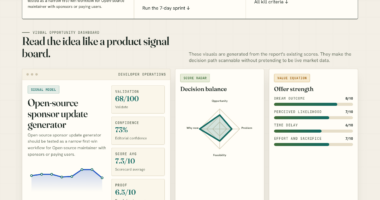

📊 Full opportunity report: Kill-Switch-Proof: How To Build So Washington Can’t Take Your AI Stack Down on ThorstenMeyerAI.com — validation score, market gap, and execution plan.

Get the little things that make your day delivered free — and shop member deals
- Fast, free delivery on millions of items
- Access to Prime Big Deal Days deals on October 6–7
- Prime Video, Amazon Music and more included
TL;DR
Following the June 2026 government shutdowns of major AI models, organizations are adopting architecture strategies to prevent future outages. Key measures include dependency mapping, abstraction gateways, fallback tiers, and self-hosted open-weight models.
In June 2026, the US government issued directives that led to the shutdown of Anthropic’s Fable 5 and limited access to OpenAI’s GPT-5.6, affecting global AI operations. These actions demonstrated that government-imposed model outages are now a real threat, prompting organizations to adopt architectural strategies to prevent future shutdowns from crippling their AI stacks.
The June 2026 shutdown revealed that model access is no longer solely controlled by vendors but can be revoked unilaterally by government agencies. Organizations relying on external AI providers faced outages with no SLA or warning, especially when models were used across international borders, due to export restrictions. To counter this, experts recommend mapping all dependencies, implementing abstraction gateways, establishing fallback tiers, and self-hosting open-weight models. These measures aim to make AI infrastructure resilient to government actions, reducing reliance on vendor-controlled models and enabling quick swaps in critical situations.Kill-switch-proof: build so Washington can’t take your AI stack down
In June, the US government switched off the market’s most capable model — twice, in three weeks. You can’t stop the gate. You can decide whether it takes you down. The difference is entirely architectural — and buildable.
You can’t control the gate — Washington will keep deciding which frontier models ship, and both labs are pushing to make review permanent. What you control is your exposure to it. Kill-switch-proofing isn’t predicting the next directive — it’s making the next one a config change instead of an outage, a routing rule that fails over to a model no one can pull while your users notice nothing. The question stops being “will they take my model away?” and becomes the boring one you can answer: “which one do I route to next?”
Implications for AI Deployment and Sovereignty
This development underscores the importance of building AI systems that are resistant to external shutdowns, especially in geopolitical contexts. Organizations that adopt these architectural principles can maintain operational continuity despite government disruptions, enhancing sovereignty and control over AI assets. The shift also raises questions about the future of vendor dependency and the role of open-source models in critical infrastructure.As an affiliate, we earn on qualifying purchases.
Recent Trends in AI Model Control and Geopolitical Risks
Over the past decade, reliance on third-party AI providers has grown, with many organizations integrating models via APIs. The June 2026 directives marked a turning point, demonstrating that government actions can cause sudden, indefinite outages. This has prompted a reevaluation of AI architecture, emphasizing dependency mapping, self-hosting, and flexible deployment strategies to mitigate risks associated with geopolitical restrictions and export controls.“The June shutdowns made it clear that relying solely on vendor-controlled models is a risk organizations can no longer afford. Building kill-switch-proof architectures is now essential.”
— Thorsten Meyer, AI infrastructure expert
Unresolved Questions on Implementation and Policy
While the architectural principles are clear, it remains uncertain how quickly organizations will adopt these measures universally. There are also questions about the evolving legal landscape, export restrictions, and whether governments will impose further controls that could complicate self-hosting or dependency mapping. The long-term effectiveness of open-weight models as a resilient alternative is still being evaluated, especially regarding performance on complex reasoning tasks.
Next Steps for Organizations Building Resilient AI Stacks
Organizations are expected to conduct dependency audits, implement abstraction gateways, and establish fallback protocols in the coming months. Increased adoption of open-weight models and self-hosted solutions is anticipated, alongside industry standards for resilience. Policymakers may also refine export and security regulations, influencing how organizations structure their AI infrastructure moving forward.
Key Questions
What is a kill-switch-proof AI architecture?
A kill-switch-proof architecture is one designed to prevent government or vendor shutdowns from disabling critical AI systems. It relies on dependency mapping, abstraction layers, fallback tiers, and self-hosted open-weight models.
Why are open-weight models important in this context?
Open-weight models can be self-hosted and controlled entirely by the organization, reducing dependency on external vendors or government directives that could cause outages.
What are the main steps to make an AI stack resilient?
Key steps include mapping all dependencies, implementing abstraction gateways, defining fallback protocols, and self-hosting open-weight models on infrastructure the organization controls.
Are these strategies feasible for all organizations?
While technically feasible, implementation complexity and resource requirements vary. Larger organizations and those with technical expertise are better positioned to adopt these measures quickly.
What legal or regulatory challenges exist?
Export restrictions, licensing, and compliance with international laws can complicate self-hosting and model deployment, requiring careful legal review.
Source: ThorstenMeyerAI.com
Halloween Picks
halloween
As an affiliate, we earn on qualifying purchases.