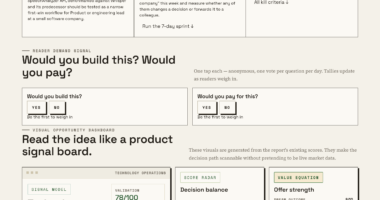
📊 Full opportunity report: What A Switching Service Does For Nonprofit Technology Teams on IdeaNavigator AI — validation score, market gap, and execution plan.

Get the little things that make your day delivered free with Prime
- Fast, free delivery on millions of items
- Prime Video, Amazon Music and more included
- Member-only deals all year
TL;DR

An IdeaNavigator AI business proposal outlines a service to audit small nonprofits’ software subscriptions and, for a fixed fee, move selected workflows to managed open-source tools. The idea has not been presented as a launched or validated service: its proposed test is to audit 20 nonprofits, win five paid migrations and track client retention for a year.
IdeaNavigator AI has proposed a switching service that would help small nonprofits audit software costs and move selected work to managed open-source tools. The proposal targets executive directors facing tight budgets, but it describes a business concept and validation plan, not a confirmed operating service or proven savings.
The proposed service begins with a software stack audit to identify subscriptions that might be replaced and estimate the associated spending. It would then offer a fixed-fee migration to a managed bundle covering customer relationship management (CRM), forms, email and documents, alongside staff training.
After migration, clients would pay an ongoing support and managed-hosting subscription, according to the plan. The proposal frames the main obstacle not as a lack of open-source software, but as a shortage of staff expertise to evaluate alternatives, move data and keep systems running.
To test demand, the plan calls for auditing 20 nonprofits, publishing average savings and converting five organizations into paid migrations. It also proposes tracking retention for one year. No audit findings, customer commitments, pricing, migration results or retention figures are provided.
The Expertise Behind Software Switching
The proposal points to a practical challenge for small nonprofits: replacing a subscription is not simply a matter of choosing another product. Staff must assess whether an alternative fits their work, transfer data, configure access and train users. If an organization lacks dedicated IT capacity, those tasks can make the cost and risk of switching more consequential than the software license itself.
A managed service could package those tasks into a single engagement, potentially making open-source options more accessible to organizations that cannot hire technology specialists. But the proposal does not establish that clients would save money after migration. Hosting, support, training, staff time and any required integrations all affect total cost. The suggested audit and paid trials would need to show both that savings are real and that the replacement systems meet operational needs.
open source CRM software for nonprofits
As an affiliate, we earn on qualifying purchases.
As an affiliate, we earn on qualifying purchases.
A Proposed Test, Not a Launch
The concept is aimed at executive directors of small nonprofits whose organizations rely on multiple software subscriptions. IdeaNavigator AI describes grant budgets as squeezed and SaaS prices as rising, while arguing that mature open-source tools and managed hosting have narrowed the usability gap. Those points are the proposal’s rationale; it supplies no market-wide figures or examples of price increases to quantify them.
The recommended first step is deliberately narrow: test one workflow for one buyer rather than promise a broad technology overhaul. The proposed bundle spans several common functions—CRM, forms, email and documents—but an actual engagement would still need to determine which tools an individual nonprofit uses, what data must move and what dependencies could prevent a change.
The business model combines one-time migration fees with recurring hosting and support revenue. The proposed validation numbers—20 audits and five paid migrations—are targets, not completed results. Tracking retention a year after migration would help test whether organizations continue paying for support, although retention alone would not establish service quality or financial savings.
Costs, Results and Readiness
Key details remain unspecified. The proposal gives no fixed-fee amount, subscription price, list of software products, migration timetable or support terms. It also does not say which nonprofit systems would be eligible, how sensitive data would be protected, or how the service would handle integrations and regulatory requirements.
No verified savings figures are available, and there is no evidence in the proposal that the audits or paid migrations have taken place. The suggested publication of average savings would need a clear method, including which costs are counted and over what period. It is also unclear whether the five proposed customers are intended to represent a particular organization size or mix of technology needs.
Evidence From the First Audits
The next stated milestone is to audit 20 nonprofit software stacks and report average potential savings. The plan then calls for converting five organizations to paid migrations and monitoring whether they remain customers over the following year. These are proposed validation steps; no dates or evidence that they are underway have been given.
For readers evaluating the idea, the most useful evidence would include the audit methodology, the full cost of each replacement—including hosting and support—and whether teams can continue using the new systems after training. Until those results are reported, the service’s demand, savings and long-term retention remain unverified.
Source: IdeaNavigator AI
Key Questions
What would the proposed switching service do?
It would audit a nonprofit’s software subscriptions, identify possible replacements and offer a fixed-fee migration to a managed open-source bundle, with training and ongoing support.
Which tools are included in the proposed bundle?
The proposal lists CRM, forms, email and document tools. It does not identify specific products or say that every nonprofit would use the same bundle.
Has the service demonstrated savings?
No savings results are provided. Publishing average savings is part of the proposed validation plan, not a reported outcome.
How would the idea be tested?
The plan proposes auditing 20 nonprofits, publishing average savings, converting five organizations to paid migrations and tracking retention for one year.
Why might a nonprofit need help switching software?
The proposal identifies staff expertise as a barrier: evaluating alternatives, migrating data, maintaining systems and training users take time and technical knowledge.
Source: IdeaNavigator AI
Halloween Picks
halloween
As an affiliate, we earn on qualifying purchases.