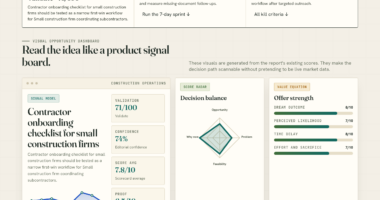
📊 Full opportunity report: Can Voice AI Handle Calls And Appointments For Trades? on IdeaNavigator AI — validation score, market gap, and execution plan.

Get the little things that make your day delivered free with Prime
- Fast, free delivery on millions of items
- Prime Video, Amazon Music and more included
- Member-only deals all year
TL;DR

A proposal from IdeaNavigator AI frames voice AI call answering as a focused way for plumbing, HVAC and electrical businesses to capture calls owners miss while working. It suggests a five-shop, one-month trial, but provides no test results showing how many jobs AI would book or what the service would cost.
IdeaNavigator AI has proposed a focused test of voice AI that answers calls and books appointments for plumbing, heating and air-conditioning, and electrical businesses. The concept targets owner-operators who may miss calls while working on a job, but no trial results or performance figures have been provided to show how reliably the system can turn calls into booked work.
The suggested product would answer calls through a dedicated phone number using a natural-sounding voice. During an intake call, it would collect the customer’s issue, address and urgency, then schedule an appointment in the business’s calendar or a platform such as ServiceTitan or Jobber. It would also text the owner a call summary and transfer emergencies to a person.
The proposed business model combines a monthly fee per phone line with a charge for each job booked. The proposal does not specify prices, contract terms, how a booking would be verified, or whether the per-job fee would apply to every appointment or only completed work.
To test demand, IdeaNavigator AI suggests forwarding after-hours calls for five trade businesses over one month. The test would count jobs booked that owners believe they otherwise would have missed, then compare that number with the businesses’ average job value. This is a proposed validation method, not a reported pilot or evidence of revenue gains.
Can Voice AI Handle Calls And Appointments For Trades?
IdeaNavigator AI proposes voice AI to answer calls and book appointments for plumbing, HVAC and electrical businesses. The idea has not yet been tested in a reported pilot.
How the service would work
The proposed workflow focuses on missed calls while owners are working.
Gather the job issue, address and urgency.
Schedule an appointment and text the owner a call summary.
Transfer urgent cases to a person.
Who it targets
The idea is aimed at owner-operators who may be unable to answer while on a job.
Capture missed calls
Answer potential customers when the owner is busy working.
Arrange appointments
Schedule work in a business calendar or named scheduling software.
Keep owners informed
Send a summary and route emergencies to a person.
What the trial would measure
The suggested test forwards after-hours calls and checks whether bookings represent work owners believe they would otherwise have missed.
- Calls forwarded and appointments booked
- Emergency transfers and completed jobs
- Service charges and usual call-handling costs
- Average job value for potentially recovered work
What remains unproven
The proposal reports no pilot results, measured booking rate or cost comparison.
- How reliably calls become booked work
- How availability and customer data are handled
- How cancellations and completed jobs affect fees
- Monthly fee per phone line
- Additional charge per booked job
- No prices or counting rules provided
Missed Calls Can Mean Lost Jobs
For a small trade business, a call can arrive while the owner is under a sink, on a roof or otherwise unable to answer. The proposal argues that a potential customer who reaches voicemail may contact another contractor instead. If that pattern is common for a particular shop, answering more calls could help it capture work without requiring the owner to stop a job.
The commercial case depends on more than picking up. The system would need to gather accurate information, schedule within the shop’s real availability and recognize situations that require a person. Emergency escalation matters because a routine appointment workflow may be unsuitable for an urgent safety or property issue. A trial would also need to distinguish a genuinely recovered job from a caller who would have booked anyway.
For tradespeople considering the idea, the proposed model offers a practical way to test value against their own call volume and job economics. However, the proposal gives no measured booking rate, customer outcome or cost comparison. A business should not treat the suggested workflow or pricing structure as proof that an AI service will pay for itself.
Products Worth Considering

Philips Hue Play Gradient Light Tube, Large, Black

Levoit Core 600S-P Smart Air Purifier for Large Rooms up to 2933 ft²

Dyson Cyclone V10 Origin Cordless Vacuum
As an affiliate, we earn on qualifying purchases.
A Narrow Test for Trade Calls
The concept sits within the broader category of home-services front-office software, but it focuses on a specific task: handling inbound calls and arranging appointments. Rather than proposing a system to run an entire business, it describes an initial workflow aimed at owner-operators in plumbing, HVAC and electrical work.
IdeaNavigator AI says voice AI reached a reliability threshold for structured intake calls in 2025–2026, and argues that round-the-clock answering could cost less than a human answering service. Those statements are presented as the rationale for the opportunity; the proposal includes no independent reliability data, service-price comparison or named provider to substantiate them.
The suggested test starts with after-hours calls, where owners may have fewer opportunities to answer while working. It would forward those calls for a month across five shops and track booked jobs. That setup could offer an early signal about whether the service captures missed demand, but it would not by itself establish performance across different seasons, call types or business sizes.
Reliability and Pricing Remain Untested
No completed pilot is described, so it is not clear how often an AI system would successfully book a job, how many calls it might mishandle, or how frequently it would need to transfer callers to a person. The proposal also provides no details about appointment availability checks, integrations beyond naming ServiceTitan and Jobber, or how customer information would be stored and protected.
The suggested cost advantage over a human answering service is not accompanied by prices or a like-for-like comparison. The proposed per-booked-job charge also leaves open how cancellations, duplicate calls and appointments that do not become paid jobs would be counted. Results from five businesses over one month, if collected, would be an early test rather than proof that the approach works across the trades sector.
A Five-Shop Trial Could Test Demand
The next step outlined by IdeaNavigator AI is to run the proposed one-month after-hours trial with five shops. A useful report would clarify the number of calls forwarded, bookings made, emergency transfers and appointments that became completed jobs, alongside the service’s charges and each shop’s usual call-handling costs.
No pilot schedule, participating businesses, product provider or launch announcement has been provided. Until those details and results are available, the proposal remains a testable business idea—not confirmation that voice AI can reliably handle trade calls or generate additional revenue.
Source: IdeaNavigator AI
Key Questions
What would the proposed voice AI do?
It would answer calls, collect the job issue, address and urgency, book an appointment in a business calendar or named scheduling software, and text the owner a summary. The proposal also calls for live escalation of emergencies.
Is the service already proven to book jobs?
No results are provided. The five-shop, one-month test is a proposed validation plan, not a reported trial.
Which businesses is the idea aimed at?
The proposal targets owner-operated plumbing, HVAC and electrical businesses whose owners may be unable to answer calls while working.
How might the service charge customers?
The suggested model is a monthly fee per phone line plus a fee per booked job. No prices or rules for counting a booking are specified.
What would a pilot need to measure?
The proposed trial would count jobs booked that owners believe they otherwise would have missed and compare them with average job value. Call volume, completed work, transfers and costs would also help readers judge the results.
Source: IdeaNavigator AI