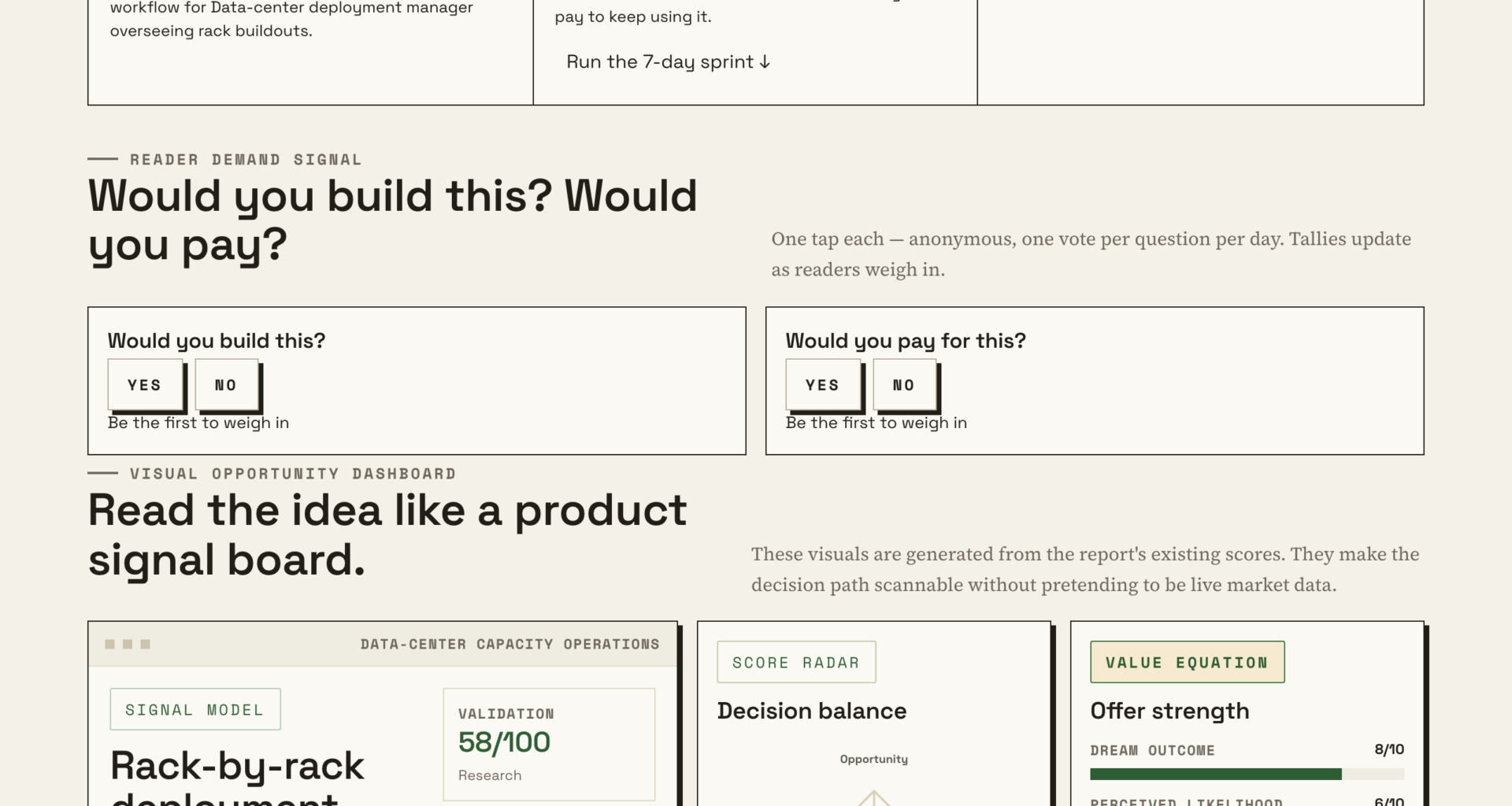

📊 Full opportunity report: Mastering Data Center Buildouts With Detailed Rack Deployment Tracking on IdeaNavigator AI — validation score, market gap, and execution plan.

Get the little things that make your day delivered free — and shop member deals
- Fast, free delivery on millions of items
- Access to Prime Big Deal Days deals on October 6–7
- Prime Video, Amazon Music and more included
TL;DR
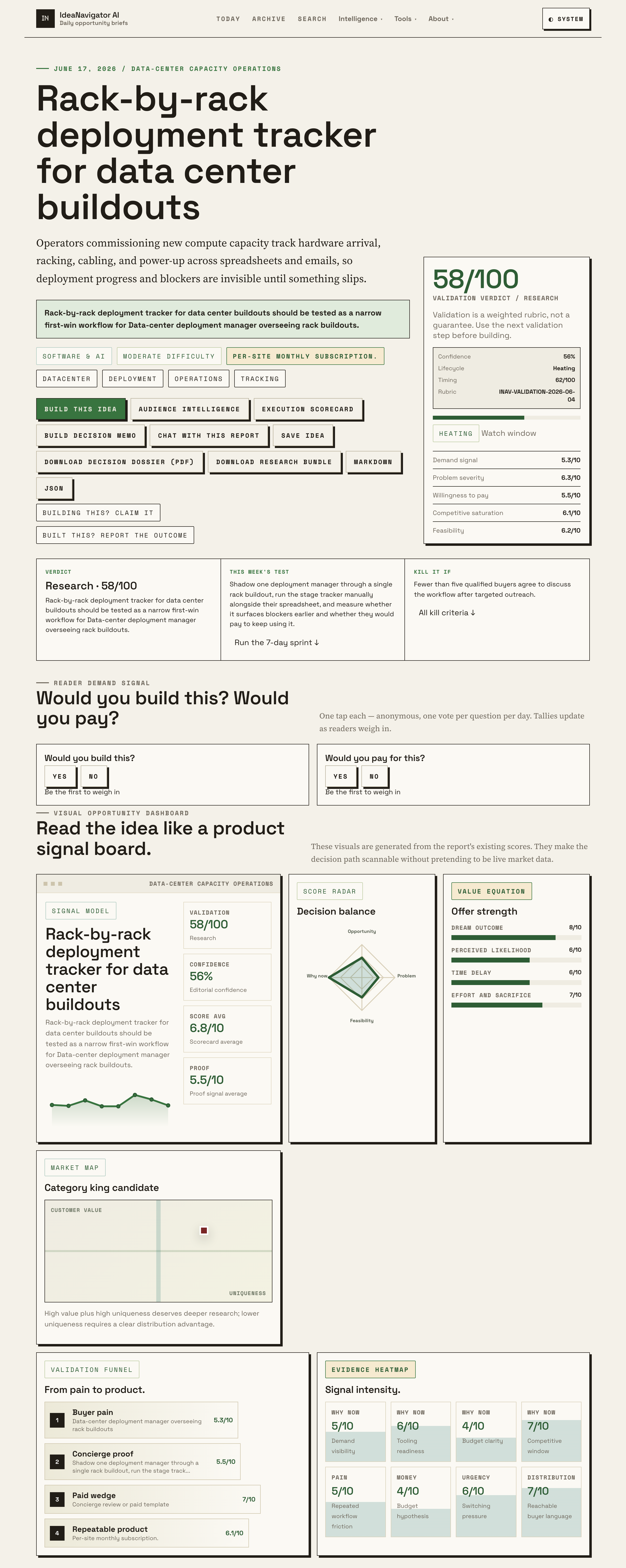
A simple deployment tracking tool for data center rack buildouts is being tested as a potential solution to improve progress visibility. Early trials aim to validate its effectiveness in identifying blockers and streamlining operations.
A prototype rack-by-rack deployment tracker for data center buildouts is being tested with a single deployment manager to evaluate its potential to improve progress visibility and identify blockers early. This initiative responds to the increasing demand for faster data center capacity expansion driven by AI and cloud workloads.
The tracker is designed as a simple, real-time deployment board where managers log each rack through stages such as delivered, racked, cabled, powered, and validated. The system provides a live percentage of completion per site and highlights stalled racks, aiming to replace or complement existing spreadsheet-based workflows.
According to sources familiar with the project, the goal is to determine whether this tool can surface bottlenecks sooner and support operators in managing rapid buildouts more effectively. The initial trial involves shadowing a deployment manager, comparing manual stage tracking with the new system, and measuring its ability to detect issues earlier.
Market interest is high, as data center operators face pressure to expand capacity quickly, often racking thousands of GPUs per site with minimal purpose-built tracking infrastructure. The proposed subscription model would charge per site on a monthly basis, offering a scalable solution for capacity operations.
Potential Impact on Data Center Deployment Efficiency
If successful, the rack deployment tracker could significantly improve visibility into buildout progress and reduce delays caused by unrecognized blockers. Early detection of issues could lead to faster completion times, lower operational costs, and more predictable project timelines, which are critical as demand for AI infrastructure accelerates.
By streamlining tracking workflows, this tool could also reduce reliance on manual spreadsheets, decreasing errors and improving coordination among teams. Its adoption might set a new standard for data center capacity expansion practices, especially in high-pressure environments.
data center rack deployment tracking software
As an affiliate, we earn on qualifying purchases.
As an affiliate, we earn on qualifying purchases.
Growing Data Center Demands and Tracking Challenges
Over recent years, data centers have faced unprecedented growth driven by AI, cloud computing, and digital transformation initiatives. This surge has led to record-breaking buildout timelines, often compressed into months rather than years. Currently, operators rely heavily on spreadsheets and email communication to track hardware delivery, racking, cabling, and powering, which can obscure real-time progress and delay issue detection.
Despite the critical need for efficient project management, there are no widely adopted purpose-built tools for rack-by-rack deployment tracking. This gap has become more apparent as data center capacity must be expanded rapidly and accurately to meet rising demand. The concept of a simple, live deployment board emerges as a promising solution, with early testing now underway.
“The trial aims to see if a straightforward deployment tracker can surface bottlenecks earlier, reducing delays and improving overall buildout efficiency.”
— an anonymous researcher
Uncertainties About Tracker Effectiveness and Adoption
It is not yet confirmed how well the tracker will perform in real-world deployment scenarios or whether operators will find it valuable enough to adopt permanently. The effectiveness of the tool in reducing delays and improving project timelines remains to be validated through ongoing trials. Additionally, questions about integration with existing workflows and scalability across multiple sites are still open.
Next Steps for Validation and Potential Rollout
The next phase involves closely monitoring the trial, collecting feedback from the deployment manager, and comparing manual versus automated tracking results. If the tracker demonstrates clear benefits, developers plan to refine the tool and expand testing to additional sites. A decision on broader deployment and commercial rollout will follow based on trial outcomes and operator interest.
Key Questions
How does the rack deployment tracker work?
The tracker is a simple digital board where managers log each rack through stages such as delivered, racked, cabled, powered, and validated. It provides real-time progress updates and highlights stalled racks to identify issues early.
What are the main benefits of using this tracker?
Potential benefits include improved visibility into buildout progress, earlier detection of blockers, reduced reliance on manual spreadsheets, and faster project completion times, especially important amid rapid capacity expansion demands.
Is this tracker expected to replace existing workflows?
Initially, it is intended as a complementary tool to enhance current manual processes. Widespread replacement would depend on its proven effectiveness and operator acceptance during trials.
When will the results of the trial be available?
Details about the trial’s outcomes are still emerging. The testing phase is ongoing, with a decision on wider deployment expected once sufficient data is collected.
How much will the service cost?
The proposed model is a per-site monthly subscription, but exact pricing details have not yet been finalized.
Source: IdeaNavigator AI
Fall Picks
fall essentials
As an affiliate, we earn on qualifying purchases.