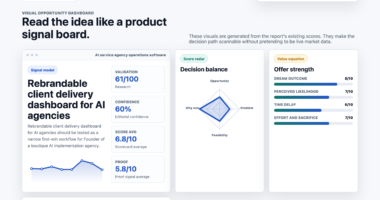

📊 Full opportunity report: The Neocloud Cartel: How the AI Industry Started Renting Compute From Itself on ThorstenMeyerAI.com — validation score, market gap, and execution plan.

Get the little things that make your day delivered free — and shop member deals
- Fast, free delivery on millions of items
- Access to Prime Big Deal Days deals on October 6–7
- Prime Video, Amazon Music and more included
TL;DR
In 2026, AI firms are increasingly renting compute from each other, forming a small cartel led by Nvidia. This shift decouples ownership from use but creates a fragile, tightly controlled market.
In 2026, the AI industry has shifted toward a model where companies rent their compute resources from each other, rather than owning hardware outright. This development, confirmed by industry sources, signifies a fundamental change in how AI infrastructure is controlled and accessed, with Nvidia emerging as the central figure in this new ‘neocloud’ ecosystem.
Recent reports reveal that AI firms such as xAI, Anthropic, and Google are leasing massive GPU clusters from each other, often on multi-billion dollar contracts. For example, xAI leased its Colossus 1 supercomputer to Anthropic for around $1.25 billion per month and to Google for about $920 million monthly, totaling roughly $26 billion annually. This pattern indicates that ownership of compute hardware is increasingly decoupled from its use, with companies acting as landlords.
Leading chipmaker Nvidia plays a pivotal role, with Jensen Huang stating that a gigawatt of AI data center capacity costs approximately $50 billion, with about $35 billion flowing directly to Nvidia. The company has also invested heavily in firms like OpenAI, with up to $100 billion committed, and holds stakes in multiple cloud and AI hardware firms. The circular flow of capital, chips, and compute contracts creates a tightly interconnected network that concentrates control within a small group of firms.
The Neocloud Cartel
Almost no one racing to build AI owns the machine it runs on. They rent — increasingly from each other — and the money loops back to one chip maker that’s also an investor in nearly everyone at the table.
The cartel isn’t a conspiracy — it’s the endpoint of extreme capital intensity, real scarcity, and one dominant supplier. But the same circularity that makes it powerful makes it a fuse: each cancelled order is someone else’s missing revenue. Don’t be a price-taker at the bottom of a loop you don’t control — own your inference, keep an open-weight fallback, diversify silicon.
Implications of the AI Compute Cartel for Industry Power
This emerging cartel structure grants Nvidia and a handful of other firms significant control over AI development and deployment. By controlling access to compute resources through leasing and allocation, these companies can influence market dynamics, pricing, and AI capabilities. The model also introduces fragility, as dependence on a small number of suppliers and contractual dependencies could lead to bottlenecks or disruptions, impacting the entire AI ecosystem.
As an affiliate, we earn on qualifying purchases.
How the Shift to Renting Reshaped AI Infrastructure
Over the past three years, the AI industry has faced GPU shortages that made owning hardware less feasible for many firms. As a result, renting compute resources became the norm, with companies like CoreWeave, Meta, and OpenAI relying heavily on Nvidia hardware through leasing agreements. The 2026 development marks a turning point, with companies like xAI leasing their own supercomputers to rivals, blurring the lines between owners and renters. This shift reflects a broader trend towards a ‘neocloud’ ecosystem, where control is concentrated among a few dominant players.
“A gigawatt of AI data center capacity costs about $50 billion, with most of that flowing to Nvidia.”
— Jensen Huang, Nvidia CEO
Uncertainties About the Future Stability of the Compute Cartel
It remains unclear how long this tightly interconnected compute leasing network can sustain itself without disruption. The reliance on a small number of suppliers and contractual dependencies could lead to vulnerabilities if any key player faces financial or supply chain issues. Additionally, regulatory scrutiny or new technological developments might challenge the current model, but specific risks are still emerging.
Potential Developments in AI Compute Market Dynamics
Industry observers anticipate increased regulatory attention on the concentration of control within this compute cartel. Further, companies may seek alternative supply chains or develop in-house hardware to reduce dependency. Nvidia’s role as the core supplier and financier will likely be tested as market pressures and technological innovations evolve, potentially reshaping the industry’s power structure.
Key Questions
Why are AI companies renting compute instead of owning hardware?
Due to GPU shortages and the high costs of building and maintaining hardware, companies find renting more flexible and cost-effective, especially at large scales.
What role does Nvidia play in this new ecosystem?
Nvidia acts as the primary supplier, investor, and allocator of GPU hardware, controlling a significant portion of the AI compute capacity and influencing market access through contracts and investments.
Could this cartel-like structure lead to market vulnerabilities?
Yes, dependence on a small group of firms and contractual dependencies could create bottlenecks or disruptions if any key player encounters issues or if regulatory actions intervene.
How might this development affect AI innovation and competition?
Concentration of control might limit new entrants and reduce competition, but it could also streamline large-scale AI development under a few dominant players.
Is this model sustainable long-term?
It remains uncertain. Market fragility, technological shifts, or regulatory pressures could challenge the current model, prompting industry reorganization.
Source: ThorstenMeyerAI.com
Halloween Picks
halloween
As an affiliate, we earn on qualifying purchases.