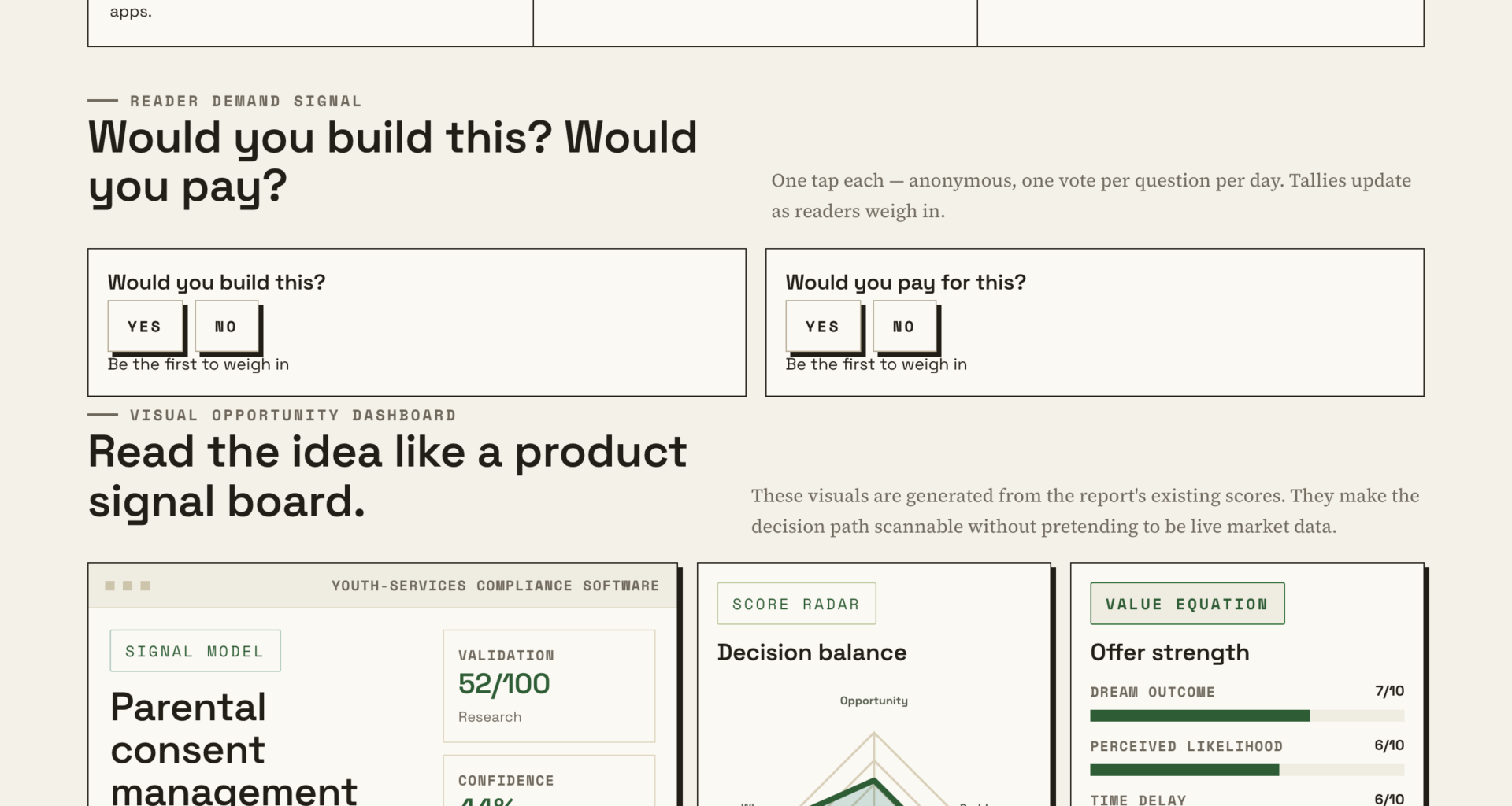

📊 Full opportunity report: Parental Consent Management For Youth-Service Compliance Teams on IdeaNavigator AI — validation score, market gap, and execution plan.

Get the little things that make your day delivered free — and shop member deals
- Fast, free delivery on millions of items
- Access to Prime Big Deal Days deals on October 6–7
- Prime Video, Amazon Music and more included
TL;DR
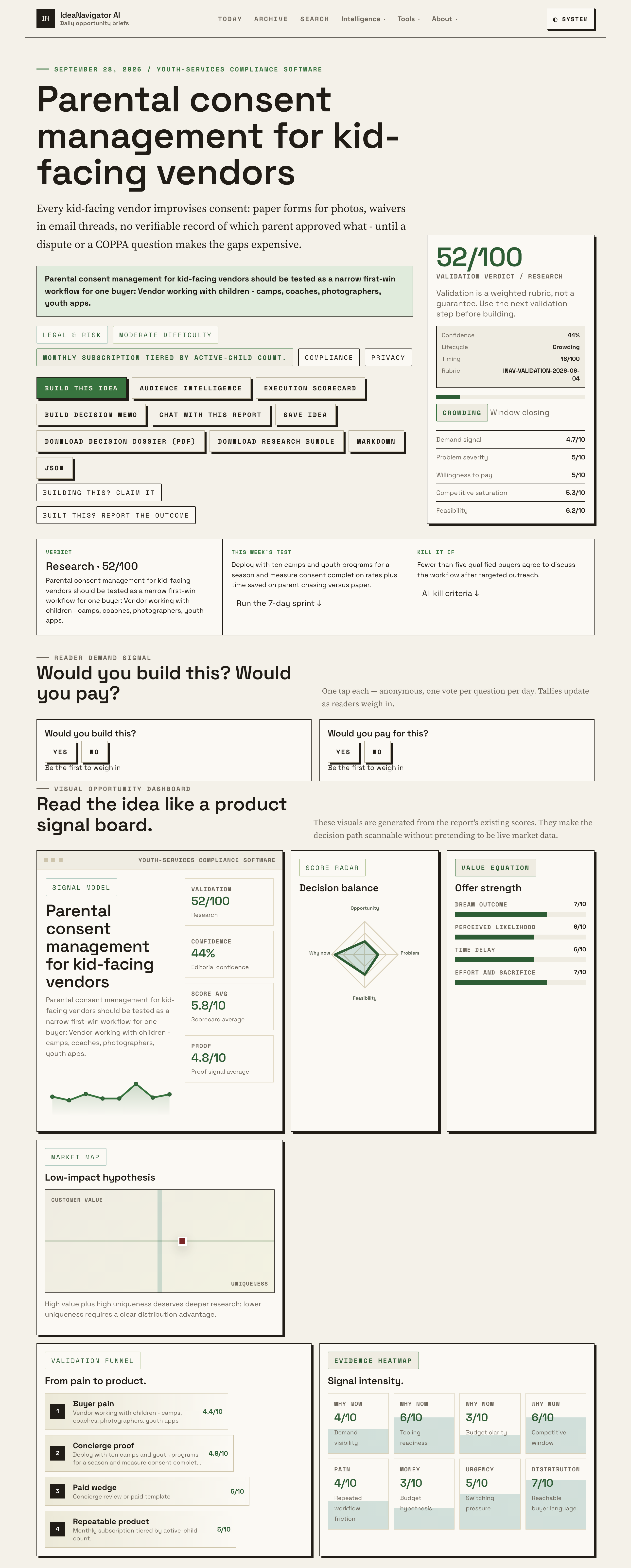
IdeaNavigator AI has outlined a business proposal for parental consent management aimed at camps, coaches, photographers and youth apps. It recommends testing phone-based consent forms, per-child records and audit exports with ten youth programs for one season; no product launch or pilot results are reported.
IdeaNavigator AI has proposed a parental consent management service for businesses working with children, including camps, coaches, photographers and youth apps. The proposal describes a phone-based workflow for collecting and tracking permissions, and recommends testing it with ten camps and youth programs for a season; it does not report that a product or pilot is already operating.
The proposed service would let vendors send parents branded consent forms to complete on their phones. Suggested form categories include photo use, data collection, medical information and liability waivers. The proposal also calls for identity checks scaled to the risk of each request, records organized by child, expiry tracking and an audit export that vendors could retrieve when they need to review a permission.
The problem identified is fragmented recordkeeping. Vendors may use paper forms and email threads, leaving them without a clear, verifiable record of which parent approved which use. The proposal says those gaps can become costly when a dispute arises or a vendor faces a question about compliance with the Children’s Online Privacy Protection Act, commonly known as COPPA. It does not provide examples of specific disputes or quantify related costs.
The proposed business model is a monthly subscription tiered by active-child count. To assess whether vendors would use the service, IdeaNavigator AI suggests a season-long deployment with ten camps and youth programs. The suggested measures are consent completion rates and time saved following up with parents compared with paper-based processes. No participating programs, pricing, results or product specifications are identified.
Consent Records Could Cut Follow-Up
For organizations handling children’s information or photographs, a searchable record could make it easier to check whether a permission exists, what it covers and whether it has expired. A consistent workflow may also help staff spend less time tracking down forms before activities begin. These are potential benefits in the proposal, not demonstrated results: there are no reported completion rates, time savings or evaluations.
The idea also addresses a practical tension for small youth-service providers. They may need to collect several kinds of permission while working with parents through different channels. A single phone-based process could make requests easier to manage, but vendors would still need to decide what information to collect, how to verify a parent’s authority and how long to retain each record. The proposal does not establish that one workflow would meet every vendor’s legal obligations.
A pilot could help distinguish operational interest from a viable business. If programs complete forms more reliably and spend less time chasing them, that would support further testing. If setup, verification or subscription costs outweigh those gains, the service may be harder to sell. Those questions matter to potential customers and builders because the proposal offers a validation plan, not evidence of market demand.
A Proposed Response to Fragmented Forms
IdeaNavigator AI frames the opportunity within youth-services compliance software. Its proposal points to expanding children’s privacy enforcement, including COPPA updates and state laws, as reasons providers may seek more defensible records. It also says parents increasingly challenge how businesses use children’s photos and data. The proposal does not cite particular laws, enforcement actions or surveys, so these points should be read as its stated rationale rather than a documented account of recent regulatory changes.
The suggested customer group spans organizations with different needs: a camp may gather medical and liability information, while a photographer may chiefly seek permission to use images. Youth apps may collect digital data under different circumstances from an in-person coach. The proposed risk-tiered identity verification and separate consent categories reflect those differences, but the proposal does not explain how vendors would set risk levels or which verification methods would be available.
The recommended first step is intentionally bounded: focus on one buyer group of vendors working with children, then test the workflow over a season with ten programs. That approach could produce practical feedback on form completion and staff workload before a wider rollout. The proposal gives no timeline for recruiting participants or selecting which types of programs would take part.
Product and Pilot Details Are Missing
It is unclear whether development has started, whether any vendors have agreed to participate or when a pilot might begin. No company operating the service, launch date, product demonstration, subscription price or technical design is provided. The recommendation to test the idea with ten programs is a proposed validation step, not confirmation that a trial has been scheduled.
Several operational and compliance questions are also unanswered. The proposal does not specify how identity verification would work, how records would be secured, who could access them, or how consent could be withdrawn or corrected. It also does not explain how the service would handle differing state requirements or determine what records each vendor needs to retain. These details would affect whether providers can use the system in practice.
There are no reported findings on how often parents complete existing forms, how much time staff spend on follow-up or how vendors currently respond to disputes. Without baseline measurements, a pilot would need to record current processes as well as outcomes to show whether the proposed workflow changes them. Demand and measurable benefits remain unverified.
A Ten-Program Season Pilot
The next step set out in the proposal is to deploy the service with ten camps and youth programs for one season. Participants would be assessed on consent completion rates and time spent following up with parents compared with paper forms. The proposal does not say who would run the test, how the programs would be recruited or when the season would begin.
If a pilot proceeds, reporting its methods and results would clarify whether families complete mobile forms more readily and whether the records help staff manage permissions. Details about identity checks, record access, expiry handling and pricing would also help vendors judge whether the service fits their work. For now, the published proposal establishes a target customer, a suggested product and a way to test it; it does not confirm a launch or successful validation.
Source: IdeaNavigator AI
Key Questions
Has a parental consent product launched?
No launch is reported. IdeaNavigator AI describes a proposed service and a possible pilot, without naming an operating product or giving a release date.
Who is the proposed service for?
The proposed customers are vendors working with children, such as camps, coaches, photographers and youth apps.
What would the service do?
It would let parents complete phone-based forms for matters such as photo use, data collection, medical information and liability waivers. The proposed records would be organized by child, track expiry and support audit exports.
How would the idea be tested?
The proposal recommends a season-long pilot with ten camps and youth programs, measuring form completion and staff time spent following up with parents compared with paper processes.
What is still unknown?
Pricing, launch timing, pilot participation and results are not provided. The proposal also leaves open how identity checks, data security, consent withdrawal and differing legal requirements would be handled.
Source: IdeaNavigator AI
Fall Picks
fall essentials
As an affiliate, we earn on qualifying purchases.