
📊 Full opportunity report: The Delegation Ladder: The Four Agentic Loops, and What Each One Lets You Stop Doing on ThorstenMeyerAI.com — validation score, market gap, and execution plan.

Get the little things that make your day delivered free with Prime
- Fast, free delivery on millions of items
- Prime Video, Amazon Music and more included
- Member-only deals all year
TL;DR
The article explains the four levels of agentic loops in AI engineering, from simple turn-based checks to fully autonomous workflows. Each rung allows increasing automation, reducing human intervention. This framework helps developers and businesses optimize AI deployment responsibly.
Anthropic’s Claude Code team has formalized a four-level framework of ‘agentic loops,’ defining how AI systems can autonomously execute tasks with varying degrees of human oversight. This development provides a clear map for building increasingly independent AI workflows, which is crucial as organizations seek to automate complex processes responsibly.
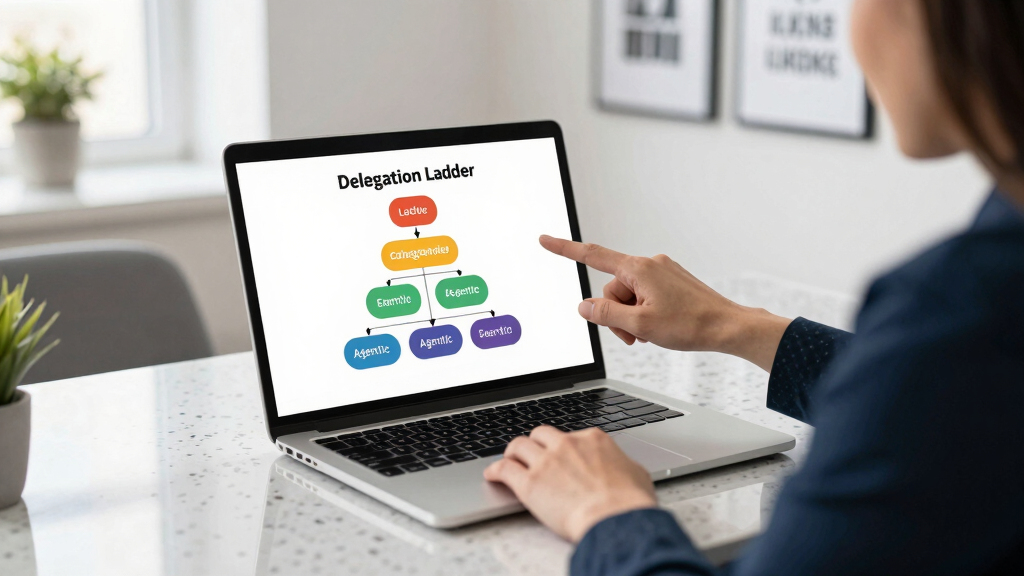
The framework, called the ‘Delegation Ladder,’ categorizes four types of agentic loops based on what is handed off to AI agents and how much control is retained by humans. The first rung, Turn-based, involves humans verifying AI outputs after each cycle. The second, Goal-based, allows AI to decide when a task is complete based on predefined success criteria, with humans setting the end condition. The third, Time-based, uses scheduled triggers for routine tasks, enabling work to continue automatically on a regular interval. The top level, Proactive, involves fully autonomous workflows triggered by events or schedules, orchestrating multiple agents without human intervention.
Anthropic emphasizes that not all tasks require these loops, advocating for starting with simple, manageable automation and climbing the ladder only as needed. They also stress the importance of system quality, verification, and documentation to ensure responsible AI deployment.
The delegation ladder: four agentic loops, and what each lets you stop doing
Strip the hype and a “loop” is simple — an agent repeating work until a stop condition is met. The useful lens isn’t the mechanics, it’s what you hand off. Four loop types = four rungs of delegation, from a tool you operate to a process that runs.
The whole framework reduces to one question about your own work: where am I the bottleneck, and which single piece can I hand off? Can you write the check? Is the goal concrete? Does the work arrive on a schedule? That answer picks your rung — and you climb one step at a time. The real skill isn’t operating a loop; it’s the judgment of what to delegate and how far — enough hands off to gain leverage, enough on the wheel that “runs without you” doesn’t become “runs away from you.”
Implications for AI Automation and Business Processes
This framework clarifies how organizations can incrementally increase AI autonomy while managing risks. It highlights the potential for reducing manual oversight in routine or repetitive tasks, thereby increasing efficiency. However, it also underscores the need for discipline in system design, verification, and oversight to prevent errors or unintended consequences as automation advances.
As an affiliate, we earn on qualifying purchases.
Evolution of AI Automation Frameworks
The concept of looping in AI has gained prominence as a way to shift from manual prompting to autonomous processes. Anthropic’s contribution formalizes this shift, building on earlier discussions about prompt engineering and AI control. Prior to this, most automation relied on simple prompting or fixed scripts; this ladder introduces a structured progression towards self-sufficient AI systems.
While the idea of autonomous agents has been debated, the explicit categorization into four levels provides a practical guide for implementation. The framework aligns with broader industry trends toward AI-driven workflows, emphasizing responsible escalation of autonomy.
“The Delegation Ladder offers a clear map for scaling AI autonomy responsibly, helping organizations understand what level of independence suits their needs.”
— Thorsten Meyer, AI researcher
Unanswered Questions About Implementation and Risks
It is not yet clear how organizations will adopt these loops in real-world settings, especially regarding safety, verification, and oversight at higher levels of autonomy. The specific challenges of managing complex workflows with multiple agents remain to be fully explored, and the potential for unintended consequences at the top rung is still being studied.
Next Steps for Developing and Applying the Delegation Ladder
Organizations and AI developers are expected to experiment with these loops in pilot projects, assessing their effectiveness and safety. Further research will likely focus on establishing best practices for verification, fail-safes, and governance at each level. Industry standards may emerge to guide responsible escalation of AI autonomy in critical applications.
Key Questions
What are the four levels of agentic loops?
The four levels are: Turn-based (human checks after each cycle), Goal-based (AI stops when a success criterion is met), Time-based (automatic execution on schedules), and Proactive (fully autonomous workflows triggered by events).
Why is this framework important?
It provides a structured way to increase AI autonomy responsibly, helping organizations balance efficiency gains with safety and oversight.
Can all tasks be automated using these loops?
No, not all tasks require or are suitable for automation at higher levels. The framework encourages starting simple and only climbing the ladder when justified.
What are the risks of higher-level automation?
Increased autonomy can lead to errors, unintended consequences, or loss of control if not properly verified and managed. Responsible implementation is critical.
How soon might organizations adopt these loops?
Adoption will depend on industry-specific needs and safety considerations, with initial experiments likely to occur within the next year or two.
Source: ThorstenMeyerAI.com
Halloween Picks
halloween
As an affiliate, we earn on qualifying purchases.