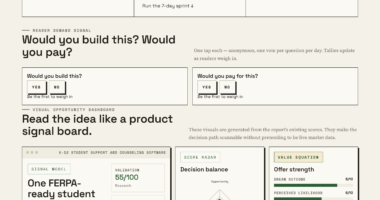

📊 Full opportunity report: Why Students In 2026 Are Raving About These 13 AI Tools on ThorstenMeyerAI.com — validation score, market gap, and execution plan.

Get the little things that make your day delivered free with Prime
- Fast, free delivery on millions of items
- Prime Video, Amazon Music and more included
- Member-only deals all year
TL;DR
Students in 2026 are increasingly adopting 13 AI tools that enhance note-taking, writing, focus, and research. These tools are praised for their versatility, ease of use, and ability to integrate into study routines, transforming how students learn.
In 2026, students are increasingly turning to a curated set of 13 AI tools that are transforming their study routines and academic productivity. These tools, praised for their versatility and user-friendly interfaces, are now considered essential by many learners, offering solutions for note-taking, writing, focus enhancement, and research. This trend reflects a broader shift toward AI integration in education, with students leveraging these technologies to improve efficiency and performance.
The 13 AI tools gaining popularity among students include StudySmart AI, which offers comprehensive note-taking and exam prep features; FocusBoost AI, designed to improve concentration and reduce distractions; and EssayAssist AI, which helps craft polished essays quickly. These tools are noted for their broad functionality, seamless integration with existing study platforms, and intuitive interfaces, making them accessible for students with varying levels of tech proficiency.
According to sources at ThorstenMeyerAI.com, the selection criteria for these tools prioritized performance, usability, and value. Many students report that these AI solutions save time, automate routine tasks, and allow them to focus more on understanding material rather than administrative work. Cost varies, with some tools offering free basic options and others providing premium features through subscriptions. The trend indicates a move toward AI-powered study environments that adapt to individual learning styles and needs.
The 13 picks
- 1
 Best AI Tools for Students: 20 AI Tools to Study Smarter, Save Time, Improve…View on Amazon →
 - 2
 AI Tools for Students: Study Smarter, Write Faster & Learn Better with 60+ Es…View on Amazon →
 - 3
 The AI Student Prompt Book: 500+ AI Prompts for Studying, Learning, Research,…View on Amazon →
 - 4
 AI Tools for Student Productivity: Practical Study Hacks to Learn Faster, Sta…View on Amazon →
 - 5
 Study Smarter with ChatGPT: The AI Guide for Students to Write Essays, Take N…View on Amazon →
 - 6
 AI Tools for Students: The Ultimate Guide to 50+ AI Tools for Study, Writing,…View on Amazon →
 - 7
 AI Tools for Students 2026 Edition: The Complete Guide to Learning Smarter wi…View on Amazon →
 - 8
 AI Tools for Students: Master Productivity, Learning, and Success in the Digi…View on Amazon →
 - 9
 AI Tools for Students: Study Faster, Write Better AssignmentsView on Amazon →
 - 10
 AI Tools for Students: How to Study Smarter, Save Time, and Boost Academic Pe…View on Amazon →
 - 11
 Top 10 AI Study Assistants: Boost Learning Speed and Productivity with Smart…View on Amazon →
 - 12
 AI Productivity for Students: Mastering ChatGPT, Gemini, and Claude for Resea…View on Amazon →
 - 13
 AI Tools for Students and Learning: 30 Powerful AI Tools to Study Faster, Imp…View on Amazon →
Impact of AI Tools on Student Learning in 2026
The widespread adoption of these 13 AI tools signifies a major shift in student learning strategies, emphasizing automation, personalized assistance, and efficiency. These tools help students manage their workload more effectively, potentially leading to improved academic outcomes. However, experts caution that reliance on AI should complement, not replace, active engagement with study material. The integration of AI into education also raises questions about data privacy and equitable access, which remain under discussion.
Rise of AI in Education and Student Preferences
The use of AI in education has grown steadily over recent years, with tools evolving from simple apps to sophisticated platforms capable of understanding and supporting complex learning tasks. In 2026, the trend is reinforced by increased availability of affordable AI solutions, the proliferation of digital learning environments, and student demand for more personalized, efficient study methods. Previous surveys indicated a rising interest in AI-powered tools, but recent reports confirm that these 13 tools are now considered essential by many students across various educational levels.
Industry experts note that the most successful AI tools in education combine multiple functions—such as note-taking, research, and writing assistance—into seamless user experiences. The emphasis on ease of use and integration has made these tools accessible to a broad student demographic, from high school to college and beyond.
“FocusBoost has completely changed how I manage distractions. I can now concentrate for longer periods without feeling overwhelmed.”
— A university student using FocusBoost AI
Unresolved Questions About AI Tool Adoption
While these 13 AI tools are widely praised, it remains unclear how sustainable their popularity will be over time. Questions about long-term data security, potential over-reliance on AI, and the accessibility for students from diverse socioeconomic backgrounds are still under discussion. Additionally, the extent to which these tools will evolve to incorporate new features or face regulatory scrutiny is uncertain, as the educational technology landscape continues to develop rapidly.
Future Developments in AI for Student Learning
In the coming months, developers are expected to introduce updates that improve customization, privacy, and integration capabilities. Educational institutions may also begin formalizing policies around AI use, potentially integrating these tools into official curricula. Researchers will likely study the long-term impacts of AI-assisted learning on academic performance and skill development, shaping future adoption trends.
Key Questions
Are these AI tools replacing teachers or traditional study methods?
No, these AI tools are designed to complement traditional learning methods and teaching. They automate routine tasks and provide personalized support but do not replace the role of educators or active engagement with study material.
Can I rely on free AI tools for serious academic work?
Many free AI tools offer useful features for basic tasks like note-taking and research. However, for high-stakes assignments or in-depth projects, paid versions often provide better accuracy, security, and support. Users should evaluate each tool based on their specific needs.
Will AI tools help me manage my study schedule and avoid procrastination?
Some AI tools include features like task prioritization, reminders, and focus timers that can help improve time management. While they support disciplined study habits, effective use also depends on personal motivation and planning.
How do I choose the best AI tool for my study style?
Start by identifying your primary needs—such as writing, focus, or research—and then test tools that emphasize those features. Many providers offer trial versions, allowing you to find the best fit for your workflow and learning preferences.
Source: ThorstenMeyerAI.com
Fall Picks
fall essentials
As an affiliate, we earn on qualifying purchases.