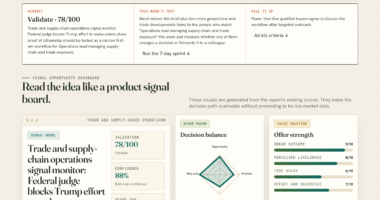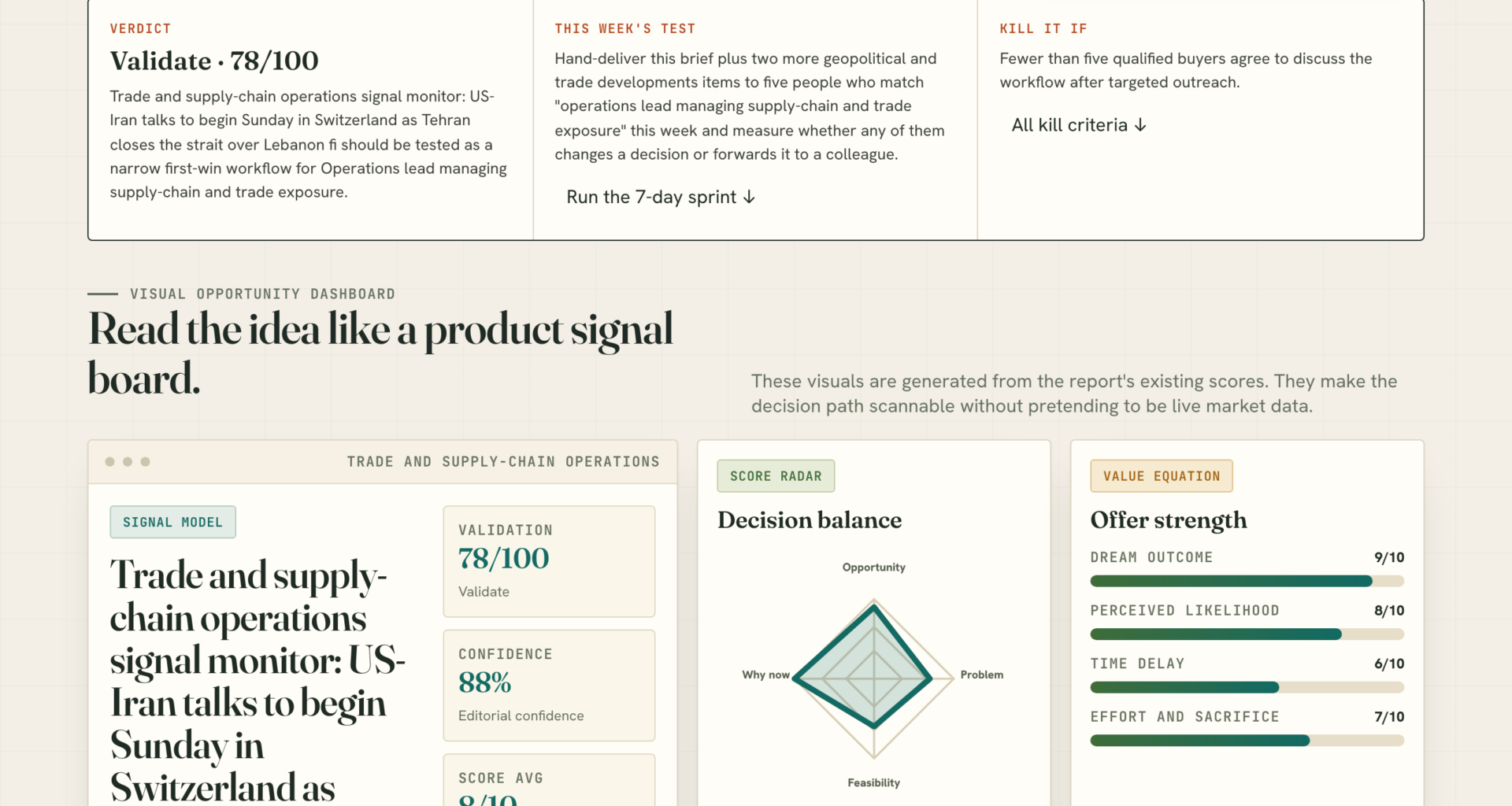

📊 Full opportunity report: Trade and supply-chain operations signal monitor: US-Iran talks to begin Sunday in Switzerland as Tehran closes the strait over Lebanon fi on IdeaNavigator AI — validation score, market gap, and execution plan.
TL;DR

U.S. and Iran are scheduled to begin talks in Switzerland on Sunday. Meanwhile, Tehran has closed the strait over Lebanon fighting, raising concerns about trade disruptions. The event is critical for supply-chain operations and geopolitical stability.
U.S. and Iranian officials are set to begin negotiations in Switzerland on Sunday, amid Iran’s decision to close the Strait of Hormuz over ongoing Lebanon conflicts, posing potential disruptions to global trade routes.
The upcoming talks between the United States and Iran are confirmed to start this Sunday in Switzerland, according to sources familiar with the schedule. Technology operations signal monitor. The negotiations come at a time when Iran has closed the Strait of Hormuz, a critical chokepoint for global oil and trade shipping, citing the Lebanese fighting as a reason. This closure has raised concerns among international trade and supply-chain operators about possible disruptions.
Trade and supply-chain monitoring tools have flagged this development as significant, especially for operations leads managing trade exposure and logistics. The closure of the strait could restrict maritime traffic, increase shipping costs, and delay deliveries, with ripple effects across various industries dependent on timely supply chains. The negotiations are viewed as a potential step toward easing tensions, but it remains uncertain whether the talks will lead to immediate de-escalation or changes in Iran’s maritime policies.
Implications for Global Trade and Supply Chains
This development underscores the fragility of global trade routes, especially in the Middle East, where geopolitical tensions can rapidly impact supply chains worldwide. The closure of the Strait of Hormuz, through which a significant portion of the world’s oil passes, could lead to increased costs and delays for companies relying on maritime shipping. The upcoming US-Iran talks could influence Iran’s future actions regarding the strait, making this a critical event for operations managers and policymakers concerned with trade security and stability.
The Management of Maritime Regulations (Routledge Studies in Transport Analysis)
As an affiliate, we earn on qualifying purchases.
As an affiliate, we earn on qualifying purchases.
Recent Escalations and Historical Tensions in the Region
Iran has periodically closed or threatened to close the Strait of Hormuz in response to regional conflicts or diplomatic disputes, notably over Lebanon and broader US-Iran tensions. The current situation follows recent fighting linked to Lebanese factions, which Iran claims justifies the closure. Historically, such closures have led to spikes in oil prices and supply chain disruptions, prompting heightened alert among global trade operators. The upcoming negotiations are part of ongoing diplomatic efforts to prevent escalation and reopen critical shipping lanes.
“The US and Iran are committed to engaging in constructive dialogue this Sunday, but outcomes remain uncertain given the regional tensions.”
— a diplomatic source familiar with the talks
supply chain disruption alert system
As an affiliate, we earn on qualifying purchases.
As an affiliate, we earn on qualifying purchases.
Unconfirmed Outcomes and Possible Escalations
It is not yet clear whether the upcoming talks will lead to a resolution that reopens the strait or result in further escalation. The precise impact on trade routes depends on Iran’s response post-negotiation and whether the US and its allies can influence Iran’s maritime policies. Ongoing regional conflicts and diplomatic tensions continue to add unpredictability to the situation.

2 Pack GPS Tracker for Vehicles Work with Find My (iOS Only) Real Time Mini Car Air Tracker Tag Devices Global Coverage Hidden Car Locator Tracking No Monthly Fee No Subscription No SIM Card Required
Left-Behind Reminder:Never forget your belongings. If the vehicles tracker disconnects from your Bluetooth, you’ll get an instant alert,…
As an affiliate, we earn on qualifying purchases.
As an affiliate, we earn on qualifying purchases.
Next Steps in Diplomacy and Trade Monitoring
Following the Sunday negotiations, analysts will closely monitor Iran’s subsequent actions regarding the strait and any shifts in regional tensions. Cybersecurity operations signal monitor. Trade and supply-chain operators should prepare for potential disruptions, including rerouting and increased costs. Further diplomatic developments or escalations could rapidly change the landscape, making real-time updates and role-specific alerts critical for decision-making.

WANJAO 100ML Engine Oil Dye Leak Detection Kit, Oil Leak Dye Accurately Locate Leaks Widely Compatible with Two Syringes for Use in Engine Oil Automatic Transmission Fluid Fuel Hydraulic Systems
Superior Fluorescence Performance: Formulated with a safe formula, the oil dye emits a bright yellow-green fluorescence under light…
As an affiliate, we earn on qualifying purchases.
As an affiliate, we earn on qualifying purchases.
Key Questions
What is the significance of the US-Iran talks starting this Sunday?
The talks could influence Iran’s decision to reopen or further close the Strait of Hormuz, directly affecting global trade routes and supply chains.
Why is Iran closing the strait over Lebanon fighting?
Iran claims the closure is a response to Lebanese conflicts and regional tensions, aiming to exert pressure or signal opposition to external influences.
How might this affect global trade and oil prices?
If the strait remains closed or further escalates, it could lead to higher shipping costs, delays, and spikes in oil prices due to restricted maritime access.
What are the chances the negotiations will succeed?
It is uncertain; while both sides are engaging in dialogue, regional tensions and differing interests make a quick resolution unlikely. Outcomes depend on post-negotiation actions.
What should supply-chain operators do now?
Operators should monitor developments closely, consider alternative routes, and prepare contingency plans for potential disruptions stemming from the geopolitical situation.
Source: IdeaNavigator AI