
📊 Full opportunity report: Before You Automate, Take A Closer Look At Your Workflow on IdeaNavigator AI — validation score, market gap, and execution plan.

Get the little things that make your day delivered free with Prime
- Fast, free delivery on millions of items
- Prime Video, Amazon Music and more included
- Member-only deals all year
TL;DR
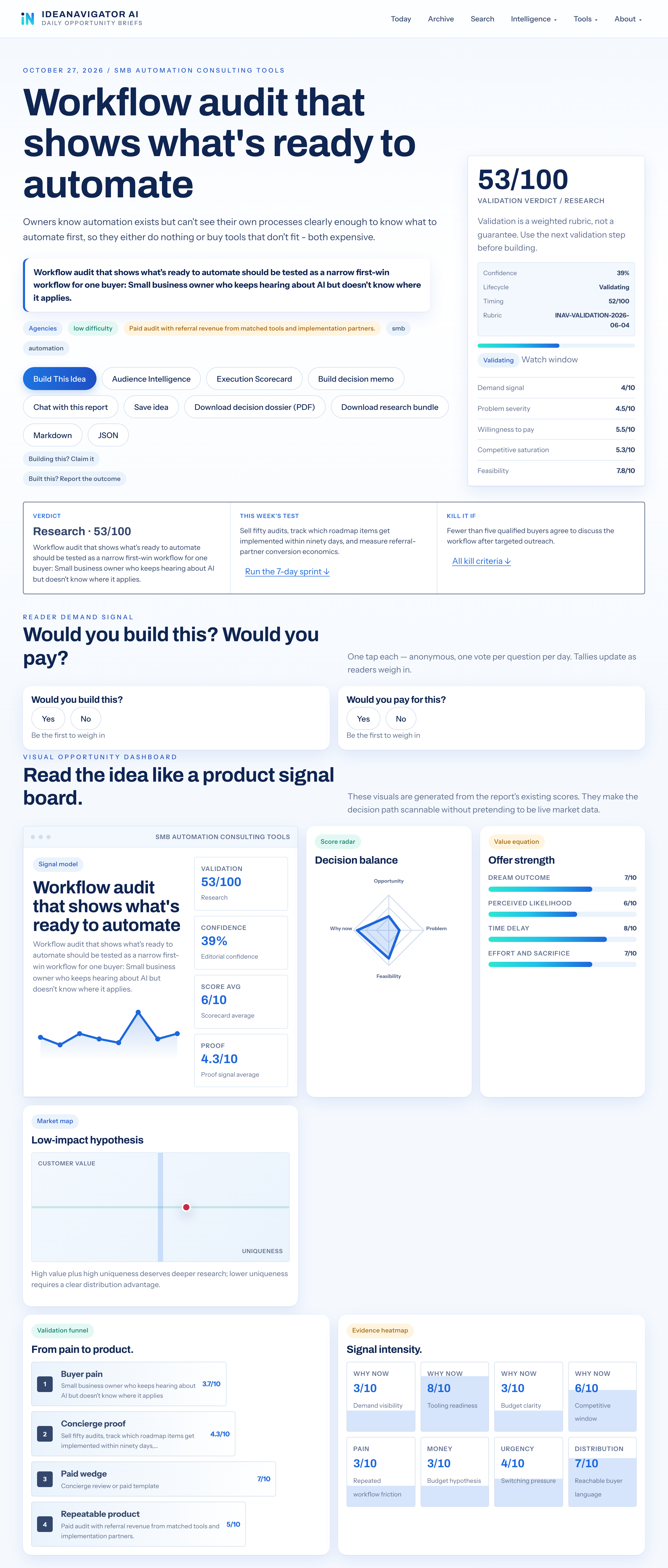
IdeaNavigator AI outlines a proposed workflow-audit service for small-business owners unsure where automation fits. Its suggested pilot would sell 50 audits, then track whether customers implement roadmap items within 90 days and whether referrals to tools and implementation partners convert.
IdeaNavigator AI has outlined a proposed workflow-audit service for small-business owners who are unsure which tasks are suitable for automation. The concept would interview an owner about business operations, rank processes by automation readiness, potential return and difficulty, then provide a sequenced 90-day roadmap with suggested tools.
The proposal targets owners who hear about artificial intelligence and automation but cannot readily see how those technologies apply to their own operations. That uncertainty can lead businesses either to put off automation or to buy tools that do not fit their processes, according to the idea description. The document characterizes both outcomes as costly, but provides no cost estimates or survey data.
The proposed minimum viable product is a guided operational interview. Its output would be a process map, a scoring of candidate tasks and a prioritized plan. Tool suggestions would be matched to each step, rather than offering an undifferentiated list of AI products. The proposal does not specify how the scoring would work or whether recommendations would be reviewed by a human consultant.
The business model would combine fees for the audit with referral revenue from recommended software providers and implementation partners. To test demand, the proposal recommends selling 50 audits and tracking which roadmap items customers put into practice within 90 days. It also calls for measuring referral-partner conversion economics; no pilot results, prices or partner agreements are reported.
A Practical Test of Automation Demand
The concept addresses a decision problem that can arise before a company selects any automation software: owners may not have a clear inventory of how work moves through the business. A structured audit could give them a way to compare candidate tasks by readiness, expected return and implementation difficulty, rather than choosing a tool first and searching for a use for it afterward.
For small firms, the proposed 90-day follow-up matters as much as the initial assessment. An audit that produces a polished roadmap would not, on its own, show that customers can carry out the recommendations or gain value from them. Tracking implementation could test whether the advice is practical. Referral conversion data could also reveal whether the service can support itself financially, though it would not by itself establish that a recommended tool improved a customer’s operations.
The idea also brings a potential tension: the provider could earn referral revenue when customers buy suggested products. That arrangement may give the service a commercial incentive beyond the audit fee. The proposal does not describe how recommendations would be selected, how referral relationships would be disclosed, or whether customers would receive options that do not generate referral income.
Products Worth Considering

Philips Hue Secure Wired Video Doorbell, 2K, Black

Dyson Ball Animal 3 Corded Upright Vacuum

Shark Navigator Lift-Away Upright Vacuum Cleaner, NV356E
As an affiliate, we earn on qualifying purchases.
Why Process Mapping Comes First
The proposal places the idea in the expanding market for small-business automation consulting tools. Its stated rationale is that the proliferation of AI tools has created decision paralysis for owners, while guided process-mapping interviews may now be automatable with large language models. This is the proposal’s explanation for why the service could be timely, not a reported measurement of business-owner behavior or a finding from a completed study.
The suggested product is narrower than a general AI assistant or a full operational overhaul. It focuses on one customer’s existing processes, then proposes a sequence of candidate changes over three months. That narrower scope could make the service easier to test, but the idea description does not specify an industry, business size, interview length, data requirements or the kinds of processes it would assess.
IdeaNavigator AI presents the concept as an opportunity to validate, not as an established product with demonstrated outcomes. Its proposed test is to obtain 50 paying customers and follow implementation for 90 days. The available description gives no evidence that those sales have taken place, or that the proposed service has produced measured savings.
Pilot Results and Advice Standards
No launch date, price or pilot findings are included in the proposal. It is unclear whether the service is being built, whether customers have already been interviewed, or whether any businesses have bought an audit. The 50-audit target is a suggested validation method, not a reported result.
The proposal also leaves open how the audit would calculate return on investment, assess difficulty and distinguish automation-ready tasks from work that requires human judgment. It does not explain how the service would handle sensitive business information, check the accuracy of AI-generated process maps, or update recommendations when tools and prices change. Nor does it state how referral relationships would be disclosed or how the provider would avoid favoring partner products.
Those details affect whether customers could rely on the roadmap and compare recommendations fairly. Until a pilot is reported, the service’s customer demand, implementation rate and referral economics remain unverified.
The Proposed 90-Day Validation
The next test outlined is to sell 50 audits, then record which recommended roadmap items customers implement within 90 days. The service would also measure whether referrals to matched tools and implementation partners lead to business, providing an early test of its revenue model.
For that test to establish more than interest in the audit, results would need to distinguish between a customer purchasing the assessment and acting on its recommendations. Useful reporting could include how many customers complete at least one suggested change, what kinds of processes are selected, and whether the change produces measurable results. The proposal does not set out these additional measures or say when results would be available.
For now, the development is a product concept and validation plan. Whether it becomes a paid service, what safeguards or review process it might use, and whether small businesses would follow the resulting roadmaps are all still open.
Source: IdeaNavigator AI
Key Questions
What is the proposed workflow audit?
It is a proposed service that would interview a small-business owner about operations, map processes and rank possible automation projects by readiness, potential return and difficulty.
Is the audit service already available?
The proposal does not say that the service has launched or provide a launch date. It describes a product concept and a plan to test demand.
How would the service make money?
The proposed model combines paid audits with referral revenue from recommended software tools and implementation partners. Pricing and referral arrangements are not specified.
How would the idea be tested?
The proposal recommends selling 50 audits, then tracking which roadmap items customers implement within 90 days and measuring referral-partner conversion. No results have been reported.
What remains unknown about the recommendations?
The proposal does not explain the scoring method, how results would be checked, or how referral incentives would be disclosed and kept from biasing tool suggestions.
Source: IdeaNavigator AI