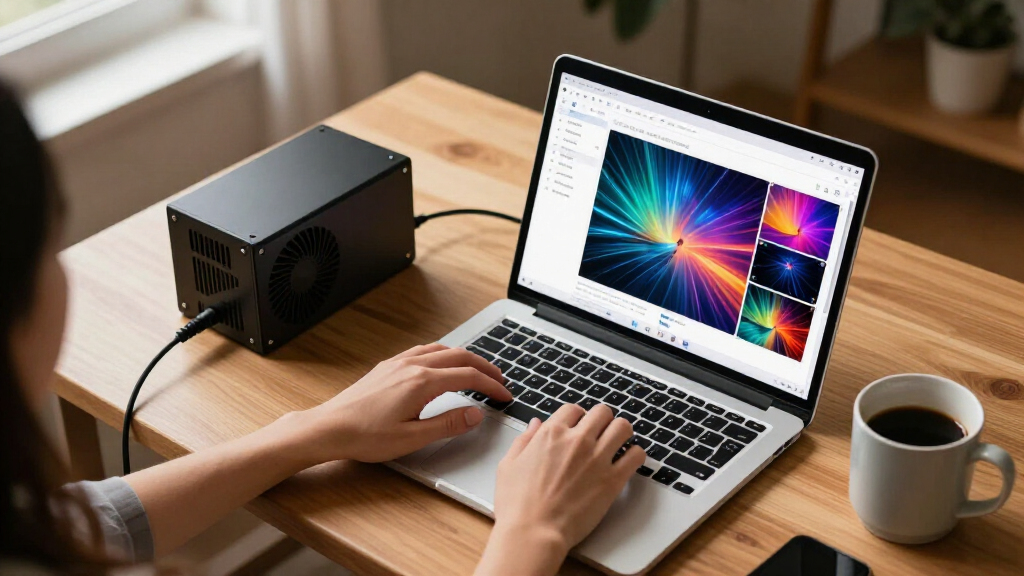

🔍 Read the full analysis: How The 9 Best External GPUs For 2027 May Support AI Work on ThorstenMeyerAI.com

Get the little things that make your day delivered free with Prime
- Fast, free delivery on millions of items
- Prime Video, Amazon Music and more included
- Member-only deals all year
TL;DR
ThorstenMeyerAI.com’s 2027 guide compares nine external GPU options for potential AI and other graphics workloads, including empty enclosures and integrated units. It names the Razer Core X V2 as its general recommendation and Plugable’s Thunderbolt 5 enclosure for throughput, but the supplied material does not provide a complete list of nine products or independent benchmark results.
ThorstenMeyerAI.com has published a 2027 guide to nine external GPU options, weighing connection bandwidth, cooling, power needs and portability for users considering workloads such as AI computing. The guide recommends the Razer Core X V2 for most users and points to Plugable’s Thunderbolt 5 enclosure for higher throughput, but the source material provided does not name all nine picks or include comparative performance tests.
The guide’s central tradeoff is between convenient connections and the bandwidth available to an external graphics card. It says Thunderbolt 5 and USB4 V2 offer up to 80Gbps, compared with 40Gbps for Thunderbolt 3 and 4. OCuLink is described as offering a native PCIe 4.0 x4 link, with lower latency in the guide’s account, but it requires a compatible computer port. For related recommendations, see top external GPUs for AI and machine learning.
The list is said to cover both empty enclosures, where buyers supply a graphics card and sometimes a power supply, and integrated eGPU units with a fixed GPU. The source names NIMO and BOSGAME as examples of integrated products and cites an RX 7600M XT as an example of a fixed configuration. It does not identify the exact models for every pick.
According to the guide, its comparison considers bandwidth, compatibility and thermal design. It warns that power supplies can add weight and cost, and that compact enclosures may face heat buildup during sustained use. Those are selection criteria and general product considerations; the supplied material does not include test methods, measured temperatures, noise figures or workload benchmarks to verify how individual products perform.
The 9 picks
- 1
 BOSGAME eGPU Graphic Card Dock Expansion Card with Radeon RX 7600M XT 8GB GDD…View on Amazon →
 - 2
 NIMO External GPU Docking Station with AMD Radeon RX 7600M XT 8GB GDDR6View on Amazon →
 - 3
 Plugable Thunderbolt 5 AI eGPU Enclosure & Dock: 80Gbps, TAA CompliantView on Amazon →
 - 4
 Razer Core X V2 External Graphics Enclosure (eGPU)View on Amazon →
 - 5
 MINISFORUM DEG2 USB4 V2 (TBT5 Compatible) & OCuLink eGPU Dock, 80Gbps Dual-Li…View on Amazon →
 - 6
 MINISFORUM DEG1 eGPU Dock – External GPU Docking Station for RTX 4090 & AMD R…View on Amazon →
 - 7
 OwlTree Graphics Card eGPU Dock for Thunderbolt 3/4 USB 4, with 60cm CableView on Amazon →
 - 8
 OCuLink eGPU Dock – PCIe 4.0 x4 (64 Gbps) ATX External GPU EnclosureView on Amazon →
 - 9
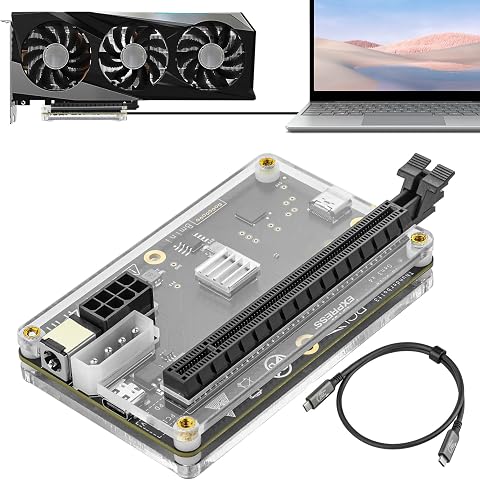 PCIe 3.0 x16 22Gbps eGPU Dock with Thunderbolt 4 Cable (compatible NVIDIA/AMD…View on Amazon →
Bandwidth Shapes AI Workloads
External GPUs can give some laptop and desktop users access to graphics hardware without installing a card inside the computer. For AI development and inference, a capable GPU may help with software that supports GPU acceleration, but the connection between the host and enclosure can limit throughput. The guide’s focus on newer interfaces reflects that concern, particularly for buyers looking at higher-end cards.
The choice is not simply a matter of selecting the fastest interface. Computer compatibility, GPU memory, software support and sustained cooling also affect whether a setup suits a given AI task. An integrated unit may be easier to transport and set up, while an empty enclosure offers a path to replace the graphics card. The guide does not establish that any option is suitable for a particular AI model or delivers a given speed improvement.
How the Connection Tradeoffs Work
An eGPU places a graphics card outside the computer and connects it over a supported interface. That arrangement can add graphics capability to a compatible system, but external connections are not identical to installing a card directly into a desktop’s PCIe slot. The guide describes Thunderbolt 3 and 4 as 40Gbps connections and Thunderbolt 5 and USB4 V2 as 80Gbps; these are interface bandwidth figures, not measured application performance.
OCuLink uses a different connection approach and is presented by the guide as an option for users whose computers include the required port. Because the source does not provide a full compatibility table, readers would need to check their specific computer, operating system, drivers and enclosure requirements before buying. The guide also distinguishes fixed-GPU systems from enclosures that let owners select or replace a card.
“The Razer Core X V2 is the top recommendation for most users.”
— ThorstenMeyerAI.com guide
Missing Models and Test Results
The source material supplied for this article does not include the complete names or specifications of all nine products, despite the guide’s title. It also does not provide prices, publication date, benchmark results, measured cooling performance or a full list of supported computers. That leaves readers unable to compare the nine picks directly from the information available here.
Claims about reliability, compatibility, reduced bottlenecks and future-proofing should be treated as the guide’s judgments rather than confirmed outcomes. The effect on an AI workload will depend on the specific GPU, software, model, memory needs and host system. The source does not specify which AI tasks were tested, if any, or quantify performance against an internal GPU or a desktop installation.
Check the Full Product Listings
Readers considering an eGPU should consult the complete guide for the remaining product names, current specifications and pricing, then verify compatibility with the computer and software they plan to use. Before purchase, they should check the required cable and port, power delivery to the laptop, GPU and operating-system support, enclosure dimensions and cooling arrangements.
No follow-up testing or product launch is identified in the supplied source. Until fuller product data or independent benchmarks are available, the guide is best read as a shortlist and buying framework rather than evidence that one of the nine options will deliver a particular AI performance gain.
Key Questions
Which eGPU does the guide recommend for most users?
ThorstenMeyerAI.com names the Razer Core X V2 as its general recommendation. The supplied material does not include test results supporting the guide’s reliability assessment.
Which option does the guide associate with higher throughput?
The guide highlights Plugable’s Thunderbolt 5 AI eGPU Enclosure for users seeking throughput. It gives no comparative benchmark figures, so the claim cannot be translated into a specific performance gain.
Are all nine products identified in the available source?
No. The source material names the Razer and Plugable enclosures and mentions NIMO and BOSGAME as integrated-unit examples, but it does not provide a complete list of nine specific models.
Will an external GPU speed up every AI task?
Not necessarily. Results depend on the task, GPU, memory, software support and connection to the computer. The guide provides no AI workload benchmarks establishing a speed increase for any named product.
What should buyers check before choosing an eGPU?
Confirm the computer has a compatible Thunderbolt, USB4 or OCuLink port, and check GPU support, power requirements, charging capability, enclosure size and cooling. Integrated units have a fixed GPU; empty enclosures offer more upgrade flexibility but may require a separate card and power supply.
Source: ThorstenMeyerAI.com
NFL season / tailgating Picks
team gear
As an affiliate, we earn on qualifying purchases.