
📊 Full opportunity report: One-Time Voice Commands For Seamless Desktop Task Automation on IdeaNavigator AI — validation score, market gap, and execution plan.

Get the little things that make your day delivered free with Prime
- Fast, free delivery on millions of items
- Prime Video, Amazon Music and more included
- Member-only deals all year
TL;DR
A new desktop automation feature allows users to record workflows once and activate them with a single voice command. Currently in beta testing, it aims to reduce repetitive tasks for power users through generalizable, voice-activated automation.
A new desktop automation system is entering beta testing, enabling users to record complex workflows once and activate them through simple voice commands. This development aims to address the long-standing challenge faced by power users who spend hours on repetitive desktop chores, offering a more intuitive and efficient way to automate tasks without scripting or brittle hotkey setups.
The system works by allowing users to perform a workflow—such as renaming files, resizing images, or transferring data—once while the software records each step. Later, a spoken command triggers the entire sequence, which replays with each step visible on the screen. If a step appears risky or uncertain, the system pauses for user approval, providing an opportunity to intervene or rollback to the last safe checkpoint.
This approach leverages recent advances in screen-understanding models, which can generalize from a single demonstration to handle similar workflows. The technology promises to make automation more accessible by removing the need for complex scripting or configuring hotkeys, which often create friction and discourage adoption among non-technical users.
Developers plan to launch a beta version that handles five common workflow archetypes, including batch renaming or resizing files, report reformatting, and data transfer between applications. The initial target market is prosumer users and teams, with a subscription model offering shared workflow libraries to enhance collaboration. Validation will depend on weekly retention metrics among approximately 200 power users during the beta phase.
Potential Impact on Desktop Productivity
This new system could significantly reduce the time spent on repetitive desktop tasks, especially for professionals who perform similar workflows regularly. By simplifying automation to a single spoken command, it lowers the barrier for non-technical users and could lead to broader adoption of automation tools in everyday workflows. If successful, it may shift the landscape of desktop productivity software, emphasizing intuitive, voice-driven automation over traditional scripting and hotkey solutions. The approach also hints at future integrations with voice assistants and AI-driven workflow generalization, potentially transforming how users interact with their computers daily.
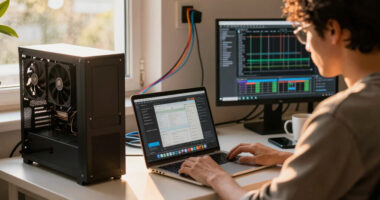
voice-activated desktop automation software
As an affiliate, we earn on qualifying purchases.
As an affiliate, we earn on qualifying purchases.
Advances in Screen-Understanding and Automation
Recent developments in screen-understanding AI models have made it possible for software to interpret and generalize from a single demonstration of a workflow. Historically, automation required scripting knowledge or brittle hotkey configurations, which created friction and limited adoption among non-technical users. The current trend toward AI-powered generalization enables systems to learn and reproduce workflows with minimal user input, making automation more accessible and flexible.
Previous efforts in desktop automation often relied on predefined macros or complex scripting, which hindered widespread use. The new approach, as announced by IdeaNavigator AI, aims to bridge that gap by offering a simple, voice-activated interface that learns from a single run, reducing setup time and frustration. This development aligns with broader trends in AI and user experience design, emphasizing natural language interaction and autonomous task handling.
The beta testing phase will focus on validating the system’s ability to handle common workflows reliably, with early feedback guiding further refinement and feature expansion.
Unanswered Questions About Reliability and Adoption
It is not yet clear how well the system will perform across diverse workflows or how accurately it can generalize from a single demonstration in real-world scenarios. The reliability of step recognition, handling of complex or variable workflows, and user acceptance remain to be tested during the beta. Additionally, the extent to which non-technical users will adopt voice commands for automation is still uncertain, as is the system’s ability to integrate smoothly with existing productivity tools.
Next Steps for Beta Testing and Market Validation
The company plans to release the beta to around 200 power users, focusing on five common workflow types. During this phase, developers will monitor weekly retention, gather user feedback, and refine the voice command interface. Success metrics include ease of use, reliability, and the frequency of workflow replays triggered by voice. Following beta validation, a broader rollout and feature expansion are expected, potentially integrating with popular productivity suites and voice assistants.
Key Questions
How does the system record workflows?
The user performs a workflow once, with the system recording each click, drag, and data transfer step. This recording then becomes a template that can be triggered later by a voice command.
Can the workflow be edited after recording?
Details are still emerging, but the initial system emphasizes replaying the recorded steps with options to approve, intervene, or rollback at risky points. Editing capabilities are likely to be part of future updates.
What types of workflows will be supported in the beta?
The beta will focus on five archetypes, including batch renaming/resizing, report reformatting, and data transfer between applications.
Will this system work with all desktop applications?
It is designed to work with common workflows across multiple applications, but compatibility details are still being finalized. Effectiveness may vary depending on application complexity.
When will the full release be available?
A full release timeline has not been announced, but if beta testing is successful, wider availability could follow within the next year.
Source: IdeaNavigator AI
Halloween Picks
halloween
As an affiliate, we earn on qualifying purchases.