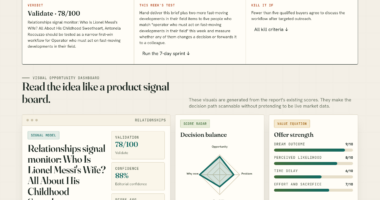

📊 Full opportunity report: Single Digits: The April That Closed the Open-Weight Gap on ThorstenMeyerAI.com — validation score, market gap, and execution plan.
TL;DR
Multiple open-weight AI models released in April 2026 have reduced the performance gap with proprietary models to single digits on key benchmarks. This shift impacts enterprise AI economics and strategic choices.
In April 2026, the performance gap between open-weight and proprietary AI models on key benchmarks has narrowed to a single digit, marking a major shift in the AI industry.
This development challenges the dominance of closed models and could reshape enterprise AI spending and strategy.
Over the past month, six labs released significant open-weight models, including DeepSeek V4-Pro, Qwen 3.6-35B-A3B, Llama 4, Gemma 4, Mistral Small 4, and Zhipu AI’s GLM-5.1. The benchmark gap, which previously favored proprietary models with a margin of several points, has now been reduced to single digits across multiple evaluation categories such as reasoning, coding, retrieval, multimodal tasks, and tool use.
For example, in reasoning tasks like GSM8K, the best open-weight model scored 92.4, just 2.7 points below the closed frontier’s 95.1. Similarly, in code evaluation, the gap shrank from over 3.6 points to 3 points or less. These results suggest open models are now competitive enough for many enterprise applications, undermining the previous premium on proprietary API access.
This shift is driven by advances in distillation techniques, access to open base weights, and engineering discipline, enabling open models to approach the capabilities of models built by labs with thousands of PhDs.
Impact on Enterprise AI Economics and Strategy
The narrowing of the performance gap means enterprises can now consider open-weight models as viable alternatives to costly proprietary APIs, potentially reducing AI operational costs significantly.
With inference costs dropping below API prices, organizations might shift from API subscriptions to self-hosted solutions, altering the traditional AI vendor landscape.
Additionally, model selection will become a portfolio decision, balancing open and closed options based on use case, licensing, and sovereignty considerations. This could lead to a redefinition of competitive advantage in AI deployment.

Personal AI Servers: A Guide to Building Private AI Infrastructure for Secure, Offline and Self-Hosted Local LLMs for Data Privacy
As an affiliate, we earn on qualifying purchases.
As an affiliate, we earn on qualifying purchases.
Recent Trends in Open-Weight Model Development
Throughout early 2026, multiple labs released advanced open-weight models, including Meta’s Llama 4, Google’s Gemma 4, and Zhipu AI’s GLM-5. These releases followed a pattern of rapid innovation across the industry, with benchmarks showing a consistent closing of the performance gap.
Historically, proprietary models held a significant advantage due to access to larger datasets, specialized training, and engineering resources. However, recent advances in distillation, open base weights, and engineering discipline have enabled open models to close this advantage.
This trend was predicted in early 2026, but the speed of convergence in April exceeded expectations, with the benchmark gap shrinking from around 5-6 points to less than 3 in many categories within weeks.
“The recent releases demonstrate that distillation and engineering discipline can now scale to the frontier, making open models competitive at the highest levels.”
— Industry expert
Remaining Uncertainties About Long-Term Impact
It is still unclear how closed labs will respond in the coming months. Predictions suggest they will raise the bar with new models, but the pace and nature of these improvements remain uncertain. Additionally, the impact on licensing, regulation, and enterprise adoption patterns is still evolving and may influence the broader industry trajectory.
Next Steps for Industry and Enterprises
Expect closed labs to introduce more advanced models in summer 2026, potentially re-establishing some performance gaps. Meanwhile, enterprises should evaluate open-weight models for cost savings and flexibility, possibly running pilot programs to test their capabilities. Regulatory developments around open training and inference are also likely to influence future adoption.
Organizations that rely heavily on AI should consider diversifying their model portfolio, balancing open and closed options based on use case, licensing, and sovereignty considerations.
Key Questions
How significant is the performance gap now between open and closed models?
The gap has narrowed to single digits across key benchmarks, making open models increasingly viable for enterprise use.
Will proprietary models still have an advantage?
While the gap is closing, closed models may re-establish a lead with future model releases, especially if they incorporate new capabilities or longer context windows.
What does this mean for AI costs in enterprises?
Inference costs for open models are now often lower than API prices, potentially enabling cost savings and self-hosted deployment at scale.
Are there licensing or sovereignty concerns with open models?
Yes, licensing varies, with some open models like Mistral Small 4 under permissive licenses, while others like Llama 4 have restrictions. Sovereignty and licensing will influence enterprise adoption decisions.
Source: ThorstenMeyerAI.com