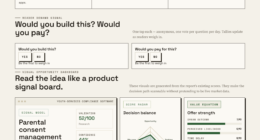
📊 Full opportunity report: Keep Your TRT Lab Results And Symptoms In One Place on IdeaNavigator AI — validation score, market gap, and execution plan.

Get the little things that make your day delivered free — and shop member deals
- Fast, free delivery on millions of items
- Access to Prime Big Deal Days deals on October 6–7
- Prime Video, Amazon Music and more included
TL;DR

IdeaNavigator AI has outlined a product concept for a lab and symptom tracker aimed at men on testosterone replacement therapy. The proposal calls for importing lab PDFs, charting hormone panels against dose changes and daily symptom check-ins, and validating demand with 300 TRT users over eight weeks.
A new product analysis from IdeaNavigator AI proposes a lab and symptom tracker for men on testosterone replacement therapy (TRT), arguing that a simple app connecting lab values to dose changes and daily symptoms could solve a real gap for a growing population of self-managing patients. The concept exists only as a proposal: no product has been built, launched, or validated, and the analysis itself recommends testing demand before committing to development.
According to the analysis, the core problem is fragmentation. TRT patients juggle periodic labs, dose adjustments, and symptom fluctuations across clinic portals, downloaded PDFs, and memory. The analysis states that because no tool connects how patients feel to what their hormone levels were, protocol changes effectively happen “on vibes” — decisions made without a structured record linking symptoms to measurable values.
The proposed minimum viable product (MVP) has four functions: import lab PDFs; chart hormone panels over time against dose changes and daily symptom check-ins; generate trend summaries for clinic visits; and flag values drifting outside target ranges. Revenue would come from a consumer subscription, with an additional clinic-partnership tier offering patient-monitoring dashboards for providers.
The proposed validation plan is specific: recruit 300 TRT users from hormone-therapy communities and measure two metrics over eight weeks — lab-import rates and weekly check-in retention. The analysis frames the tracker as a deliberately narrow “first-win workflow” for a single buyer: a man on TRT managing his own labs and dosing.
Why Fragmented TRT Care Creates an Opening
The analysis argues the timing is driven by a structural shift: TRT prescriptions and telehealth clinics have surged, creating a large population of men who manage their own therapy but whose care is, in the analysis’s words, “fragmented across providers by design.” Men who switch clinics, use telehealth providers, or supplement clinic care with their own lab work often have no single record of how their protocol has changed over time.
If the concept works, the practical benefit is concrete: a patient could walk into a clinic visit with a chart showing how his total testosterone, estradiol, hematocrit, or other panel values moved relative to dose changes and how he felt week to week — rather than reconstructing history from memory and scattered PDFs. For clinics, a monitoring dashboard could surface out-of-range values across patients between appointments.
The commercial logic is that TRT is an ongoing, data-heavy therapy with recurring lab work, which fits a subscription model better than one-off health tools. That framing is the analysis’s own interpretation, not a demonstrated result.
Men’s Health Apps and the Self-Tracking Trend
: “The proposal sits within the broader men’s health and hormone therapy app market, a category that has grown alongside direct-to-consumer telehealth. As more men obtain TRT through online clinics rather than a single long-term physician, the traditional model of one clinic holding all records has weakened.
The analysis positions the tracker as a “narrow first-win workflow” — a deliberately small product for one well-defined buyer, rather than a broad health platform. This build-small approach reflects a common validation philosophy: prove that one specific population will import data and return weekly before expanding scope.
What the TRT Tracker Proposal Hasn’t Proven
Nothing in the concept has been tested. Key open questions include: whether TRT patients will reliably import lab PDFs, given the friction of manual uploads; whether weekly symptom check-ins retain users past the initial novelty period; and whether patients or clinics will pay. The eight-week, 300-user validation study is proposed, not completed, so no lab-import or retention figures exist.
The analysis does not address several practical constraints: how the app would handle medical privacy and data protection obligations for lab results, whether flagging out-of-range values constitutes regulated medical advice, or how PDF parsing would handle the varied formats used by different laboratory providers. No developer, company, or launch date is associated with the concept.
The Eight-Week Validation Test
Under the proposed plan, the immediate next step is recruiting 300 TRT users from hormone-therapy communities and running the tracker for eight weeks, tracking lab-import rates and weekly check-in retention as the two success metrics. If those metrics hold, the analysis implies the consumer subscription and clinic-partnership tiers would follow.
Anyone considering building the concept would need to resolve the unanswered compliance and privacy questions first, since lab results are sensitive health data. Until a validation study is actually run, the tracker remains an untested idea rather than a product.
Source: IdeaNavigator AI
Key Questions
Does a TRT lab and symptom tracker app currently exist?
No product based on this concept has been built or launched. What exists is a product analysis from IdeaNavigator AI describing the problem, a proposed MVP, and a validation plan.
What would the tracker actually do for a TRT patient?
According to the proposal, it would import lab PDFs, chart hormone panel values over time against dose changes and daily symptom check-ins, generate trend summaries to bring to clinic visits, and flag values drifting outside target ranges.
How would the app be validated?
The proposed plan is to recruit 300 TRT users from hormone-therapy communities and measure two metrics over eight weeks: how often users import lab results and how many retain weekly symptom check-ins.
How would the tracker make money?
The proposal outlines a consumer subscription for individual users and a clinic-partnership tier that would give providers patient-monitoring dashboards. No pricing has been set.
Why is this relevant now?
The analysis points to a surge in TRT prescriptions and telehealth clinics, which has created many men managing their own therapy across multiple providers without a unified record of labs, doses, and symptoms.
Source: IdeaNavigator AI
NFL season / tailgating Picks
team gear
As an affiliate, we earn on qualifying purchases.