
TL;DR

Get the little things that make your day delivered free — and shop member deals
- Fast, free delivery on millions of items
- Access to Prime Big Deal Days deals on October 6–7
- Prime Video, Amazon Music and more included
In 2026, AI technology is transforming studio microphones, with top models like RØDE NT1 Signature Series leading the market. These microphones combine low self-noise, AI-driven features, and durability, offering improved sound for professionals and enthusiasts alike.
In 2026, leading microphone manufacturers are integrating artificial intelligence (AI) into studio condenser microphones, revolutionizing professional audio recording, as detailed in the original analysis. The top models now feature AI-driven noise reduction, adaptive sound shaping, and intelligent connectivity, making high-quality recording more accessible and efficient for both professionals and hobbyists. For more on microphone options, see our recommended list.
According to industry sources, the RØDE NT1 Signature Series remains the top choice for overall performance, praised for its low self-noise and warm sound profile, now enhanced with AI-based noise filtering. The Audio-Technica AT2035 continues to stand out for its versatility and includes AI-powered auto-tuning features that optimize sound quality based on environment and voice characteristics. Meanwhile, the Shure SM4 is favored for its durability and its new AI-assisted vocal clarity enhancements, ideal for demanding studio setups.
Manufacturers emphasize that AI integration allows microphones to adapt dynamically to recording conditions, reducing background noise, and improving clarity without extensive manual adjustments. Learn more about the latest microphone technology in this comprehensive review. These advancements are expected to influence both professional studios and home recording setups, providing smarter, more reliable tools for creators.
The 8 picks
- 1
 Shure SM4 XLR Studio Condenser Microphone Kit for RecordingView on Amazon →
 - 2
 Audio-Technica AT2035 Cardioid Condenser Microphone with Shock Mount and Acce…View on Amazon →
 - 3
 RØDE NT1 Signature Series Large-Diaphragm Condenser Microphone with Shock Mou…View on Amazon →
 - 4
 Audio-Technica AT2020 Cardioid Condenser Studio XLR MicrophoneView on Amazon →
 - 5
 AKG Pro Audio P120 Condenser MicrophoneView on Amazon →
 - 6
 MAONO A04 Gen2 XLR/USB Condenser Microphone Kit for PC and Content CreationView on Amazon →
 - 7
 Mackie EM-Series Large-Diaphragm Condenser Microphone (EM-91C)View on Amazon →
 - 8
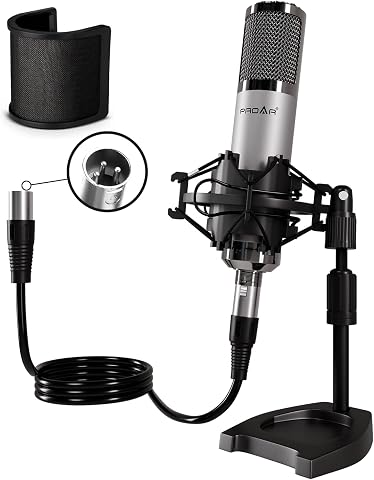 XLR Condenser Microphone with Desktop Stand for Vocals and PodcastingView on Amazon →
Impact of AI-Integrated Microphones on Recording Quality
The incorporation of AI technology into studio microphones marks a significant step forward in audio recording. It allows for real-time noise suppression, adaptive equalization, and improved clarity, reducing the need for post-production editing. This shift enhances productivity and sound fidelity, especially for remote recording, podcasts, and music production. As a result, both professionals and amateurs can achieve broadcast-quality results more easily, potentially lowering barriers to high-quality audio creation.
Evolution of Microphone Technology and AI Adoption
Over the past decade, studio microphones have evolved from basic analog devices to sophisticated digital tools. The recent integration of AI features reflects a broader trend of smart audio equipment, driven by advances in machine learning and digital signal processing. Leading brands have started incorporating AI to enhance noise reduction, auto-tuning, and environment adaptation, with 2026 seeing a surge in models that combine traditional quality with intelligent features. This development builds on previous improvements in self-noise reduction and connectivity, making AI a key differentiator in the market.
Unconfirmed Aspects of AI Microphone Adoption
While AI integration into studio microphones is gaining traction, it is not yet clear how widespread adoption will become across different market segments. Specific details about the long-term durability of AI features, compatibility with existing recording setups, and potential limitations in varied acoustic environments remain under discussion. Additionally, some professionals question whether AI can fully replace manual adjustments in complex recording scenarios.
Upcoming Developments and Market Trends for 2026
Manufacturers are expected to release new AI-enhanced microphone models throughout 2026, with improvements in noise reduction algorithms and user interface design. Industry analysts predict increased integration of AI in other audio equipment, such as audio interfaces and mixers, creating a more interconnected, intelligent recording ecosystem. Further, user feedback from early adopters will shape future iterations, potentially leading to standard features in mid-range and professional microphones by year’s end.
Key Questions
Are AI features in microphones essential for professional recording?
While not essential, AI features significantly improve noise reduction and sound clarity, making high-quality recordings easier and more consistent, especially in challenging environments.
Will AI integration increase microphone prices?
Typically, AI-enhanced microphones are priced higher due to advanced technology, but the benefits may justify the cost for many users, especially professionals seeking optimal sound quality.
Can AI features be disabled or customized?
Most current AI-equipped microphones offer user controls to adjust or disable certain features, allowing customization based on specific recording needs.
Will AI replace manual sound tuning entirely?
AI aims to assist rather than replace manual adjustments; experienced engineers may still prefer manual control for complex or creative recording scenarios.
What should beginners consider when choosing an AI-enabled microphone?
Beginners should consider compatibility with their existing setup, ease of use, and whether AI features align with their recording goals, balancing cost and functionality.
Source: ThorstenMeyerAI.com
NFL season / tailgating Picks
team gear
As an affiliate, we earn on qualifying purchases.