

TL;DR

Get the little things that make your day delivered free with Prime
- Fast, free delivery on millions of items
- Prime Video, Amazon Music and more included
- Member-only deals all year
This article examines whether the latest portable SSDs, including Samsung T9 and SanDisk Extreme PRO, can improve AI project workflows in 2026. It discusses confirmed features, potential benefits, and remaining uncertainties.
Recent releases of high-performance portable SSDs, such as the Samsung T9 2TB and SanDisk Extreme PRO 1TB, suggest these drives could significantly impact AI project workflows in 2026, as detailed in the original analysis. These drives offer high transfer speeds, large capacities, and rugged features, making them attractive tools for AI developers and researchers who handle large datasets and models. The question now is whether these hardware improvements will translate into tangible productivity gains for AI projects this year, highlighting the importance of choosing the right storage solutions.
The Samsung T9 2TB is highlighted for its balanced combination of fast transfer speeds, large capacity, and thermal management, making it suitable for frequent large data transfers typical in AI workflows. The SanDisk Extreme PRO 1TB offers premium speed and ruggedness, with an IP65 rating for environmental protection, appealing to field researchers and mobile AI developers. Meanwhile, the Samsung T7 1TB remains a popular choice for everyday backups and moderate data handling, thanks to its compatibility with more devices via a 10Gbps interface.
Experts like Thorsten Meyer note that while these drives are capable of peak speeds near 2,000MB/s, actual performance depends heavily on the host device’s connection—particularly whether it supports 20Gbps interfaces like Thunderbolt 3/4 or USB 3.2 Gen 2×2. The drives’ capacities, physical durability, and compatibility are crucial considerations for AI professionals managing large datasets across different hardware setups, which can be explored further in dedicated reviews of portable SSDs.
The 9 picks
- 1
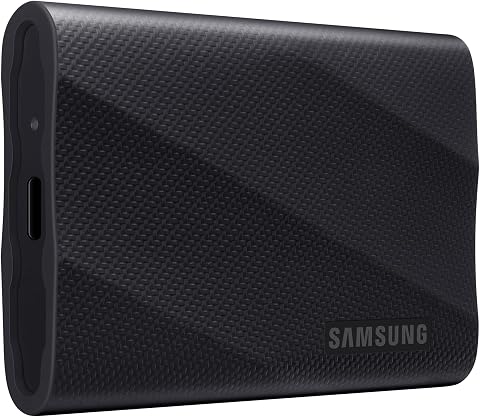 Samsung T9 Portable SSD 2TB USB 3.2 Gen 2×2 External Solid State DriveView on Amazon →
 - 2
 Crucial X10 2TB Portable SSD, Up to 2,100MB/s, USB-C, External Solid State Dr…View on Amazon →
 - 3
 SanDisk 2TB Extreme Portable SSDView on Amazon →
 - 4Samsung T9 Portable SSD 1TB USB 3.2 Gen 2×2 External Solid State DriveView on Amazon →
- 5
 SanDisk 1TB Extreme Portable SSDView on Amazon →
 - 6
 Samsung T7 Portable SSD 1TB External Solid State DriveView on Amazon →
 - 7
 SanDisk 1TB Extreme PRO Portable SSD – Up to 2000MB/s – USB-C, IP65 Water and…View on Amazon →
 - 8SanDisk 1TB Extreme Portable SSD – USB-C, Up to 1050MB/s, IP65 Water & Dust R…View on Amazon →
- 9
 SSK Portable SSD 500GB External Solid State Drive USB C SSD External Hard DriveView on Amazon →
Why These SSDs Matter for AI in 2026
High-performance portable SSDs could streamline data management for AI projects, reducing transfer times and enabling more efficient workflows. For AI researchers working with large models or datasets, faster and more reliable storage means less downtime and more focus on development. Rugged features and increased capacities also support fieldwork and mobile computing, expanding the environments where AI development can occur. However, whether these hardware improvements will lead to measurable productivity gains remains to be seen, especially given the variability in host device support and actual transfer conditions.
Recent Trends in Portable SSD Technology and AI Workflows
Over the past few years, portable SSDs have evolved from simple storage devices to critical tools for data-intensive tasks. The introduction of drives like Samsung’s T9 and SanDisk’s Extreme PRO reflects a push toward higher transfer speeds, larger capacities, and rugged designs suitable for diverse environments. Meanwhile, AI workflows increasingly demand fast, reliable storage to handle large datasets, complex models, and frequent backups. The convergence of these trends suggests that the latest SSDs could play a vital role in shaping AI development in 2026, provided their capabilities align with the hardware and workflows of users.
It is still early to determine how widespread adoption will be, as many AI professionals rely on internal storage or networked solutions. Compatibility issues and real-world performance under different conditions are ongoing considerations.
“While these drives are capable of peak speeds near 2,000MB/s, actual performance depends heavily on the host device’s connection—particularly whether it supports 20Gbps interfaces like Thunderbolt 3/4 or USB 3.2 Gen 2×2.”
— Thorsten Meyer
Unresolved Questions About SSD Performance and Compatibility
It remains unclear how many AI professionals will have hardware capable of supporting the maximum speeds of these new drives, particularly the 20Gbps interfaces. Compatibility issues across different devices and operating systems could limit performance gains. Additionally, the real-world benefits for AI workflows—such as reduced transfer times and improved data handling—are still to be quantified through user testing and industry adoption in 2026.
Future Developments and Industry Adoption Expectations
In the coming months, hardware manufacturers and AI developers are expected to conduct real-world testing of these SSDs to assess their impact on AI workflows. Industry benchmarks and user feedback will clarify whether the theoretical speed and ruggedness translate into tangible productivity improvements. Further, advancements in host device support and interface standards may expand compatibility, making these drives more universally beneficial for AI projects in 2026 and beyond.
Key Questions
Will these SSDs significantly speed up AI training and inference?
Potentially, if the host device supports the maximum interface speeds. Faster transfer rates can reduce data handling times, but actual gains depend on the entire system configuration.
Are rugged SSDs necessary for AI work?
Rugged features are mainly beneficial for fieldwork or mobile setups where environmental protection is needed. For desk-based AI development, capacity and speed are often more critical.
Will these drives work with all computers in 2026?
Compatibility depends on the device’s interface support. Drives with 20Gbps capabilities require compatible ports, which may not be present on older or lower-end hardware.
How much capacity do I need for AI projects?
For large datasets and models, 2TB or more is advisable. Smaller capacities may suffice for routine backups or smaller projects, but future growth should be considered.
When will these SSDs become widely adopted in AI workflows?
Widespread adoption is expected over the next year as hardware support improves and industry benchmarks demonstrate clear benefits.
Source: ThorstenMeyerAI.com
Fall Picks
fall essentials
As an affiliate, we earn on qualifying purchases.