
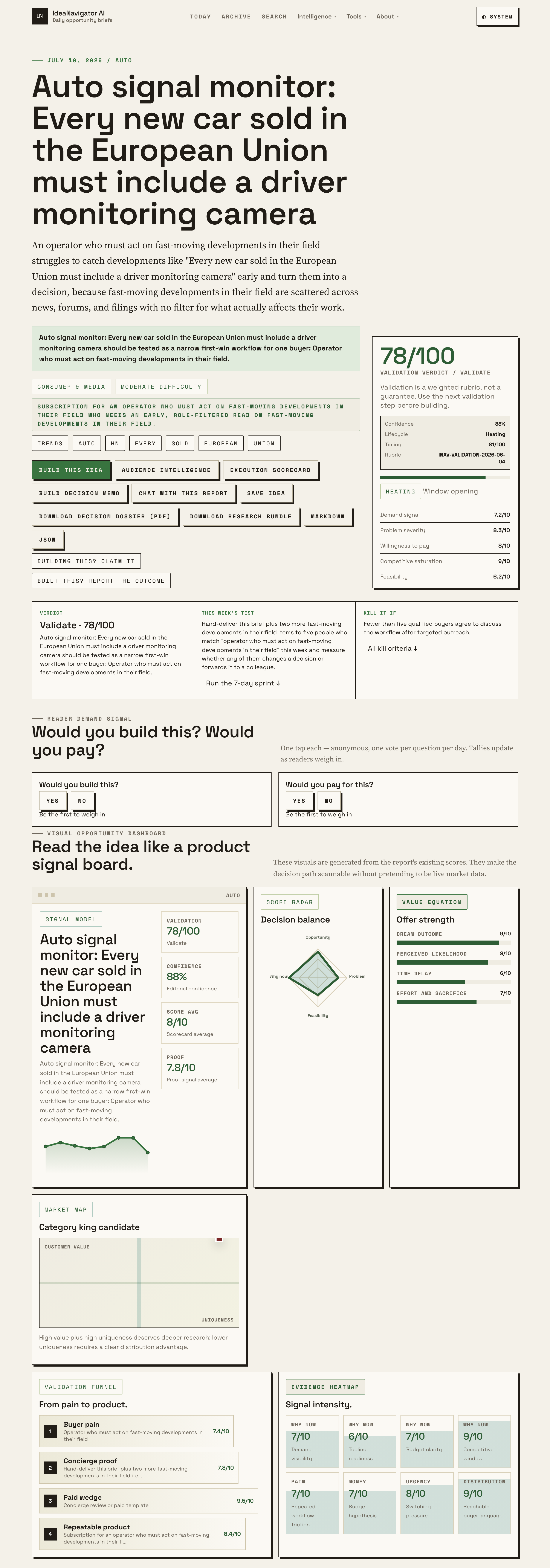
📊 Full opportunity report: Driver Monitoring Cameras Required In Every New Car Across The EU on IdeaNavigator AI — validation score, market gap, and execution plan.

Get the little things that make your day delivered free — and shop member deals
- Fast, free delivery on millions of items
- Access to Prime Big Deal Days deals on October 6–7
- Prime Video, Amazon Music and more included
TL;DR
The supplied brief does not substantiate its claim that every new car sold in the EU must include a driver-monitoring camera. EU vehicle safety rules address driver drowsiness and attention warnings, but the brief gives no regulation, date, or evidence that those systems must use cameras. The exact requirement and its application to current vehicles should be checked against the relevant EU legal text.
The supplied brief says every new car sold in the European Union must include a driver-monitoring camera, but it does not identify a law or provide evidence for that specific claim. The European Commission’s General Safety Regulation overview describes EU vehicle-safety requirements that include driver drowsiness and attention warning systems; the available sources do not establish that a camera is mandatory in every new car.
The IdeaNavigator AI brief describes the purported requirement as a fast-moving automotive development and says it surfaced on Hacker News with an 88/100 signal. The brief provides no definition, comparison baseline, or measurement window for that score, so it cannot establish the accuracy or legal status of the camera claim.
The IdeaNavigator AI brief includes no regulation number, official announcement, implementation date, vehicle category, or compliance detail. It also does not say whether it refers to a camera facing the driver, another sensor, or a system that monitors attention through different means. The European Commission’s overview describes the relevant safety requirement in terms of drowsiness and attention warning systems; that description alone does not show that one particular sensor technology is compulsory.
The IdeaNavigator AI brief proposes a subscription monitor that tracks industry developments and turns them into short decision briefs for automotive operators. It suggests testing the service by delivering this item and two others to five people in the target audience, then recording whether anyone changes a decision or forwards a brief. These are proposed product-validation steps in the brief, not evidence that the alleged vehicle rule has been confirmed.
Camera Mandate Needs Verification
If an EU rule does require driver-facing cameras in new vehicles, it could affect automakers, suppliers, and vehicle buyers, including decisions about hardware, software, compliance, and data handling. The IdeaNavigator AI brief does not establish that such a camera mandate exists, so those consequences should not be presented as current legal obligations.
The European Commission’s General Safety Regulation overview identifies driver drowsiness and attention warning systems as a vehicle-safety requirement, but does not establish from the information cited here that the requirement prescribes a specific device. Confirming the wording of the applicable legal provision would show whether manufacturers have a choice of method and which vehicles or sales are covered. Without that check, readers cannot reliably assess costs, privacy implications, or deadlines.
From Safety Function to Sensor
The European Commission’s General Safety Regulation overview connects the claim to EU vehicle-safety requirements concerning drowsiness and attention warning systems. The IdeaNavigator AI brief does not provide the legal text or explain how that requirement relates to a camera. The sources cited here therefore do not establish when a particular obligation began, which vehicle types it covers, or whether it applies to all new cars sold today.
The IdeaNavigator AI brief says its purpose is to test whether operators need faster, role-specific updates drawn from news, forums, and filings. It proposes that the monitor filter items for relevance and explain what changed, why it matters, and what action might follow. Here, however, the brief lacks the legal reference readers would need to distinguish a confirmed rule from a headline or interpretation.
Legal Basis Remains Unspecified
The central uncertainty is whether the relevant EU requirement specifically mandates a camera, or instead requires a driver drowsiness or attention warning that can use other methods. The IdeaNavigator AI brief cites no legislation, EU institution, regulator, or automaker statement that resolves this point. The European Commission’s General Safety Regulation overview supports the existence of drowsiness and attention warning requirements, but does not, on its own, verify a camera-specific mandate.
The IdeaNavigator AI brief also leaves the effective date, scope, and compliance standard unstated. It gives no information on exemptions, vehicle categories, whether existing models are treated differently, or what happens if a system cannot reliably assess a driver. Its reported Hacker News score has no stated methodology, so its significance cannot be evaluated from the brief.
Check the Applicable EU Text
The next step is to identify the EU legal provision behind the claim and verify its exact language, scope, and start date. The European Commission’s General Safety Regulation overview is a starting point for the relevant safety requirements, but the applicable legal text or a statement from the responsible EU body is needed to clarify whether the rule specifies cameras or leaves manufacturers to choose how to meet a driver-monitoring function.
Until that evidence is available, automotive operators should treat the camera-specific claim as unverified and avoid using it as the basis for a compliance decision. The product test proposed in the IdeaNavigator AI brief could still measure whether readers find the brief useful, but the item should first be checked against an authoritative legal reference.
Sources: IdeaNavigator AI brief; European Commission General Safety Regulation overview.
Key Questions
Does the brief confirm that every new EU car must have a camera?
No. The IdeaNavigator AI brief states that claim but provides no legal citation or other evidence establishing a camera-specific mandate.
What EU safety requirement does the brief mention?
The brief refers generally to driver drowsiness and attention warnings. The European Commission’s General Safety Regulation overview also describes these warning systems, but the sources cited here do not establish whether they must use cameras or define the requirement’s full legal scope.
When would a camera requirement take effect?
The IdeaNavigator AI brief gives no effective date. The applicable EU legal text would need to be checked to confirm timing.
What should automotive operators verify?
They should identify the relevant EU regulation and confirm its wording, vehicle coverage, compliance date, and whether it requires a camera or only a safety function. The European Commission’s General Safety Regulation overview can help identify the relevant policy area.
Source: IdeaNavigator AI
NFL season / tailgating Picks
team gear
As an affiliate, we earn on qualifying purchases.