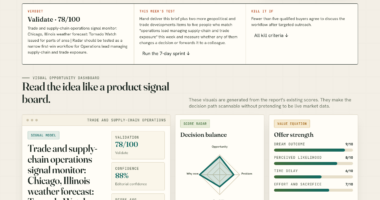
📊 Full opportunity report: The Impact Of Phone-Photo Gauge Reading On Industrial Efficiency on IdeaNavigator AI — validation score, market gap, and execution plan.

Get the little things that make your day delivered free — and shop member deals
- Fast, free delivery on millions of items
- Access to Prime Big Deal Days deals on October 6–7
- Prime Video, Amazon Music and more included
TL;DR

A pilot program replacing traditional clipboard gauge readings with phone photos is underway at three facilities. Early results suggest reduced errors and improved trend tracking, potentially transforming maintenance workflows.
Industrial plants are testing a new workflow that uses phone photos to record gauge readings, replacing traditional clipboard methods. This approach aims to reduce transcription errors, improve data accuracy, and enable better trend analysis, with early pilot results showing promising signs of increased efficiency.
The initiative involves technicians photographing analog gauges, sight glasses, and counters during routine rounds using a dedicated app. The app employs vision models to automatically read the gauge values, compare them to expected ranges, and log the data with timestamps and location tags. This process aims to eliminate manual transcription, which has historically led to errors and missed early failure signals.
Three facilities are currently running parallel gauge reading methods—traditional clipboard rounds versus phone-photo logging—for a month. Preliminary data indicates a reduction in reading errors and earlier detection of anomalies, according to project sources. The phone-photo system also creates a digital trend history that maintenance teams can review, potentially reducing downtime and preventing failures.
The pilot’s success could lead to wider adoption across industrial operations, especially as vision models have become reliable enough to read from ordinary phone images, removing the need for costly retrofitting of legacy equipment with IoT sensors.
Potential Impact on Maintenance and Data Accuracy
This development could significantly improve maintenance workflows by providing more accurate, timely data. Reducing transcription errors means fewer false alarms or missed failures, which can lead to costly downtime. Additionally, automated trend analysis allows for predictive maintenance, shifting from reactive to proactive strategies.
For plant managers, adopting phone-photo gauge reading could lower operational costs by avoiding expensive sensor retrofits and streamlining data collection. If validated at scale, this method might become a standard in the industry, especially for legacy systems where sensor installation is impractical.
industrial gauge photo reading app
As an affiliate, we earn on qualifying purchases.
As an affiliate, we earn on qualifying purchases.
Legacy Equipment and the Need for Better Data Collection
Many industrial facilities rely on analog gauges for critical process monitoring. Traditionally, technicians perform manual rounds, transcribing readings onto paper or digital logs. This process is prone to errors, delays, and often results in data that is not easily analyzable or trendable.
Recent advances in computer vision have made it feasible to read analog gauges from photographs reliably. This technological shift offers a low-cost alternative to retrofitting older equipment with IoT sensors, which can be prohibitively expensive or technically challenging.
The concept of replacing clipboard rounds with phone photos has gained interest as a practical, immediate step toward digitizing maintenance data, with pilot programs now underway to assess its effectiveness in real-world settings.
“The vision models now reliably read gauges from standard phone photos, making this an accessible and scalable solution for legacy equipment.”
— an anonymous researcher
Unconfirmed Long-Term Benefits and Industry Adoption
While initial results are promising, it remains unclear how the approach will perform over extended periods and across diverse facility types. The scalability, cost-effectiveness at larger scales, and integration with existing maintenance systems are still being evaluated.
Further data is needed to confirm whether the reduction in errors and early failure detection translate into measurable operational savings and reliability improvements long-term.
Next Steps for Validation and Broader Implementation
The pilot programs will continue for another month, with detailed analysis of error rates, anomaly detection speed, and maintenance outcomes. If results remain positive, plans include scaling the solution to additional facilities and integrating it with existing asset management systems. Industry stakeholders are watching closely for potential adoption guidelines and best practices emerging from these trials.
Key Questions
How accurate is the phone-photo gauge reading compared to manual transcription?
Preliminary data suggests the phone-photo method reduces reading errors significantly, but comprehensive analysis after the pilot will confirm the exact accuracy improvements.
Will this method replace all manual rounds in the future?
It is currently being tested as a targeted solution for specific use cases. Broader replacement will depend on pilot outcomes, scalability, and integration with existing workflows.
What are the costs associated with implementing this system?
The system operates on a per-facility subscription model, with minimal additional hardware costs since it uses existing smartphones and a dedicated app.
Are there any limitations to using phone photos for gauge reading?
Challenges may include poor lighting conditions, dirty gauges, or obstructed views, which could impact reading accuracy. These issues are being addressed through app improvements and operational protocols.
When can we expect wider industry adoption?
If the current pilot shows sustained success, broader adoption could occur within the next year, as facilities seek cost-effective, reliable data collection methods.
Source: IdeaNavigator AI
NFL season / tailgating Picks
team gear
As an affiliate, we earn on qualifying purchases.