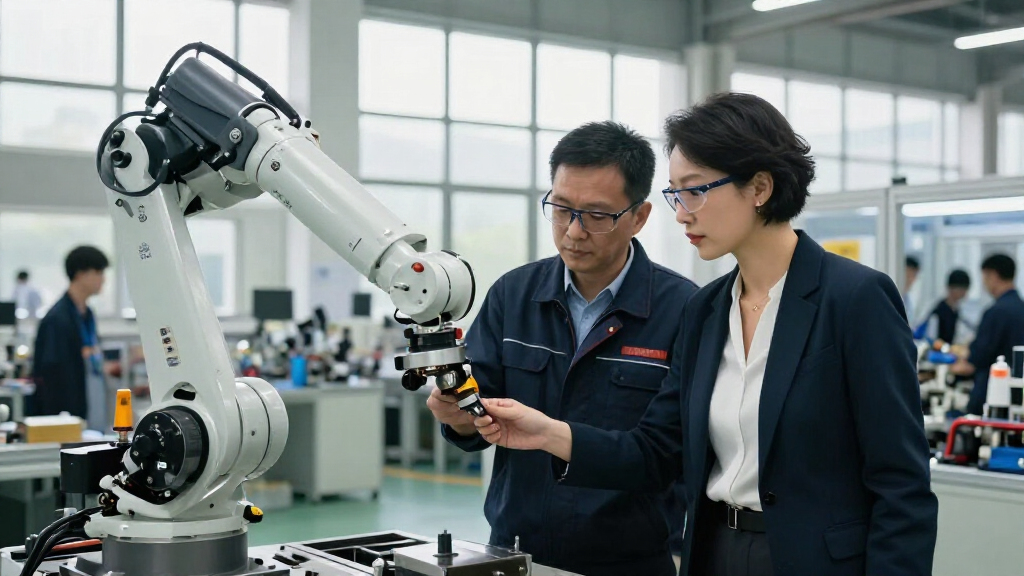

🔍 Read the full analysis: What’s Behind China’s No To SoftBank’s $5.4 Billion Robotics Deal? on ThorstenMeyerAI.com

Get the little things that make your day delivered free with Prime
- Fast, free delivery on millions of items
- Prime Video, Amazon Music and more included
- Member-only deals all year
TL;DR
ABB said on Nov. 5 that SoftBank had been informed China’s foreign-investment security review office prohibited the acquisition of ABB’s robotics business in China. The announcement does not say the global transaction has been canceled, and China has not published its reasoning. The companies say they remain in dialogue as they work on the transaction.
China’s foreign-investment security review office has prohibited SoftBank’s acquisition of ABB’s robotics business in China, ABB said on Nov. 5, putting a major regulatory obstacle in the way of SoftBank’s planned $5.375 billion purchase. ABB did not say the global transaction had been canceled, and the Chinese government has not publicly explained its decision.
ABB said it was informed by SoftBank that the Office of the Working Mechanism for Foreign Investment Security Review in China had prohibited the acquisition of the company’s robotics business in China. ABB added that SoftBank manages the regulatory approval process and that the companies “are in close dialogue and are working constructively on the transaction.”
The wording identifies the China business as the subject of the prohibition. It does not establish whether the deal can proceed in other markets, whether the parties will restructure it, or whether SoftBank may apply again. ABB’s announcement relayed what SoftBank told it; no public Chinese decision text was cited in the statement.
The Financial Times reported on Nov. 5, citing people familiar with the matter, that China’s National Development and Reform Commission had told SoftBank the acquisition would not be allowed. The report said SoftBank was examining what had gone wrong and whether it could seek approval again. Those details have not been confirmed in a published statement from Chinese authorities or SoftBank. The deal was agreed in October 2025 at an enterprise value of $5.375 billion. ABB had said on Oct. 20 that it expected to close before year-end.
Infographic 01 · SoftBank × ABB Robotics
What China decided, and what it did not
Three sentences from ABB are the only official text so far. Here is what they say, what was only reported, and what nobody knows yet.
Prohibited in China, not withdrawn. The deal still exists. What ABB describes is a ban on the China business, decided by a security review, not by competition law.
- ABB: SoftBank was told the China security review office “has prohibited” the purchase of ABB Robotics in China.
- Approvals are managed by SoftBank; both sides are “in close dialogue”.
- China’s foreign ministry: “I would refer you to the competent Chinese authorities.”
- FT: the message came from the NDRC.
- FT: officials worried robotics data could move abroad and train AI models.
- FT: SoftBank is checking whether it can seek approval again.
- The decision text and the official reason.
- Whether the deal can close without China.
- The US review. SoftBank’s own statement.
- 8 Oct 2025Deal signedABB drops its spin-off plan; SoftBank pays $5.375B
- 11 Mar 2026EU clears itEuropean Commission, case M.12248
- Aug 2026Loan lined upSoftBank: $1.8B LBO financing
- 20 Oct 2026Closing expected in Q4ABB third-quarter report
- 5 Nov 2026China says noABB confirms the prohibition of the China business
Sources: ABB, 5 Nov 2026 · ABB, 8 Oct 2025 · SoftBank, 8 Oct 2025 · European Commission, M.12248 · SoftBank Q1 FY2026 · ABB Q3 2026, 20 Oct 2026 · PRC Foreign Ministry, 5 Nov 2026. FT reporting (5 Nov 2026) is paywalled and cited only as reported.
Powered by Thorsten Meyer AI
A Security Review, Not Merger Control
The reported decision concerns national-security review of foreign investment, not the ordinary competition review that asks whether a merger would limit competition. China’s review mechanism is separate from the State Administration for Market Regulation, the country’s antitrust regulator. That distinction matters because the two processes examine different risks and can produce separate outcomes.
Industrial robots are strategically important equipment used in manufacturing, including automotive assembly and logistics. China installed 354,000 industrial robots in 2025, equal to 59% of global installations, according to the International Federation of Robotics. The scale gives the country a substantial industrial base connected to robotics suppliers, production data and factory automation.
The Financial Times reported that officials were concerned robotics data could move abroad and be used to train foreign AI models. That is a reported explanation, not a reason officially published by China. If data or industrial capabilities were part of the security assessment, the case could affect how international companies plan acquisitions involving technology, manufacturing operations and sensitive information. That implication remains an assessment, not a stated government policy change.
For customers, ABB’s announcement does not say that existing robots in Chinese factories will stop operating or that service will change. For SoftBank, the decision complicates its stated push into robotics and what the source describes as its “Physical AI” strategy. The immediate issue is whether the parties can find a transaction structure that satisfies Chinese requirements while preserving enough of the planned acquisition.
Products Worth Considering

Arlo Ultra 4K HDR Wireless Security Camera (3rd Gen), 3-Camera Kit with SmartHub

Shark AV2501AE AI Robot Vacuum with XL HEPA Self-Empty Base

Philips Hue Bridge Pro Starter Kit with 4 A19 E26 Smart Bulbs
As an affiliate, we earn on qualifying purchases.
How the ABB Deal Reached Review
SoftBank agreed on Oct. 8, 2025, to buy ABB’s robotics division for an enterprise value of $5.375 billion. The deal required regulatory approvals across jurisdictions. The European Union cleared it in March 2026, according to the source material. ABB was still expecting a fourth-quarter 2026 closing as recently as Oct. 20.
China’s foreign-investment security review operates under measures issued jointly by the NDRC and the Ministry of Commerce as Order No. 37 in December 2020, in force from Jan. 18, 2021. The rules cover foreign investment in specified security-relevant areas, including major equipment manufacturing and key technologies. The source material says China has not identified which category it applied to this transaction.
Under the rules described in the source, the process can include an initial decision on whether to conduct a review, a general review and, if needed, a special review. That process is distinct from merger control. The deal’s clearance in Europe therefore did not settle whether China would permit the purchase of the Chinese business.
“The two companies “are in close dialogue and are working constructively on the transaction.””
— ABB, in its Nov. 5 statement
The Global Deal’s Status Is Open
Several central points remain unresolved. China has not published a decision explaining why it prohibited the acquisition, what national-security concerns it considered, or which provisions it applied. The reported concern about robotics data and AI training comes from the Financial Times, not an official Chinese explanation.
It is also unclear whether the prohibition applies only to the proposed purchase of ABB’s Chinese business or will affect the transaction’s structure elsewhere. ABB’s statement is limited to the China business; it does not say the worldwide deal is approved, canceled or being revised. SoftBank had not issued a public statement at the time described in the source material, and the Chinese foreign ministry did not confirm or deny the report.
The parties have not disclosed whether they will seek a new approval, change the deal’s scope, or pursue another arrangement. Nor has ABB said what the prohibition means for the planned closing timetable. Until the companies or regulators provide more detail, the final form and timing of the transaction remain uncertain.
The Parties Must Decide Their Next Step
ABB says it and SoftBank are in dialogue, but neither company has announced a revised structure or timetable. The next concrete development would be a statement from SoftBank or ABB explaining whether the buyer will challenge the decision, submit a new application or alter the transaction.
Further clarification from China could identify the legal reasoning and whether any conditions or review process remain available. For now, ABB’s most recent timing expectation—that the deal would close in the fourth quarter of 2026—has been put in doubt by the prohibition. No revised closing date has been announced, and the status of the transaction outside China has not been set out.
Key Questions
What did China prohibit?
ABB said SoftBank told it that China’s foreign-investment security review office prohibited the acquisition of ABB’s robotics business in China. ABB did not say that the entire global deal had been canceled.
Was the decision an antitrust ruling?
No. The stated authority was China’s foreign-investment security review office, which handles national-security reviews. That process is separate from merger control by the State Administration for Market Regulation.
Why did China block the acquisition?
Chinese authorities have not published a reason. The Financial Times reported that officials were concerned robotics data could move abroad and be used to train foreign AI models, but that account has not been confirmed as the official rationale.
Is the SoftBank-ABB deal canceled?
That has not been established. ABB said the companies remain in dialogue and are working on the transaction, while its announcement specifically described the prohibition as covering the business in China. The companies have not explained whether the rest of the deal can proceed.
Will ABB robots in Chinese factories stop working?
ABB’s announcement did not say that existing robots will stop operating or that customer service will change. It concerned the proposed acquisition, and no operational impact on customers was announced.
Source: ThorstenMeyerAI.com