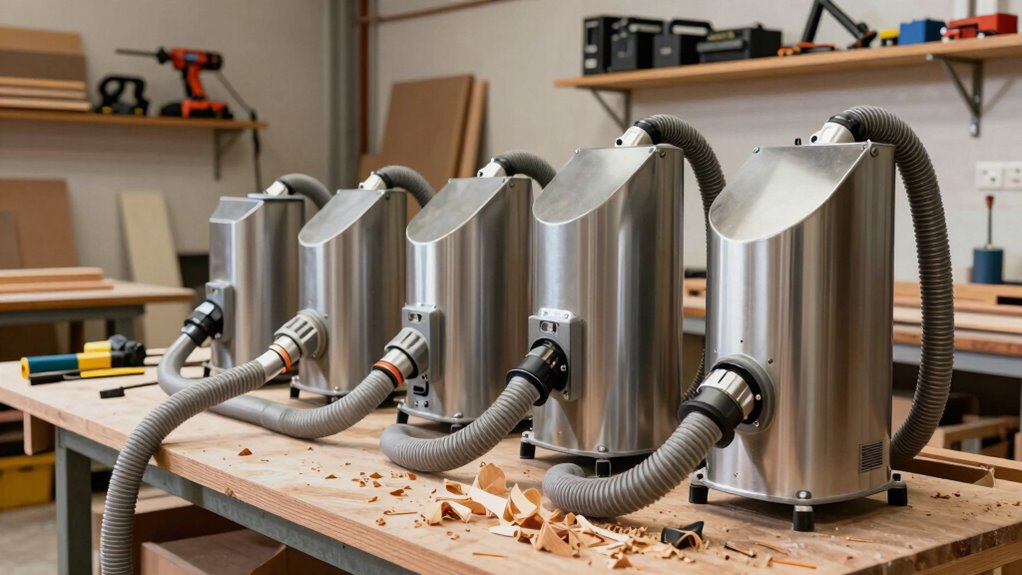

Choosing the right dust collector for a woodshop can significantly improve air quality and safety, while also keeping your workspace tidy. The VEVOR Wall Mount Dust Collector stands out as the best overall, thanks to its compact design and high CFM. For larger setups, the VEVOR 1100 CFM System offers impressive capacity, though it comes with a higher price tag. Meanwhile, the WEN Dust Collector with 15-Gallon Bag provides solid value for smaller shops. Each option involves tradeoffs between power, size, noise, and budget. Keep reading for a detailed breakdown to find the best fit for your needs.

Get the little things that make your day delivered free with Prime
- Fast, free delivery on millions of items
- Prime Video, Amazon Music and more included
- Member-only deals all year
Key Takeaways
- High CFM capacity is essential for managing dust from multiple power tools efficiently.
- Size and mobility often trade off with power; larger units tend to be less portable.
- Filtration quality varies, impacting air cleanliness and maintenance requirements.
- Budget options can perform well for small workshops but may lack durability or capacity.
- Features like automatic start, noise levels, and filter accessibility influence usability.


| dust collector for woodshop | Motor Power | Airflow | Collection Capacity | Impeller Size |
|---|---|---|---|---|
| VEVOR Wall Mount Dust Collecto | — | 560 CFM | 21 gallons (80L) | — |
| WEN Woodworking Dust Collector | 7.4 amps | — | 15 gallons | 9 inches |
| SHOPMAX 20 Gal. 6.3 Amp Dust C | 6.3 amps | — | — | 12 inches |
| Abestorm Tabletop Dust Collect | — | — | — | — |
| VEVOR Dust Collector | 1.5HP | 1100 CFM | — | — |
| WEN Woodworking Dust Collector | 5.7 amps | 660 CFM | 12 gallons | 6 inches |
| WEN DC1300 1,300 CFM 14-Amp 5- | 14 Amps | 1300 CFM | 50 gallons | 10 inches |
More Details on Our Top Picks
VEVOR Wall Mount Dust Collector 1 HP, 560 CFM with 2.5 Micron Bag for Woodworking and Industrial Use
This wall-mounted model stands out for its high airflow of 560 CFM, making it ideal for medium to large workshops that need efficient dust removal without taking up floor space. Compared with the WEN Woodworking Dust Collector, it offers a larger capacity and finer filtration, which benefits those concerned with air quality. However, the noise level can be noticeable, and the wall-mount setup requires proper installation, which might be a hurdle for DIYers. Its 21-gallon bag reduces the frequency of emptying, and the micro filtration captures fine dust, ensuring cleaner air. This unit is well-suited to professional shops or serious hobbyists who prioritize high airflow and filtration quality but can handle wall-mount installation.
Pros:- High airflow of 560 CFM for effective dust capture
- Large 21-gallon capacity minimizes emptying frequency
- Micro filtration improves air quality by capturing fine dust
- Easy-to-empty bag with bottom zipper
Cons:- Noise level may be bothersome during operation
- Wall-mounted installation requires dedicated space and effort
- Limited to industrial or woodworking dust, not versatile for other debris
Best for: Workshop owners needing high airflow and efficient space-saving dust collection
Not ideal for: Small or portable setups where mobility and compactness are priorities
- Power:1 HP
- Airflow:560 CFM
- Collection Capacity:21 gallons (80L)
- Filtration Size:2.5 microns
- Motor Type:Induction
- Noise Level:≤ 90dB
Our verdict“This model is best suited for workshops that need strong, space-efficient dust collection with excellent filtration, accepting some noise and installation effort.”
WEN Woodworking Dust Collector with 7.4-Amp Motor and 15-Gallon Bag
Compared with the VEVOR Wall Mount, the WEN offers portability with its swivel casters and a slightly higher airflow of 600 CFM, making it a flexible choice for small to medium woodworking shops. Its 15-gallon bag is smaller, meaning more frequent emptying, but the 7.4-amp motor provides strong suction at a budget-friendly price. Wall mounting is optional, giving users flexibility, though it’s less space-efficient than wall-mounted units. This model suits hobbyists or small shop owners who want decent power without investing in a dedicated wall setup. The tradeoff comes in the form of portability over capacity, and the noise might be higher than more industrial models.
Pros:- Powerful 7.4-amp motor for effective dust collection
- Includes a 15-gallon bag, suitable for small to medium tasks
- Mobility with swivel casters and optional wall mount
- Affordable price point
Cons:- Heavier at over 41 pounds, less portable for frequent moving
- Requires wall mounting for optimal use, adding setup steps
- Limited capacity compared to larger units like the VEVOR 1100 CFM system
Best for: Small woodworking shops or serious hobbyists seeking a versatile, budget-friendly dust collector
Not ideal for: Large workshops or industrial settings where higher capacity and quieter operation are needed
- Motor Power:7.4 amps
- Impeller Size:9 inches
- Air Flow:600 CFM
- Dust Port:4 inches
- Collection Capacity:15 gallons
- Dimensions:43.3 x 17.7 x 20.1 inches
Our verdict“Ideal for small shops needing flexible, effective dust collection without a big investment, accepting some mobility and capacity limitations.”
SHOPMAX 20 Gal. 6.3 Amp Dust Collector
The SHOPMAX 20 Gal. offers a high airflow of 677 CFM, surpassing many compact models and making it suitable for demanding woodworking environments. Its 20-gallon dust capacity and five hose adapters make it versatile and capable of handling multiple tools simultaneously. Compared to the WEN 15-Gallon, it provides more capacity and slightly higher airflow, ideal for busy workshops. Its 12-inch impeller adds to its suction strength, but this power comes with increased noise levels. It’s best for shop owners who prioritize capacity and adaptability, though its size and noise might be less suitable for small or quiet workspaces.
Pros:- High airflow capacity of 677 CFM for effective dust collection
- Large 20-gallon dust capacity reduces emptying frequency
- Multiple hose adapters for versatile connections
- Durable construction for frequent use
Cons:- Powerful motor may generate significant noise
- Heavy when filled, making handling more difficult
- Size may be cumbersome in compact spaces
Best for: Workshops requiring high capacity and multiple tool connections
Not ideal for: Very small or noise-sensitive environments where quieter operation is a priority
- Motor Power:6.3 amps
- Airflow Capacity:677 CFM
- Dust Capacity:20 gallons
- Impeller Size:12 inches
- Number of Hose Adapters:5
Our verdict“This model fits larger workshops demanding high volume and flexibility, with some tradeoffs in noise and size.”
Abestorm Tabletop Dust Collector with Timer for Woodworking Shops
The Abestorm Tabletop Dust Collector is tailored for small workshops or hobbyists seeking an easy-to-move, space-saving solution. Its compact size and sturdy handle make it highly portable, while the built-in timer and high-efficiency motor add convenience. The MERV-13 filter ensures good air purification, comparable to larger systems like the VEVOR Wall Mount, but on a much smaller scale. It’s perfect for occasional use or as a supplementary device, especially in environments where space is limited. The main tradeoff is its limited dust capacity and only two speed settings, which may not handle heavy-duty, prolonged dust collection well.
Pros:- Highly portable with a sturdy handle
- Effective dust filtration with MERV-13 filter
- Convenient timer up to 120 minutes for automated operation
- High-efficiency motor with safety features
Cons:- Filter replacement needed every 6 months
- Limited to two speed settings
- Size may be too large for very tiny workspaces
Best for: Home woodworkers or small hobby shops needing a compact, automated dust collector
Not ideal for: Large commercial workshops or environments with continuous, heavy dust production
- Dimensions:14.57″×9.45″×11.81″
- Speed Settings:2 (580 CFM, 780 CFM)
- Electrical Requirements:115V, 0.9A
- Timer:up to 120 minutes
- Filter:MERV-13 (lasts up to 6 months)
- Portability:Sturdy handle, side cord wrap
Our verdict“This tabletop model is ideal for small-scale or home workshops that require simple, automated dust control, accepting limited capacity and features.”
VEVOR Dust Collector, 1100 CFM, 2.5 Micron Vortex Cone, 1.5HP, 35-Gallon Dust Collector System with 42-Gallon Filter Bag
Compared to smaller, woodworking-focused units like the SHOPMAX 20 Gal., this VEVOR system offers a staggering 1100 CFM airflow and a large 42-gallon filter bag, making it suitable for demanding industrial environments. Its 1.5HP motor provides strong suction to handle large debris and fine dust alike. The vortex cone design enhances airflow efficiency, and the easy-access clip-style bags simplify maintenance. However, its size and noise levels could be disruptive in smaller workshops, and the high airflow at 3400 RPM might generate significant sound, which could be a concern. This pick is ideal for large-scale operations where continuous, high-capacity dust collection is essential, but less suitable for quiet or small spaces.
Pros:- Exceptional airflow of 1100 CFM for maximum dust removal
- Large 42-gallon filter bag for continuous operation
- Vortex cone design improves airflow efficiency
- Easy access for maintenance
Cons:- Potentially noisy at high speeds
- Size and weight limit portability and ease of setup
- Higher power consumption
Best for: Industrial woodworking shops or large commercial setups needing maximum airflow and capacity
Not ideal for: Small or quiet workshops where noise and space are limiting factors
- Airflow:1100 CFM
- Filtration:2.5 microns
- Motor Power:1.5HP
- Dust Collection Capacity:35-Gallon bag, 42-Gallon filter
- Speed:3400 RPM
- Noise Level:Under 90dB
Our verdict“This heavy-duty system is best suited for industrial-sized workshops that require maximum capacity and airflow, accepting noise and size tradeoffs.”
WEN Woodworking Dust Collector with 5.7-Amp Motor and 12-Gallon Bag
This model stands out for those needing a balance of power and portability. With a 5.7-amp motor and 660 CFM airflow, it can handle moderate dust loads efficiently, making it a solid choice for small to medium workshops. Compared with the WEN DC1300, which offers higher airflow at 1,300 CFM, this unit is less suitable for large-scale dust collection but excels in tight spaces thanks to its compact design. The 12-gallon bag means more frequent emptying, a tradeoff for its smaller footprint and mobility features like lockable casters and optional wall mounting. Its size can feel bulky in very confined areas, but its portability makes it easy to move around as needed.
Pros:- Compact and lightweight at just 17 pounds for easy handling
- Includes a large 12-gallon collection bag for fewer emptying trips
- Versatile mounting options with wall mount and lockable casters
- Powerful 5.7-amp motor with 660 CFM airflow for effective dust pickup
Cons:- Limited to 12-gallon capacity, requiring frequent emptying in busy shops
- Size can feel somewhat bulky for very tight spaces
- Not designed for continuous heavy-duty use in large workshops
Best for: Woodworkers with small to medium setups who prioritize space-saving, easy mobility, and straightforward operation.
Not ideal for: Large professional shops with extensive dust generation where higher airflow capacity is necessary to keep the workspace clean.
- Motor Power:5.7 amps
- Airflow:660 CFM
- Impeller Size:6 inches
- Dust Port:4 inches
- Collection Capacity:12 gallons
- Dimensions:34.25 x 13 x 14.2 inches
- Weight:17 pounds
- Warranty:2 years
Our verdict“This dust collector is a smart choice for small to medium workshops that need a portable, space-efficient solution without sacrificing too much power.”
WEN DC1300 1,300 CFM 14-Amp 5-Micron Woodworking Dust Collector with 50-Gallon Collection Bag and Mobile Base
This pick makes the most sense for larger woodworking environments needing serious dust collection power. Its 14-amp motor and 1,300 CFM airflow outperform smaller models like the WEN 5.7-Amp, ensuring rapid removal of dust from multiple machines simultaneously. The 50-gallon collection bag reduces the frequency of emptying, which is a significant advantage in high-volume settings. Its large size and heavy build, however, mean it requires dedicated space and setup time, making it less suitable for small or cluttered workshops. The included mobile base with swivel casters improves maneuverability, but the overall footprint remains substantial, and the noise level can be high during operation.
Pros:- Massive 50-gallon collection capacity for extended use
- High 1,300 CFM airflow efficiently captures dust from multiple tools
- Sturdy mobile base with swivel casters for easy repositioning
- Powerful 14-amp motor handles continuous operation
Cons:- Heavy and bulky, needing significant space for placement
- Requires a dedicated electrical outlet and longer setup time
- Potentially loud, which can be disruptive in smaller or shared environments
Best for: Large woodworking shops or professional setups where high airflow and large capacity are essential for continuous dust management.
Not ideal for: Small hobbyist garages or spaces with limited room, due to its weight and size requiring substantial floor space.
- Airflow:1300 CFM
- Motor Power:14 Amps
- Collection Capacity:50 gallons
- Impeller Size:10 inches
- Inlet Size:4 inches
- Impeller Speed:3450 RPM
Our verdict“This system is ideal for large, busy workshops demanding high-volume dust collection with minimal interruption for emptying.”

How We Picked
I evaluated these dust collectors based on performance, build quality, usability, and value. High CFM ratings indicate better dust collection capacity, especially for larger workshops with multiple tools. Ease of installation, maintenance, and noise levels also played a role, along with overall durability and feature set. The ranking reflects a balance between power, size, cost, and user convenience, aiming to recommend options suitable for a range of shop sizes and budgets. Products with proven reliability and versatile features scored higher, ensuring users get the best performance relative to their investment.Factors to Consider When Choosing Dust Collector For Woodshop
When selecting a dust collector for your woodshop, it’s important to consider several factors that influence performance, cost, and ease of use. Making the right choice depends on understanding your workshop size, the types of tools you use, and your maintenance preferences. Here are key considerations to help you navigate the options and avoid common pitfalls.Power and CFM Capacity
CFM (Cubic Feet per Minute) measures how much air a dust collector moves, directly affecting its ability to clear dust effectively. Larger workshops with multiple tools require higher CFM ratings to prevent dust buildup and protect air quality. However, a high-CFM unit also tends to be bigger and louder, so balancing power with your workspace constraints is essential.Size and Portability
Larger dust collectors often provide greater capacity and power but can be cumbersome and less mobile. Smaller, wall-mounted or tabletop models save space and are easier to reposition but may struggle with larger dust volumes or multiple tools operating simultaneously. Consider your workshop layout and whether you prefer a fixed or portable solution.Filtration System
Effective filtration improves air quality and reduces filter maintenance. Look for units with at least 1-micron filtration; finer filters capture smaller particles but may cost more and clog faster. A vortex cone or cyclone system can also enhance dust separation, extending filter life and improving overall performance.Noise Levels
Many powerful dust collectors generate significant noise, which can be disruptive over long periods. Some models incorporate sound dampening or quieter motors, which are worth considering if your workshop shares space with living areas or if noise sensitivity is an issue.Budget and Long-Term Costs
While budget options might suffice for small or occasional use, investing in a higher-quality unit can pay off through durability, better filtration, and lower maintenance. Factor in costs for filters, bags, and potential repairs when evaluating the total value of each model.Additional Features
Features like automatic start/stop, remote controls, or easy filter access can improve usability and safety. However, these add to the cost, so weigh their benefits against your budget and how often you’ll use them.Frequently Asked Questions
How much CFM do I need for my small woodworking shop?
For small shops with only a few tools, a dust collector with around 400-600 CFM typically provides sufficient airflow. This capacity handles dust from standard woodworking equipment without overwhelming the unit or creating excessive noise. However, if your workspace contains multiple high-power tools operating simultaneously, opting for a slightly higher CFM can prevent dust from escaping and ensure cleaner air.
Is a cyclone dust collector worth the extra cost?
Cyclone dust collectors are often more expensive but offer significant advantages in dust separation and filter longevity. They reduce filter clogging by pre-separating larger debris, which means less frequent maintenance and better performance over time. For serious woodworking shops or those with high dust output, investing in a cyclone system can improve airflow and air quality, making it a worthwhile upgrade.
Should I prioritize higher filtration micron ratings?
Yes, finer filtration—such as 1-micron or smaller—captures more airborne dust particles, improving air quality and reducing health risks. However, finer filters can clog faster and require more frequent cleaning or replacement. Balancing filtration quality with ease of maintenance is key; some units include multi-stage filters to optimize both dust collection and airflow.
Can I use a smaller dust collector with a dust separator?
Using a dust separator, such as a cyclone or vortex cone, allows a smaller dust collector to handle larger volumes of dust more efficiently. These systems pre-separate debris before reaching the main filter, reducing clogging and extending filter life. If space or budget limits your options, adding a separator can significantly boost your existing system’s capacity and performance.
What maintenance is involved with a dust collector?
Regular maintenance includes emptying collection bags or bins, cleaning or replacing filters, and inspecting hoses and seals for leaks. Proper upkeep ensures consistent airflow and dust collection efficiency. Some models feature tool-less filter access or automatic cleaning options, which can save time and reduce hassle during routine maintenance.
Conclusion
For most hobbyist woodworkers or small shops, the WEN Woodworking Dust Collector with 15-Gallon Bag offers a practical balance of power and affordability. Serious professionals or larger workshops should consider the VEVOR 1100 CFM System for its high capacity, despite higher costs. Beginners aiming for simplicity and ease of use might prefer tabletop or wall-mounted models, while those with specific filtration needs should prioritize units with finer filters. Ultimately, your choice depends on your workshop size, dust output, and budget, but with these options, you’ll find a solution tailored to your needs in 2026.