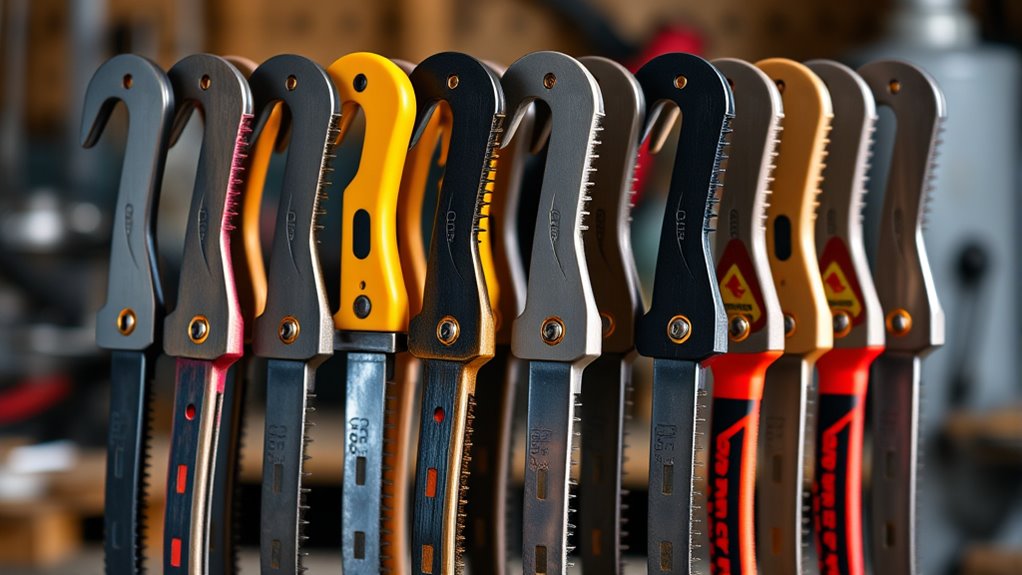

For most metal-cutting jobs, I’d start with the Lenox HT50 High-Tension Hacksaw, which prioritizes a rigid frame and controlled cuts. The Milwaukee 48-22-0012 Compact Hack Saw suits tight spaces, while the DEWALT 5-in-1 Hacksaw offers more setup options for varied tasks. The main tradeoffs are frame rigidity versus compact access, plus whether extra blade positions or included spares matter more than a straightforward 12-inch design. Blade fit, tooth count, and usable tension also affect how well a saw handles different stock. Read on for the full comparison and a pick matched to your work.

Get the little things that make your day delivered free with Prime
- Fast, free delivery on millions of items
- Prime Video, Amazon Music and more included
- Member-only deals all year
Complete the kit


Key Takeaways
- Frame rigidity separates the main full-size contenders: the Lenox HT50 and Milwaukee 48-22-0050 are the high-tension choices, while simpler frames may suit lighter cutting.
- Compact access comes with a capacity tradeoff: Milwaukee’s compact model and KATA’s mini saw can reach confined work, but they are not substitutes for a full-size frame on larger stock.
- Extra features serve different needs: DEWALT’s 5-in-1 format emphasizes configuration options; it is a different proposition from a conventional fixed-frame saw.
- Included blades affect readiness, not long-term fit: AIRAJ and KATA bundle spare blades, but buyers should still check replacement-blade compatibility and tooth pitch.
- A 12-inch frame is the lineup’s practical baseline: STANLEY, WORKPRO, CRAFTSMAN, Hanpex, and the full-size Milwaukee model favor familiar capacity over compact storage.
| Milwaukee 48-22-0012 Compact Hack Saw with Tool-Free Blade Change |  | Best for Flush Cuts in Tight Spaces | Model: 48-22-0012 | Blade length: 10 inches | Blade material: High-speed steel | VIEW ON AMAZON | See Our Full Breakdown |
| STANLEY 12-Inch D-Shape Hacksaw, 24 TPI |  | Best for General-Purpose Metal Cutting | Power source: Manual | Blade length: 12 inches | Teeth per inch: 24 | VIEW ON AMAZON | See Our Full Breakdown |
| Lenox HT50 High-Tension Hacksaw |  | Best for Fast, Straight Cuts | Power source: Manual | Maximum blade tension: 50,000 psi | Blade length: 12 inches | VIEW ON AMAZON | See Our Full Breakdown |
| KATA 10-Inch Mini Hacksaw with 3 Blades |  | Best Lightweight Kit for Light Repairs | Model: KT21019M | Frame material: Aluminum | Blade length: 10 inches (250 mm) | VIEW ON AMAZON | See Our Full Breakdown |
| AIRAJ 12-Inch Adjustable Tension Hacksaw for Metal with 10 Spare Blades |  | Best for Spare-Blade Supply and Angle Options | Power source: Manual | Blade length: 12 inches | Blade material: Alloy steel | VIEW ON AMAZON | See Our Full Breakdown |
| DEWALT 5-in-1 Hacksaw, 12-Inch (DWHT20547L) |  | Best for Flush Cuts and Reach | Blade length: 12 inches | Blade material: High-speed steel | Blade angles: 45° and 90° | VIEW ON AMAZON | See Our Full Breakdown |
| Milwaukee 48-22-0050 12-Inch High-Tension Hacksaw |  | Best for Blade Storage and Grip | Blade length: 12 inches | Frame: Reinforced metal | Blade position: 45 degrees | VIEW ON AMAZON | See Our Full Breakdown |
| WORKPRO 12-Inch Adjustable Hacksaw with 3 Bi-Metal Blades |  | Best Mixed-Material Blade Kit | Blade length: 12 inches | Frame material: Aluminum alloy | Blade material: Bi-metal | VIEW ON AMAZON | See Our Full Breakdown |
| CRAFTSMAN 12-Inch Hacksaw (CMHT20138) |  | Best for a Simple, Sturdy Frame | Blade length: 12 inches | Cutting depth: 4.375 inches | Maximum frame tension: 225 lbs | VIEW ON AMAZON | See Our Full Breakdown |
| Hanpex 12-Inch High-Tension Hacksaw with 24 TPI Bi-Metal Blade |  | Best Lightweight Option | Power source: Hand-powered | Blade length: 12 inches | Blade material: Bi-metal | VIEW ON AMAZON | See Our Full Breakdown |
| hacksaws for metal cutting | Blade length | Blade material | Handle material | Model |
|---|---|---|---|---|
| Milwaukee 48-22-0012 Compact H | 10 inches | High-speed steel | Rubber | 48-22-0012 |
| STANLEY 12-Inch D-Shape Hacksa | 12 inches | Carbon steel | — | — |
| Lenox HT50 High-Tension Hacksa | 12 inches | High-speed steel | — | — |
| KATA 10-Inch Mini Hacksaw with | 10 inches (250 mm) | Flexible bi-metal HSS | Soft TPR / rubber | KT21019M |
| AIRAJ 12-Inch Adjustable Tensi | 12 inches | Alloy steel | Rubber | — |
| DEWALT 5-in-1 Hacksaw | 12 inches | High-speed steel | Plastic | DWHT20547L |
| Milwaukee 48-22-0050 12-Inch H | 12 inches | — | Rubber | 48-22-0050 |
| WORKPRO 12-Inch Adjustable Hac | 12 inches | Bi-metal | Thermoplastic elastomer (TPR) | W000503AE |
| CRAFTSMAN 12-Inch Hacksaw | 12 inches | Metal | Plastic | CMHT20138 |
| Hanpex 12-Inch High-Tension Ha | 12 inches | Bi-metal | Plastic | X053-AU |
More Details on Our Top Picks
Milwaukee 48-22-0012 Compact Hack Saw with Tool-Free Blade Change
The Milwaukee 48-22-0012 is the most specialized pick here: its compact frame and adjustable blade length make it suited to short cuts where a full-size saw is awkward, including flush cuts near a surface. The tool-free blade change also makes replacement simpler than on a basic fixed-frame design. At 227 g, it is far lighter than the Lenox HT50, whose high-tension frame is better suited to longer, straighter cuts. That small format is also the main tradeoff: this saw is intended for small cutting jobs, not repeated cuts through thick stock. Choose it for access and control rather than speed or reach.
Pros:- Compact frame fits into tight work areas
- Adjustable blade length supports flush cutting
- Tool-free blade change simplifies blade replacement
- Rubber overmold grip adds comfort during short cuts
Cons:- Designed for small cutting applications rather than heavy or sustained work
- Short compact format offers less reach than 12-inch-frame alternatives
Best for: Plumbers, maintenance workers, and DIYers making occasional short cuts or flush cuts in confined spaces.
Not ideal for: People cutting thick metal stock or making frequent long cuts who need a full-size frame and more sustained cutting capacity.
- Model:48-22-0012
- Blade length:10 inches
- Blade material:High-speed steel
- Handle material:Rubber
- Weight:227 g
- Cutting angle:180 degrees
- Included:Compact hacksaw and 10-inch blade
Our verdict“Choose this Milwaukee for access and flush cuts in tight spaces, but pick a full-size saw such as the Lenox HT50 for longer or heavier cutting.”
STANLEY 12-Inch D-Shape Hacksaw, 24 TPI
The STANLEY 12-Inch D-Shape Hacksaw is a straightforward choice for routine hand cutting: its 12-inch, 24 TPI carbon steel blade and 4-3/8-inch throat depth give it a familiar setup for general-purpose jobs. The D-shaped handle provides a secure hold, while the blade can be set at 90 or 180 degrees for different approaches, including flush cuts. Compared with the Milwaukee compact saw, STANLEY offers more frame reach; compared with the Lenox HT50, it lacks a stated high-tension frame, so it is less tailored to fast, especially straight cuts. The handle material is listed as plastic or rubber, leaving its exact feel unclear. It suits varied household and workshop tasks, not buyers seeking a specialty high-tension frame.
Pros:- 12-inch blade provides more reach than compact hacksaws
- 24 TPI carbon steel blade is suited to general-purpose cutting
- 90- and 180-degree blade positions allow varied cutting approaches
- D-shaped handle is designed for a secure grip
Cons:- Handle material is ambiguously listed as plastic or rubber
- Does not specify the high blade tension offered by the Lenox HT50
- At 1.2 pounds, it is heavier than compact options for confined work
Best for: Homeowners and occasional workshop users who want a full-size hacksaw for mixed, routine metal-cutting jobs.
Not ideal for: Buyers who need a documented high-tension frame for frequent straight cuts or who want certainty about the handle material before buying.
- Power source:Manual
- Blade length:12 inches
- Teeth per inch:24
- Blade material:Carbon steel
- Cutting angles:90 and 180 degrees
- Throat depth:4-3/8 inches
- Weight:1.2 pounds
- Warranty:Limited lifetime
Our verdict“Pick the STANLEY for a versatile full-size household hacksaw, but choose the Lenox HT50 if high blade tension is your priority.”
Lenox HT50 High-Tension Hacksaw
The Lenox HT50 earns its place for buyers who want a rigid frame and a blade that can be tensioned up to 50,000 psi. That high-tension I-beam construction is aimed at keeping cuts straight and supporting faster work than the general-purpose STANLEY D-Shape Hacksaw. Rubberized handles add grip, and onboard storage for up to five spare 12-inch blades means replacements travel with the tool rather than loose in a kit. It also accepts Lenox reciprocating saw blades for jab-saw use, though that feature is tied to Lenox blades rather than unrestricted compatibility. At 1.9 pounds, it is substantially heavier than the compact Milwaukee, and its robust frame is more tool than occasional, confined cuts require.
Pros:- I-beam frame supports blade tension up to 50,000 psi
- Designed to support fast, straight cutting
- Stores up to five spare 12-inch blades in the frame
- Rubberized handles support a secure grip
Cons:- At 1.9 pounds, it is heavier than the other listed saws
- Jab-saw use specifies Lenox reciprocating saw blades
- High-tension frame is less suited to occasional, confined-space work
Best for: Metalworkers and frequent DIY users who prioritize a rigid, high-tension frame for repeatable straight cuts.
Not ideal for: People who mainly make occasional cuts in tight spaces, or buyers who want a lightweight saw or broad jab-saw blade compatibility.
- Power source:Manual
- Maximum blade tension:50,000 psi
- Blade length:12 inches
- Blade teeth:24 TPI
- Blade material:High-speed steel
- Frame:I-beam construction
- Spare blade storage:Up to 5 blades
- Weight:1.9 pounds
Our verdict“Choose the Lenox HT50 for a sturdy high-tension setup and spare-blade storage, not for lightweight or compact cutting.”
KATA 10-Inch Mini Hacksaw with 3 Blades
The KATA 10-Inch Mini Hacksaw pairs a compact aluminum frame with three flexible 24 TPI bi-metal blades, making it a practical light-duty kit for repairs involving metal rods, tubing, or bolts. Its 4.8-ounce weight favors control and easy handling in restricted spaces, while two spare blades are ready when the installed one wears out. Compared with the Milwaukee 48-22-0012, KATA includes more blades and names bi-metal construction, but the Milwaukee offers adjustable blade length for flush cuts. KATA’s own use case sets a clear limit: it is not intended for thick hardened steel or demolition. Buyers seeking a full-size frame for longer cuts should instead look at the STANLEY or Lenox options.
Pros:- Lightweight aluminum frame is easy to handle in tight spaces
- Includes three flexible 24 TPI bi-metal blades
- Soft TPR grip supports control during short cuts
- Can handle light-duty work on metal, PVC, and plastic
Cons:- Not intended for thick hardened steel
- Compact frame is unsuitable for heavy-duty demolition
- Offers less reach than 12-inch saws such as the STANLEY
Best for: DIYers and repair workers who want a lightweight mini saw with spare blades for occasional cuts in thin metal and tubing.
Not ideal for: People cutting thick hardened steel, tackling demolition, or needing the reach and frame support of a full-size hacksaw.
- Model:KT21019M
- Frame material:Aluminum
- Blade length:10 inches (250 mm)
- Teeth per inch:24 TPI
- Blade material:Flexible bi-metal HSS
- Blades included:3 (1 installed, 2 extra)
- Handle material:Soft TPR / rubber
- Weight:4.8 ounces
Our verdict“Choose KATA for lightweight repair work with spare blades, but use a full-size hacksaw for thick stock or longer cuts.”
AIRAJ 12-Inch Adjustable Tension Hacksaw for Metal with 10 Spare Blades
The AIRAJ 12-inch hacksaw stands apart through its adjustable frame and the package of 10 spare blades, a useful combination for buyers who expect blade changes during ongoing repair work. The frame offers 45- and 90-degree cutting angles, giving it more stated setup flexibility than the STANLEY’s 90- and 180-degree positions, though those configurations serve different approaches to a cut. A rubber grip is intended to help during longer hand-sawing sessions. The tradeoff is that the supplied blade is listed as alloy steel with six teeth, not the 24 TPI specification given for the STANLEY and Lenox blades. That makes the blade detail less clearly comparable for fine metal cuts. Choose AIRAJ for its spare supply and adjustability, not for a clearly specified fine-tooth setup.
Pros:- Adjustable frame allows blade tension to be set
- Includes 10 spare blades
- Provides 45- and 90-degree cutting-angle options
- Rubber grip is designed to reduce hand fatigue
Cons:- Blade is listed as having six teeth, with no TPI specification provided
- No maximum blade-tension rating is stated
- Blade wear means the included consumable blades will need replacement
Best for: DIYers and maintenance users who want a 12-inch adjustable-frame saw with a large supply of replacement blades and alternate cutting angles.
Not ideal for: Buyers who need a clearly specified fine-tooth blade for controlled metal cuts or who want a documented high-tension rating.
- Power source:Manual
- Blade length:12 inches
- Blade material:Alloy steel
- Number of teeth:6
- Adjustable frame:Yes
- Cutting angles:45 degrees; alternates to 90 degrees
- Handle material:Rubber
- Weight:460 g
Our verdict“Choose AIRAJ if spare blades and angle flexibility matter most, but select the STANLEY or Lenox when a documented 24 TPI blade is the priority.”
DEWALT 5-in-1 Hacksaw, 12-Inch (DWHT20547L)
The DEWALT earns its place for buyers who need more than a straight-ahead hacksaw. Its 45° and 90° blade positions handle ordinary cuts and flush work, while the front handle converts to a pistol-grip jab saw for reaching into awkward spots. The frame’s stated tension capacity of up to 330 pounds is higher than the CRAFTSMAN’s 225-pound rating, which may help keep the blade taut during metal cutting. That flexibility comes with compromises: the plastic handle may not feel as durable as the Milwaukee’s rubber-overmolded grip, and the listed dimensions suggest it can take up substantial storage space. I’d choose it over a simpler fixed-frame saw when access and cut style matter more than compact storage.
Pros:- 45° and 90° blade positions support standard and flush cuts
- Converts to a pistol-grip jab saw for added reach
- Frame is rated for blade tension up to 330 pounds
- Can cut metal and plastic
Cons:- Plastic handle may be less durable than the Milwaukee’s overmolded rubber grip
- Listed dimensions suggest it may be bulky to store
Best for: DIYers and maintenance workers who cut metal in tight spaces and want flush-cut and jab-saw options in one tool.
Not ideal for: Buyers who prioritize a compact toolbox fit or prefer a metal or rubber-overmolded handle for a more robust grip.
- Blade length:12 inches
- Blade material:High-speed steel
- Blade angles:45° and 90°
- Maximum blade tension:Up to 330 lbs
- Handle material:Plastic
- Item weight:600 g
- Design:5-in-1; converts to a pistol-grip jab saw
- Model:DWHT20547L
Our verdict“Choose the DEWALT if flush cuts and extra reach matter more than a compact design or a more durable-feeling handle.”
Milwaukee 48-22-0050 12-Inch High-Tension Hacksaw
For metal cutting that calls for a firm hold and spare blades close at hand, the Milwaukee is the most focused pick here. Its reinforced metal frame is built for high tension, and the rubber-overmolded handle offers a grippy alternative to the plastic handles on the DEWALT and CRAFTSMAN. Internal storage for up to six blades is especially useful for shop work, where replacements can stay with the saw rather than getting lost in a toolbox. The tradeoff is less flexibility: the frame takes 12-inch blades, and its 45-degree position is the listed option for flush cuts, unlike the DEWALT and WORKPRO, which also offer a 90-degree position. I’d favor it for a dedicated metal-cutting setup, not for buyers seeking a multi-material kit.
Pros:- Reinforced metal frame is designed for high blade tension
- Stores up to six spare blades internally
- Overmolded rubber handle provides a secure grip
- 45-degree blade position supports flush cuts
Cons:- Designed for 12-inch blades, limiting blade-size flexibility
- Only a 45-degree blade position is specified
- No included mixed-material blade set is listed
Best for: Metalworkers and workshop users who want a sturdy 12-inch saw with spare blades stored in the frame and a secure grip.
Not ideal for: Buyers who need multiple blade sizes or 90-degree blade positioning, or who want included blades for cutting materials beyond metal.
- Blade length:12 inches
- Frame:Reinforced metal
- Blade position:45 degrees
- Spare blade storage:Up to 6 blades
- Handle material:Rubber
- Recommended surface:Metal
- Warranty:Limited lifetime
- Model:48-22-0050
Our verdict“Pick the Milwaukee for a dedicated metal-cutting saw with a reinforced frame, grippy handle, and onboard spare-blade storage.”
WORKPRO 12-Inch Adjustable Hacksaw with 3 Bi-Metal Blades
The WORKPRO is the clearest choice for buyers who cut metal but also want a saw ready for other jobs. It includes two 24T bi-metal blades suited to metal and plastic, plus an 18T blade for wood, giving it more out-of-the-box material coverage than the metal-focused Milwaukee. Its 45° and 90° positions add flush-cut flexibility, while the skid-resistant TPR handle is designed to stay comfortable in hand. The extra versatility does not make it a specialist: changing materials means choosing the appropriate blade, and every cut still takes manual effort. If metal is your only target, the Milwaukee’s reinforced frame and built-in blade storage make a more focused alternative; choose WORKPRO when the included blade selection matters more.
Pros:- Includes two 24T blades for metal and plastic plus an 18T blade for wood
- 45° and 90° blade positions support flush and standard cuts
- TPR handle is designed for a skid-resistant grip
- Can also cut PVC, laminates, and branches with suitable blades
Cons:- Hand-powered cutting requires manual effort
- Mixed-material use depends on selecting the appropriate included blade
- Listed dimensions appear unusually large for a 12-inch hacksaw
Best for: Homeowners and DIYers who regularly cut metal and plastic and want an included blade for occasional wood cutting.
Not ideal for: Metal-only users who want a reinforced, storage-equipped frame rather than a mixed-material blade set.
- Blade length:12 inches
- Frame material:Aluminum alloy
- Blade material:Bi-metal
- Included blades:2 × 24T; 1 × 18T
- Blade positions:45° or 90°
- Handle material:Thermoplastic elastomer (TPR)
- Item weight:1.3 pounds
- Model:W000503AE
Our verdict“Choose the WORKPRO if you want one hand saw and included blades for metal, plastic, and occasional wood cutting.”
CRAFTSMAN 12-Inch Hacksaw (CMHT20138)
The CRAFTSMAN suits buyers who want a straightforward metal-cutting frame with useful blade positioning rather than a multi-function design. Its solid metal frame is specified to withstand up to 225 pounds of tension, and the 90° and 180° blade angles give it a different flush-cut approach from the Milwaukee’s 45-degree position. A 4.375-inch cutting depth gives buyers a clear limit for sizing workpieces before starting. The full-grip handle and large tension knob make blade tensioning and holding the saw simpler, though the plastic handle lacks the Milwaukee’s rubber-overmolded feel. Compared with the DEWALT, this is less adaptable but more direct: it has no jab-saw conversion, and its fixed 12-inch blade keeps the setup conventional.
Pros:- Solid metal frame is designed for up to 225 pounds of tension
- 90° and 180° blade angles support flush-cut positioning
- 4.375-inch cutting depth helps define workpiece limits
- Full-grip handle and large tension knob support handling and adjustment
Cons:- Uses a fixed 12-inch blade length
- Plastic handle lacks the rubber-overmolded grip of the Milwaukee
- No multi-material blade set or jab-saw conversion is specified
Best for: DIYers cutting metal who want a conventional 12-inch frame, a stated cutting-depth limit, and angled blade options.
Not ideal for: Buyers who need a converting jab saw, a mixed blade kit, or a handle with a rubber-overmolded grip.
- Blade length:12 inches
- Cutting depth:4.375 inches
- Maximum frame tension:225 lbs
- Blade angles:90° and 180°
- Blade material:Metal
- Handle material:Plastic
- Dimensions:15.7 × 5.8 × 1.2 inches
- Model:CMHT20138
Our verdict“Choose the CRAFTSMAN for conventional metal cutting with a solid frame and clear cutting-depth specification, without paying for conversion features you may not need.”
Hanpex 12-Inch High-Tension Hacksaw with 24 TPI Bi-Metal Blade
The Hanpex is a straightforward choice when low carry weight and a fine-toothed blade matter more than extra features. Its 12-inch, 24 TPI bi-metal blade is specified for metal as well as plastic, wood, and PVC, while adjustable tension lets users set the blade taut before cutting. At 0.3 kg, it is lighter than the WORKPRO’s listed 1.3 pounds, making it easier to carry for occasional repair work. The tradeoff is a 4-inch maximum cutting depth, slightly less than the CRAFTSMAN’s stated 4.375 inches, and it remains a hand-powered tool. Unlike WORKPRO, the listed package does not include a selection of blades, so buyers get less material-specific flexibility out of the box.
Pros:- Lightweight 0.3 kg frame is easy to carry
- 24 TPI bi-metal blade is specified for metal and other materials
- Adjustable blade tension supports a taut setup
- Non-slip plastic handle is designed to reduce fatigue
Cons:- Maximum cutting depth is limited to 4 inches
- Hand-powered cutting requires manual effort
- Only one 24 TPI blade is specified, unlike the WORKPRO’s three-blade set
Best for: DIYers and maintenance workers who want a lightweight 24 TPI hand saw for occasional metal and plastic cuts.
Not ideal for: People cutting workpieces deeper than 4 inches or buyers who want multiple included blades for different materials.
- Power source:Hand-powered
- Blade length:12 inches
- Blade material:Bi-metal
- Tooth count:24 TPI
- Maximum cutting depth:4 inches (100 mm)
- Weight:0.3 kg
- Handle material:Plastic
- Model:X053-AU
Our verdict“Choose the Hanpex for portable, occasional metal cutting with a 24 TPI blade, but skip it for deeper cuts or a multi-blade kit.”

How We Picked
I compared these hacksaws for metal cutting by the features that shape real cutting work: frame stiffness and tension, blade length and replacement, grip and control, access around obstacles, and versatility across jobs. I also looked at whether the design makes sense for repeated cuts or occasional repairs, and whether included blades add useful readiness rather than just more pieces in the package. The goal is to distinguish tools for different work patterns, not treat every 12-inch frame as interchangeable.
The ranking gives priority to controlled, dependable cutting for common metalwork, then accounts for specialized advantages such as compact reach, adjustable setup, or blade storage. High-tension full-size designs rank well for users who value stability, while compact and multi-position saws rise for specific needs but give up some simplicity or capacity. Where product details alone do not establish a clear performance advantage, I frame the pick around its intended use and note the tradeoff rather than assume results.
| hacksaws for metal cutting | Blade material | Handle material |
|---|---|---|
| Milwaukee 48-22-0012 Compact H | High-speed steel | Rubber |
| STANLEY 12-Inch D-Shape Hacksa | Carbon steel | — |
| Lenox HT50 High-Tension Hacksa | High-speed steel | — |
| KATA 10-Inch Mini Hacksaw with | Flexible bi-metal HSS | Soft TPR / rubber |
| AIRAJ 12-Inch Adjustable Tensi | Alloy steel | Rubber |
| DEWALT 5-in-1 Hacksaw | High-speed steel | Plastic |
| Milwaukee 48-22-0050 12-Inch H | — | Rubber |
| WORKPRO 12-Inch Adjustable Hac | Bi-metal | Thermoplastic elastomer (TPR) |
| CRAFTSMAN 12-Inch Hacksaw | Metal | Plastic |
| Hanpex 12-Inch High-Tension Ha | Bi-metal | Plastic |
Factors to Consider When Choosing Hacksaws For Metal Cutting
Before choosing a frame, I’d match the saw to the material, access, and frequency of your cuts. These factors matter across the lineup, even when two models share the same nominal blade length.
Match Blade Teeth to the Metal and Stock Thickness
Tooth pitch affects both cutting speed and how smoothly the blade engages the work. A finer tooth count is generally a better fit for thin-wall tubing and sheet, where coarse teeth can catch; thicker stock can benefit from a coarser pitch that clears material more readily. Keep several teeth in contact with the work during each stroke to reduce snagging and tooth damage. A 24 TPI blade, like the stated blade on the Hanpex, is a useful starting point for finer work, but it does not make one blade right for every material. A common mistake is buying a saw based on the included blade alone and overlooking whether suitable replacements are easy to find.
Choose Frame Size Around Workpiece Access
A full-size 12-inch frame gives the blade reach and clearance for many general repairs, but the frame itself can obstruct cuts in crowded assemblies. Compact and mini designs can approach fasteners, pipes, or brackets where a standard bow frame cannot swing freely. That access often comes with a shorter stroke or less room for larger workpieces, so a small saw may feel slow on repeated cuts through substantial stock. Before buying, measure the clearance around the cut, not just the material’s width. If most jobs happen at a bench, a full-size frame is usually the more flexible starting point; if cuts happen in place, compact access may matter more.
Treat Tension and Frame Stiffness as Control Features
Blade tension is not just a setup detail: a blade that stays straight under pressure is easier to guide and less prone to wandering. High-tension designs can help with longer or repeated cuts, but the frame and tensioning hardware must hold the blade securely as well. More tension is not a reason to overtighten beyond the tool’s intended range, since that can stress the blade or fittings. Adjustable frames offer flexibility, yet added adjustment points can mean more setup and maintenance than a simple fixed frame. For occasional light work, ease of setup may matter more than the highest tension claim; for regular cutting, rigidity deserves more weight.
Check Blade Replacement and Compatibility Before You Buy
Blade changes can become a frequent chore if you cut several materials or work in awkward positions. Tool-free changes may save time, while a conventional tensioning mechanism can be appealing for its familiar, direct setup. Confirm the blade length and mounting style supported by the frame before relying on inexpensive or specialty replacements. Bundled spare blades are handy when a saw arrives, but their quantity does not tell you how long they will last or whether the exact type will suit future work. I’d favor a common replacement format over an unusually specific setup if the saw will be a regular shop tool.
Decide Whether Multi-Position Features Earn Their Complexity
Alternate blade positions and combination designs can help when a cut must start close to a surface or when the frame cannot sit in its usual orientation. That flexibility is useful for occasional awkward cuts, but it may add bulk, setup steps, or features you rarely use. A conventional hacksaw is often quicker to grab for routine straight cuts and easier to store alongside standard blades. Think through the jobs you actually encounter: a remodeler or repair technician may value unusual configurations more than someone cutting stock at a bench. Paying for extra positions makes sense when they solve a recurring access problem, not simply because the feature list is longer.
Prioritize Grip and Stroke Control for Repeated Work
Handle shape and balance affect how comfortably you can keep the blade aligned over many strokes. A secure grip helps reduce twisting, especially when the workpiece is small or the cut begins at an awkward angle. If possible, check whether the handle supports a natural wrist position and whether the frame leaves enough room for your knuckles near the work. A heavier or more feature-rich frame can feel stable, but it may be tiring during overhead or extended cutting. Buyers who make only a few cuts at a time can prioritize straightforward handling; frequent users should pay closer attention to balance and grip comfort.
Frequently Asked Questions
Should I choose a 12-inch hacksaw or a compact model for cutting metal?
I’d choose a 12-inch frame when most cuts happen at a bench or on stock that needs a longer stroke and more clearance. A compact saw makes more sense when the cut is close to a wall, inside an assembly, or otherwise blocked by a full frame. The smaller format can be slower on larger pieces and may limit the range of work it handles comfortably. If your jobs vary, a full-size saw is the more versatile first purchase, with a compact model as a specialist tool. Let the tightest access problem you face regularly guide the choice.
Is a high-tension hacksaw worth choosing for occasional home repairs?
It can be worthwhile if you want a blade that stays aligned and expect to cut metal repeatedly, but occasional use does not automatically call for the most rigid frame. For a few light repairs, easy blade replacement and a comfortable grip may matter more than a high-tension design. A rigid frame is more valuable when cuts need to stay controlled through thicker stock or when the saw sees frequent use. Compare the tensioning mechanism and frame construction rather than relying on the label alone. If storage and simplicity matter most, a conventional frame may be the better fit.
What blade tooth count should I use for thin metal tubing?
For thin tubing, a finer tooth pitch is generally less likely to catch than a coarse blade, especially at the start of a cut. The right choice still depends on the tubing wall and material, so check the blade maker’s guidance for the stock you are cutting. Keep multiple teeth engaged with the work; if too few teeth contact the wall, the blade can snag and damage teeth. Secure the tubing so it cannot rotate or vibrate while cutting. A saw’s included blade may be a useful starting point, but having a finer replacement available can improve control on thin walls.
Do included spare blades make a hacksaw a better value?
Spare blades are helpful if they are the right length, mounting style, and tooth pitch for your jobs. They let you start cutting without a separate blade purchase and provide backups when a blade wears or breaks. Still, a larger bundle is not automatically better if the blades do not match your materials or replacements are difficult to source. Check compatibility and the intended use of each blade before weighing the bundle as a benefit. For long-term ownership, readily available standard replacements can matter more than the number supplied initially.
When does a multi-position hacksaw make more sense than a standard frame?
A multi-position design is useful when you regularly need to cut close to a flat surface or approach stock from an unusual angle. Those configurations can solve access problems that a standard bow frame cannot, particularly during repair work on assembled equipment. If your cuts are mostly straight and clear of obstacles, extra positions may add little practical benefit. A standard frame is often simpler to set up and familiar to use for routine bench work. Choose the multi-position format when its specific configurations address jobs you already encounter, rather than as a general upgrade.
Conclusion
For a balanced full-size option, my best overall pick is the Lenox HT50, while the best premium-style choice for buyers prioritizing a high-tension frame is the Milwaukee 48-22-0050. I’d look to the AIRAJ when included spare blades and adjustable tension suit a value-focused setup, and to the STANLEY for a straightforward, familiar frame that may suit beginners. For confined work, choose the Milwaukee 48-22-0012 or KATA mini; for varied blade positions, the DEWALT 5-in-1 stands apart. Match the frame to your access and cutting frequency, then select a blade pitch suited to your metal.