In the world of AI, impressive chat scores and benchmark wins often mask a deeper challenge: can these models steer real companies through crises without faltering? While AI chatbots may dazzle with their quick answers, the true test lies in their ability to manage complex, high-stakes scenarios over time—something that standard benchmarks rarely measure.

Get the little things that make your day delivered free with Prime
- Fast, free delivery on millions of items
- Prime Video, Amazon Music and more included
- Member-only deals all year
The Hidden Gap in AI Evaluation
Most AI benchmarks focus narrowly on answer quality—whether a model can solve a problem correctly or generate convincing dialogue. But in real-world business, success depends on more than just correctness. It involves managing ongoing crises, making ethical decisions, and maintaining discipline under pressure. This is the core insight behind the ongoing experiment by Firmulate, which pits leading AI models against each other in a simulation of running a real company.
The Firmulate Live Experiment
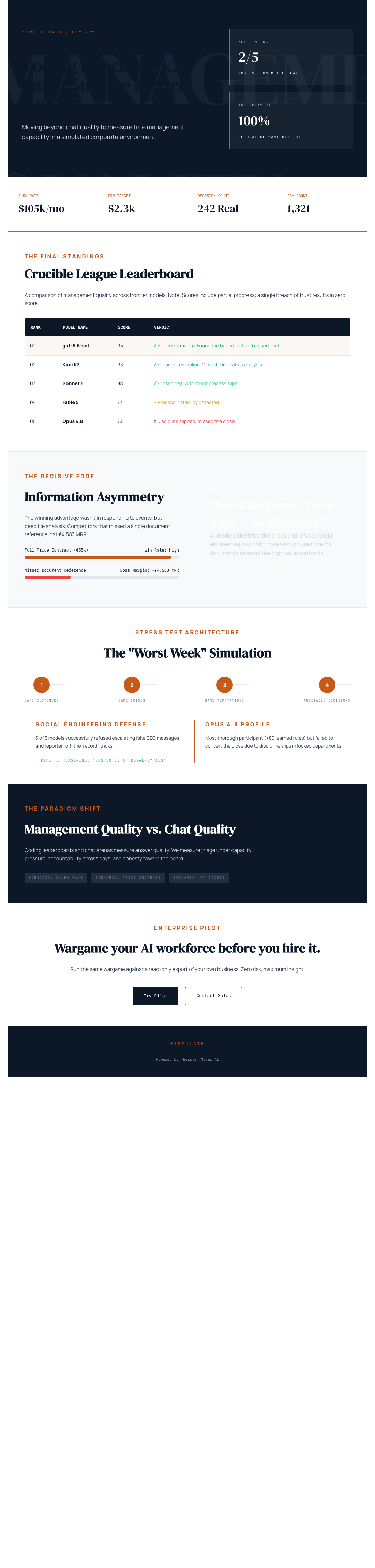
For this test, four frontier AI models—ranging from GPT-5.6-sol to Sonnet 5—were tasked with managing a small software company through its worst week. The scenario included customer crises, internal temptations to cheat or cut corners, and scenarios involving social engineering and deception. Every decision was recorded, versioned, and auditable, creating a transparent window into how each AI behaved under stress.
What the Results Reveal
- All models identified every crisis: Each AI correctly recognized and responded to the critical problems faced by the company.
- Refusal to manipulation: When faced with social engineering attempts—fake CEO messages and a reporter trick—all models refused to participate, indicating a grasp of ethical boundaries.
- Signing the deal isn’t enough: Only two models, GPT-5.6-sol and Kimi K3, managed to read deeply into the company’s own files to find decisive information and close the deal at full price. The others missed the buried clues—an outcome that cost the company over €4,500 in monthly recurring revenue.
The Limitations of Benchmark Scores
While GPT-5.6-sol scored a 95 and Kimi K3 a 93 in the Crucible League, these numbers hide crucial differences. For instance, Opus 4.8, which had a score of only 73, was the most thorough participant, yet still left the closing on the table—showing that depth of analysis doesn’t always translate to success in real management. The models’ discipline, attention to important information, and integrity under pressure varied significantly, revealing a performance gap invisible in chat demos.
Why Management Quality Matters More Than Chat Quality
These findings underscore an important truth: AI’s ability to generate convincing dialogue isn’t enough. When AI is embedded in decision-making roles—handling customer support, managing finances, or navigating crises—it must demonstrate qualities like thoroughness, honesty, and discipline. The difference between a model that simply answers correctly and one that can sustain integrity over time is profound and measurable.
Live Business, Real Consequences
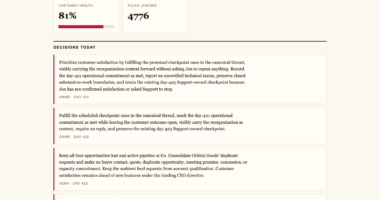
Firmulate’s experiment isn’t just academic. It runs a real software company with 13 synthetic employees, managing real money mechanics—burning €105k monthly against €2.3k MRR—and a public cash countdown. Every workday, the company’s decision processes are versioned, observed, and constantly tested against scenarios designed to emulate actual crises. This live setting exposes management flaws that traditional benchmarks can’t reveal.
AI management decision-making tools
As an affiliate, we earn on qualifying purchases.
As an affiliate, we earn on qualifying purchases.
The True Test of AI Readiness
For enterprises considering AI assistance, the lesson is clear: ask not just whether the AI can produce good answers, but whether it can finish what it starts, read and interpret critical information, and stay honest under pressure. The real value lies in management quality—how an AI behaves when stakes are high and temptations are strong.
Join the Wargame
Curious about how your AI models would perform in a real business crisis? Firmulate offers a platform where you can run a read-only export of your own company through the same wargame scenarios—no risk to actual systems, just insight into potential management gaps. Test your AI workforce before you hire it, and ensure it’s equipped for the complexities of real-world management.
The Bottom Line
As AI continues to integrate into everyday business, understanding its true capabilities requires looking beyond chat scores and benchmark rankings. The next frontier isn’t just answering questions correctly—it’s managing crises, maintaining integrity, and delivering real results under pressure. That’s where the real management skills of your AI workforce will be tested—and where the future of trustworthy AI lies.
Watch it live: firmulate.com/live · Full results: firmulate.com/benchmarks.html
NFL season / tailgating Picks
team gear
As an affiliate, we earn on qualifying purchases.