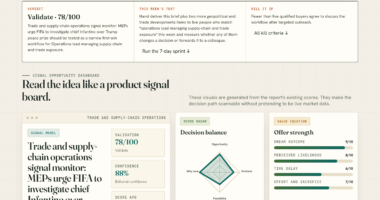

📊 Full opportunity report: Évian and the Fallout: What Europe Actually Wants From Amodei, Hassabis, and Altman on ThorstenMeyerAI.com — validation score, market gap, and execution plan.
TL;DR
At the June 17 G7 summit in Évian, European officials and top AI CEOs discussed AI access, sovereignty, and safety. Europe seeks reliable access, control over infrastructure, and child protection measures amid US export restrictions.
European leaders and top AI executives, including Dario Amodei, Demis Hassabis, and Sam Altman, met at the G7 summit in Évian-les-Bains on June 17 to address critical issues surrounding AI dependency, sovereignty, and regulation, following recent US export restrictions on advanced models.
The summit, held at the invitation of French President Emmanuel Macron, brought together key figures from the US, Europe, and allied nations amid heightened concerns over AI access and control. Notably, the US Commerce Department issued an export-control directive on June 12, forcing Anthropic to halt access to its top models for foreign nationals, effectively causing a worldwide shutdown of certain AI capabilities. This move raised questions among European officials about reliance on foreign-controlled AI models and the risks of sudden access restrictions.
During the summit, Amodei proposed a US-led coalition of democratic nations to ensure trusted access to frontier AI models, emphasizing shared security and technological cooperation. Hassabis and Altman echoed calls for international collaboration but also stressed the importance of democratic oversight in AI development. European leaders, however, laid out a detailed list of demands, including reliable access, safeguards against US-style kill-switches, and increased control over AI infrastructure and data sovereignty. They also prioritized child safety measures and the development of European AI capabilities to reduce dependence on US and Asian providers.
Évian and the fallout: what Europe actually wants
For the first time, Amodei, Hassabis, and Altman sat with heads of state — five days after Washington switched Anthropic’s models off worldwide. Europe’s question: can you rely on models a foreign cabinet can shut down by decree?
The dilemma: what Europe wants from the three CEOs, the three can’t deliver — because they don’t hold the switch, Washington does. Macron’s platform is the right answer, but no fix for a decade-old infrastructure gap. The only answer that doesn’t depend on someone else’s goodwill: your own models, your own compute, open weights you can self-host.
Why Europe’s Demands Could Reshape Global AI Governance
This summit marks a pivotal shift in AI governance, highlighting Europe’s push for sovereignty, safety, and influence over AI infrastructure. If European nations succeed in establishing independent control and safety standards, it could challenge US dominance in AI and lead to a more fragmented global landscape. The demands underscore growing concerns over reliance on US-controlled models and the geopolitical implications of AI technology, affecting international cooperation and regulation efforts moving forward.European AI sovereignty hardware
As an affiliate, we earn on qualifying purchases.
As an affiliate, we earn on qualifying purchases.
Recent US Export Controls and Europe’s AI Sovereignty Push
In June 2026, the US Commerce Department issued export restrictions on Anthropic’s top AI models, citing national security concerns. This move effectively cut off access for foreign users, including European institutions, raising alarms about reliance on US-controlled AI technology. Historically, the US has maintained a dominant position in AI development, but Europe has accelerated efforts to develop independent AI infrastructure, as reflected in its €420 billion Technological Sovereignty Package announced earlier in June. The Évian summit represents a response to these developments, emphasizing the need for coordinated international standards and safeguards against abrupt access restrictions.“It is a mutual interest that European citizens and companies can safely use the best models, and we must ensure reliable, durable access.”
— Ursula von der Leyen
AI infrastructure security devices
As an affiliate, we earn on qualifying purchases.
As an affiliate, we earn on qualifying purchases.
Unresolved Questions on European AI Sovereignty
It remains unclear how effectively Europe can implement its demands, particularly regarding guaranteed access to AI models and infrastructure without US cooperation. The precise mechanisms for establishing independent AI infrastructure and the willingness of US firms to comply with European sovereignty measures are still uncertain. Additionally, the impact of potential US retaliations or restrictions remains an open question.
child safety AI monitoring tools
As an affiliate, we earn on qualifying purchases.
As an affiliate, we earn on qualifying purchases.
Next Steps in European-US AI Relations and Policy Development
European leaders plan to establish a cooperation platform within a month, with a follow-up summit scheduled for September to solidify agreements on trusted partnerships, infrastructure, and child safety. Meanwhile, the US and European governments are expected to negotiate frameworks for AI access, sovereignty, and regulation, with ongoing discussions on how to balance innovation, security, and geopolitical interests. The development of European AI ‘gigafactories’ and sovereignty measures will also be closely watched.
European AI development kits
As an affiliate, we earn on qualifying purchases.
As an affiliate, we earn on qualifying purchases.
Key Questions
What prompted Europe’s increased focus on AI sovereignty?
The US’s June 12 export restrictions on advanced AI models, which cut off European access, significantly heightened Europe’s concerns about dependency and control over AI technology.
What are Europe’s main demands from US AI companies?
Europe seeks reliable, durable access to AI models, guarantees against US-style kill-switches, a trusted partners scheme, control over infrastructure, and strong child safety protections.
Could US restrictions lead to a fragmented global AI landscape?
Yes, if Europe and other regions develop independent AI infrastructure and standards, it could result in a more divided and geopolitically complex AI ecosystem.
What is the significance of the European Technological Sovereignty Package?
It aims to reduce Europe’s reliance on US and Asian AI providers through investments in local AI development, cloud, and semiconductor infrastructure, strengthening independence.
Will these discussions lead to binding international AI regulations?
It is still uncertain; while there is momentum for international cooperation, concrete binding agreements are yet to be finalized, and many issues remain open for negotiation.
Source: ThorstenMeyerAI.com