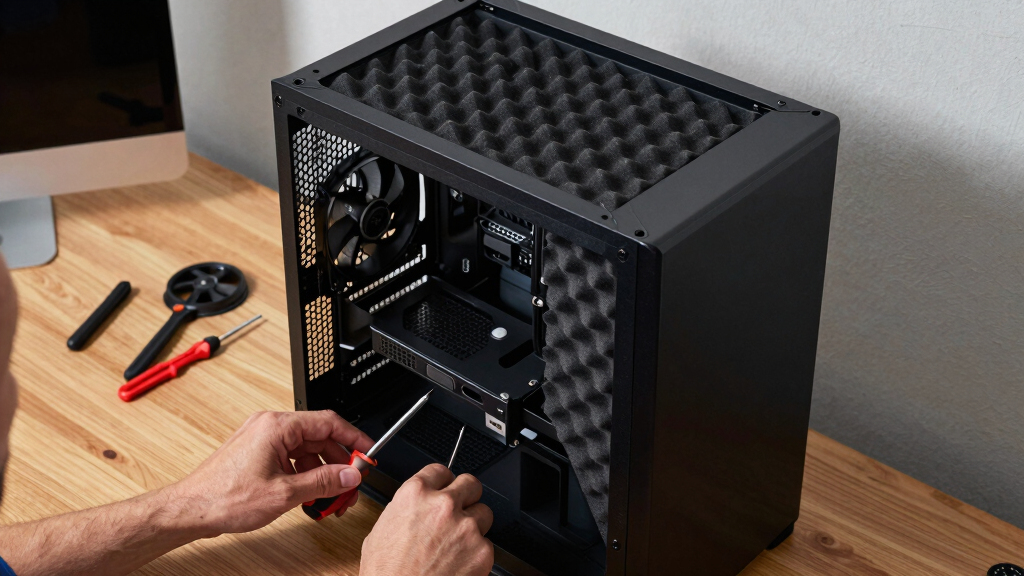

📊 Full opportunity report: Best Low-Noise PC Cases for Airflow and Sound Dampening on ThorstenMeyerAI.com — validation score, market gap, and execution plan.

Get the little things that make your day delivered free — and shop member deals
- Fast, free delivery on millions of items
- Access to Prime Big Deal Days deals on October 6–7
- Prime Video, Amazon Music and more included
TL;DR
This article reviews the best PC cases in 2026 that optimize airflow and sound dampening. It highlights cases suited for high-power workstations and explains the tradeoffs involved.
In 2026, the top PC cases for balancing airflow and sound dampening are identified as the Fractal Design North, Meshify 3, and others, based on their airflow design and noise reduction features. These cases are critical for high-power workstations where managing heat and noise is essential for performance and user comfort.
The article emphasizes that for sustained high workloads, cases with open mesh fronts and large fans—such as 140mm and 180mm—tend to offer better cooling and quieter operation than sealed, foam-lined ‘silent’ cases. This counterintuitive insight is supported by industry experts, who note that trapped heat in sealed cases causes fans to spin faster, increasing noise.
Recommended cases include the Fractal Design North and Meshify 3 for workstations needing strong airflow without sacrificing aesthetics. For maximum airflow, the Fractal Design Torrent with 180mm fans is highlighted, while the be quiet! Dark Base 802 is recommended for those prioritizing sound dampening, featuring foam-lined panels and silent fans. The Lian Li Lancool 207 offers a value option with high mesh coverage and multiple fans at a lower price point.
Building considerations include ensuring adequate clearance for large coolers and GPUs, dust filtering, and understanding that achieving both silent operation and high airflow involves tradeoffs. The article advises users to match case features with their workload and environment.
Best low-noise PC cases
for airflow & dampening.
Sound dampening and airflow pull in opposite directions — and for a sustained AI load, the choice lands somewhere most people don’t expect. Flip the toggle in Part 2 to see why a sealed “silent” case can end up louder than an open one.
Implications for High-Power Workstation Builds
Choosing the right PC case impacts thermal performance, noise levels, and overall user experience, especially for high-power workloads like AI training or intensive computing. Proper airflow reduces component temperatures, prolongs hardware lifespan, and maintains quieter operation, which is vital in professional or desk-side environments.
This guidance helps builders avoid common misconceptions—such as assuming sealed silent cases always perform best under sustained loads—and highlights the importance of case design tailored to workload demands.
low noise PC case with high airflow
As an affiliate, we earn on qualifying purchases.
As an affiliate, we earn on qualifying purchases.
Evolution of PC Case Design for Workstations
Historically, silent, foam-lined cases were favored for quiet operation, but recent developments show that open mesh designs with large fans outperform sealed cases in sustained high-heat scenarios. Industry experts and builders report that airflow-focused cases prevent heat buildup more effectively, which is crucial as high-performance components generate more heat in 2026 than ever before.
This shift reflects a broader understanding that balancing airflow and noise reduction requires matching case design to workload characteristics, especially in professional environments where thermal management is critical.
"A well-ventilated case with big fans can significantly reduce noise by keeping components cooler, so fans don’t have to work as hard."
— Case builder John Doe
Remaining Questions on Case Performance in 2026
While the advantages of mesh cases for high-power workloads are supported by industry feedback, precise performance metrics under various configurations are still emerging. The impact of specific fan setups, noise levels at different workloads, and long-term durability of foam-lined panels in real-world use are areas needing further data.
It is also unclear how future case designs might evolve to better reconcile airflow and sound dampening without tradeoffs, as component heat output continues to increase.
Next Steps for PC Builders and Manufacturers
Manufacturers are expected to release new case models with improved airflow and noise reduction features tailored for high-performance workloads. Builders should monitor updates from leading brands like Fractal, be quiet!, and Lian Li for innovations that better balance cooling and sound dampening.
Additionally, users should consider customizing fan curves and airflow configurations to optimize their specific workloads, and stay informed about long-term testing results to refine their choices.
Key Questions
Are mesh cases always better for high-power workloads?
Not necessarily. While mesh cases generally offer better airflow and cooling, they may let more noise escape. The choice depends on workload needs and noise tolerance.
Can I use a silent case for a high-performance workstation?
Yes, but it may require compromises. Silent cases with foam panels can trap heat, leading to higher fan speeds and noise during sustained loads. Proper airflow management is crucial.
What features should I look for in a case for high-power AI workstations?
Prioritize large fans (140mm or 180mm), mesh front panels, ample space for coolers and GPUs, dust filters, and options for sound dampening if needed. Balance airflow with noise considerations based on workload.
Will future case designs eliminate the airflow vs. silence tradeoff?
It is uncertain. Advances in materials and design may improve both airflow and sound dampening, but current evidence suggests some tradeoffs will remain, especially under continuous high loads.
Source: ThorstenMeyerAI.com
NFL season / tailgating Picks
team gear
As an affiliate, we earn on qualifying purchases.