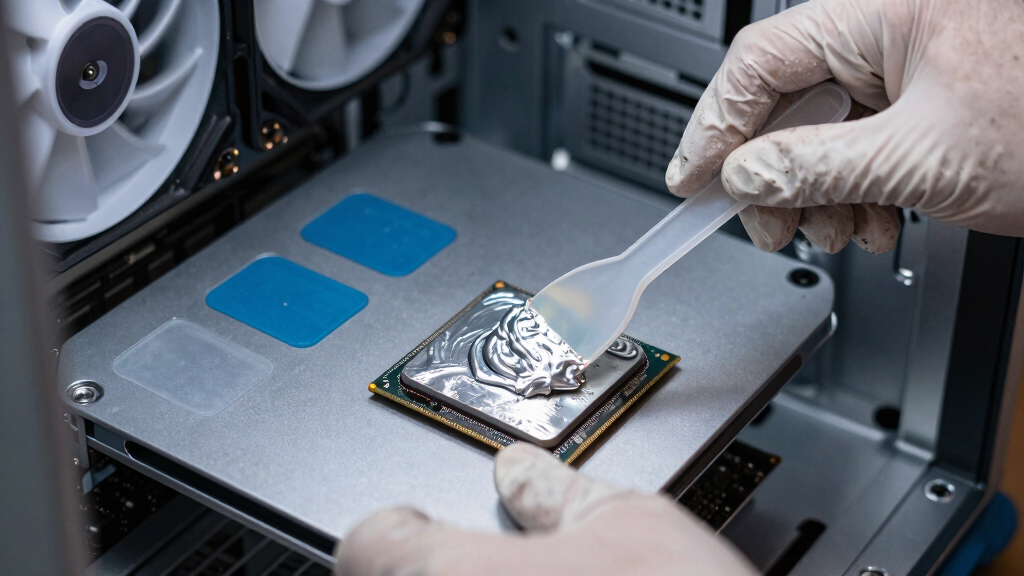

📊 Full opportunity report: Best Thermal Paste and Pads for High-TDP GPUs on ThorstenMeyerAI.com — validation score, market gap, and execution plan.
TL;DR
This article reviews the best thermal pastes and pads suitable for high-TDP GPUs used in AI and continuous workloads. It emphasizes long-term stability and resistance to pump-out, crucial for 24/7 operation.
Honeywell PTM7950, a phase-change material, is identified as the best thermal interface for high-TDP GPUs operating continuously, due to its resistance to pump-out and long-term stability, according to recent expert reviews.
Traditional thermal pastes often degrade over time under sustained high temperatures, especially in AI workloads that keep GPUs at high load levels for hours. The Honeywell PTM7950, a phase-change material, stands out as it remains stable and resists pump-out, maintaining low thermal resistance over years of continuous operation. It is supplied as a thin sheet that requires cutting and placement, which is more involved than applying paste but offers durability for long-term use.
For users preferring traditional pastes, Arctic MX-6 is recommended for its ease of application, non-conductive nature, and long-lasting performance of 8–10 years. Noctua NT-H2 offers a premium, reliable traditional paste option with consistent performance and durability. Additionally, Thermal Grizzly Kryosheet, a graphene-based reusable pad, provides a permanent solution but requires careful handling due to its electrical conductivity.
Best thermal paste
for a high-TDP GPU.
The standard “coldest on day one” advice is wrong for a 24/7 rig. Continuous heat slowly squeezes traditional paste out — a failure called pump-out — so the real question is what stays cold for years.
Why Long-Term Thermal Stability Matters for High-Power GPUs
Choosing the right thermal interface material directly impacts GPU longevity, performance stability, and noise levels. For AI and continuous workloads, maintaining consistent temperatures prevents thermal throttling and potential hardware failure. The shift toward materials like phase-change sheets reflects an industry focus on durability over initial thermal performance, especially for enterprise and research applications where long-term reliability is critical.

ARCTIC MX-4 (4 g) - Premium Performance Thermal Paste for All Processors (CPU, GPU - PC, PS4, Xbox), Very high Thermal Conductivity, Long Durability, Safe Application, Non-Conductive, Non-capacitive
- Consistent Quality: Reliable performance with proven formula
- High Thermal Conductivity: Efficient heat dissipation for CPU/GPU
- Safe, Non-Conductive: Metal-free and prevents short circuits
As an affiliate, we earn on qualifying purchases.
As an affiliate, we earn on qualifying purchases.
Thermal Interface Materials: From Traditional Pastes to Advanced Solutions
Most consumer guides favor pastes like Thermal Grizzly Kryonaut for gaming, but these are less suitable for continuous high-load scenarios due to pump-out issues. In high-performance AI workloads, sustained heat causes traditional pastes to dry out and lose contact, leading to increased temperatures over time. Phase-change materials like PTM7950 are designed to address this by maintaining contact through thermal cycling, making them more appropriate for 24/7 operation. The trend toward more durable solutions is driven by the growth of AI inference GPUs running at high TDP levels continuously.
"For a GPU running non-stop, the key is resistance to pump-out; phase-change materials like PTM7950 excel here, ensuring stable thermal contact over years."
— Thorsten Meyer, AI hardware expert
Long-Term Performance of Reusable Pads Under Continuous Load
While products like Thermal Grizzly Kryosheet show promise for long-term stability, comprehensive long-term testing under continuous high TDP conditions is limited. The electrical conductivity of some pads also poses handling risks, and their performance in real-world scenarios over multiple years remains to be fully validated.
Future Developments in GPU Thermal Interface Materials
Expect ongoing research into more durable, high-performance materials that combine ease of application with long-term stability. Manufacturers may introduce new phase-change or composite materials optimized for AI and continuous workloads, potentially reducing the need for frequent reapplication and maintenance. Monitoring industry updates and user reports over the next year will clarify which solutions prove most effective in practice.
Key Questions
Is phase-change material suitable for all high-TDP GPUs?
Phase-change materials like PTM7950 are ideal for high-TDP, continuous-operation GPUs but require careful application. Compatibility with specific GPU models should be verified before use.
Can I switch between traditional paste and phase-change materials?
Yes, but it requires removing the existing interface and properly cleaning the surfaces. The application process differs significantly, so it’s recommended for experienced users.
Does using advanced thermal interface materials void GPU warranty?
Applying aftermarket thermal materials can void warranties, depending on manufacturer policies. Users should check warranty terms before proceeding.
How often should I reapply thermal paste for a high-TDP GPU running continuously?
Traditional pastes may need reapplication every 1–3 years under continuous high load. Phase-change materials are designed to last much longer without reapplication.
Source: ThorstenMeyerAI.com