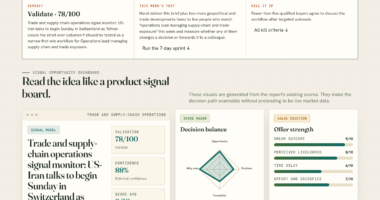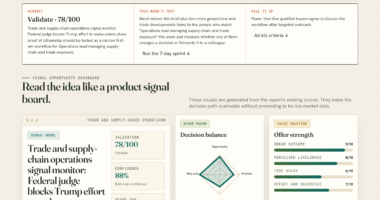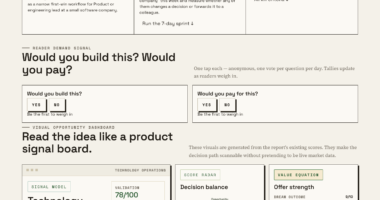
📊 Full opportunity report: A Closer Look At Trade And Supply-Chain Trends Between Belgium And The U.S. on IdeaNavigator AI — validation score, market gap, and execution plan.

Get the little things that make your day delivered free with Prime
- Fast, free delivery on millions of items
- Prime Video, Amazon Music and more included
- Member-only deals all year
TL;DR

IdeaNavigator AI has proposed a subscription-based monitor that would filter geopolitical and trade signals involving Belgium and the United States for supply-chain operations leads. The material reports a Google Trends signal score of 88/100, but gives no underlying data, evidence of a trade-policy change, or proof that the proposed service has been built or tested.
IdeaNavigator AI has proposed a focused monitor for trade and supply-chain developments involving Belgium and the United States, aimed at operations leads assessing exposure. The proposal describes a possible product and a way to test demand; it does not report a confirmed policy change, trade disruption, or newly launched service between the two countries.
According to the IdeaNavigator AI proposal, the monitor would track Google Trends and similar feeds, filter geopolitical and trade developments for their relevance to supply-chain operations, and turn selected items into short briefs. Each brief would identify what changed, why it matters, and what an operations lead could do. The proposal presents “estados unidos – belgica” as an example topic, not as evidence of a particular event affecting trade flows.
IdeaNavigator AI describes the intended user as an operations lead managing supply-chain and trade exposure. The proposal says relevant developments can be scattered across news, forums, and filings, making it difficult to identify which items could affect operational decisions. It suggests a subscription for users seeking an earlier, role-filtered read. The proposal specifies no pricing, product release date, data sources beyond the general reference to trends and similar feeds, or operating capabilities.
The proposal cites a Google Trends signal of 88/100 as a reason to explore the idea. It provides no query settings, location, measurement period, comparison basis, or underlying trend data. The score should therefore be treated as a signal reported by IdeaNavigator AI, not as a measure of trade activity, market size, or customer demand.
A Signal Is Not a Trade Disruption
For companies moving goods or managing suppliers across borders, early notice of relevant policy or logistics changes can help teams review exposure and decide whether to seek more information. A concise brief filtered for an operations role could reduce the time spent sorting through broad news feeds, if it reliably separates operationally meaningful developments from general interest.
That potential is not yet demonstrated by the proposal. A trend score alone does not establish that a supply-chain event is underway or that customers would pay for a monitoring service. The practical value would depend on the monitor’s ability to identify verifiable developments, explain their relevance accurately, and avoid presenting a search trend or unconfirmed report as a change in trade conditions.
The distinction matters for readers because the item’s framing could otherwise be mistaken for a report on current Belgium-U.S. trade. The IdeaNavigator AI material instead sets out an early-stage product idea. It supplies no figures on bilateral trade, affected industries, shipments, tariffs, customs processes, or supply-chain delays, and makes no claim that such conditions have changed.
As an affiliate, we earn on qualifying purchases.
How the Monitor Would Be Tested
In its proposal, IdeaNavigator AI recommends a small, manually delivered test rather than describing an established automated service. The suggested test is to send the Belgium-U.S. brief, along with two other geopolitical and trade items, to five people matching the intended operations-lead profile during the same week. The proposal suggests measuring whether a recipient changes a decision or forwards a brief to a colleague.
This approach would offer an initial indication of whether the format and filtering are useful to a small group. It would not, by itself, establish broader demand or show that a subscription business is viable. A decision change or forward could be a useful response, but the proposal does not specify how those outcomes would be defined, recorded, or compared with other information recipients already use.
The supplied IdeaNavigator AI description focuses on monitoring signals, not documenting a particular bilateral trade development. It provides no event timeline, official statement, filing, named company, or attributed expert assessment about a change in the relationship. That limits the report to the proposed workflow and suggested test; it does not support a wider account of current trade conditions.
Demand and Data Behind the Score
It remains unclear what specific search data produced the 88/100 score cited by IdeaNavigator AI, when it was measured, and whether the number refers to a particular query, geography, or time window. Without those details, readers cannot interpret its scale or compare it with other topics. The proposal provides no baseline or evidence linking search interest to operational exposure.
The material also does not say whether the proposed monitor exists as a working product, whether any operations leads have used it, or whether the suggested five-person test has taken place. It reports no results, customer commitments, subscription terms, or examples showing that a brief prompted a concrete action. The description identifies no particular Belgium-U.S. policy or supply-chain development and provides no independent documentation of one.
There are also open questions about how the proposed service would verify items, assess their relevance, handle conflicting accounts, and distinguish confirmed announcements from speculation. Until those points are addressed, the idea should be understood as a proposed monitoring workflow, not a verified source of operational alerts.
The Proposed Five-Person Pilot
IdeaNavigator AI proposes delivering three short briefs—including the Belgium-U.S. example—to five matching operations leads within a week. The suggested test is to track whether recipients change a decision or pass a brief to a colleague. The proposal provides no schedule, participant recruitment details, or completed pilot results.
If the test proceeds, useful follow-up details would include how participants are selected, what counts as a decision change, and whether the briefs are checked against original reporting or official notices. Results would help clarify whether the role-specific format is useful, but a small test would remain preliminary evidence rather than proof of wider demand. The proposal provides no confirmed launch date or subsequent milestone.
Key Questions
Has Belgium-U.S. trade changed?
The IdeaNavigator AI material does not report a confirmed change to bilateral trade, policy, shipments, or supply chains. It proposes a tool to monitor relevant developments.
What does the 88/100 score mean?
IdeaNavigator AI cites a Google Trends signal of 88/100, but does not provide its query settings, time period, location, or comparison basis. The score cannot be interpreted from the available details as a measure of trade activity or customer demand.
Is the monitoring service available?
The IdeaNavigator AI description presents the monitor as a proposed product idea. It does not confirm that a service has been built, launched, or used by customers.
How would IdeaNavigator AI test demand?
The proposal is to hand-deliver three geopolitical and trade briefs to five operations leads in one week, then check whether any recipient changes a decision or forwards a brief. The material supplies no results from that test.
Source: IdeaNavigator AI
NFL season / tailgating Picks
team gear
As an affiliate, we earn on qualifying purchases.